2D03 image
Deposition Date 2005-07-23
Release Date 2006-01-24
Last Version Date 2024-11-13
Entry Detail
PDB ID:
2D03
Keywords:
Title:
Crystal structure of the G91S mutant of the NNA7 Fab
Biological Source:
Source Organism:
Mus musculus (Taxon ID: 10090)
Host Organism:
Method Details:
Experimental Method:
Resolution:
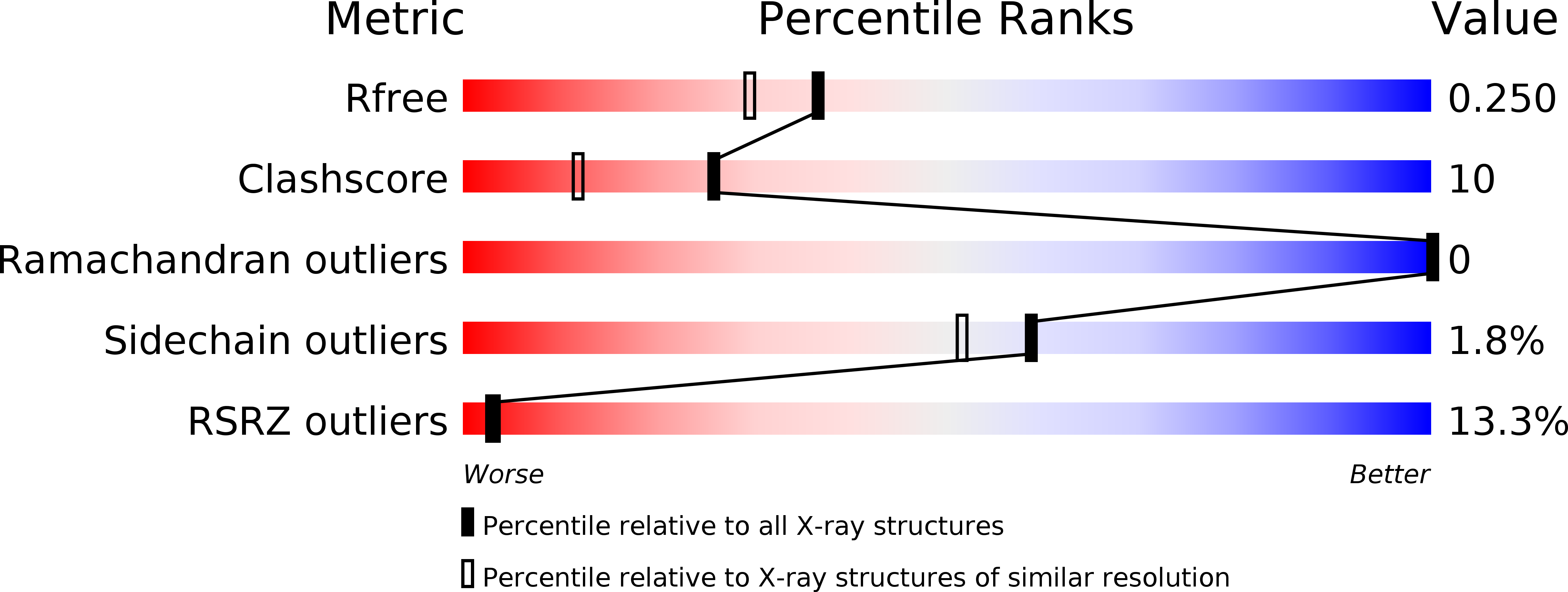
1.97 Å
R-Value Free:
0.26
R-Value Work:
0.21
R-Value Observed:
0.21
Space Group:
P 21 21 21
Macromolecular Entities
Polymer Type:polypeptide(L)
Molecule:anti-glycophorin A type N immunoglobulin heavy chain
Chain IDs:B (auth: H)
Chain Length:223
Number of Molecules:1
Biological Source:Mus musculus
Polymer Type:polypeptide(L)
Molecule:anti-glycophorin A type N immunoglobulin light chain
Mutagens:G91S
Chain IDs:A (auth: L)
Chain Length:217
Number of Molecules:1
Biological Source:Mus musculus
Primary Citation
Crystallographic analysis of the NNA7 Fab and proposal for the mode of human blood-group recognition.
Acta Crystallogr.,Sect.D 61 1386 1394 (2005)
PMID: 16204891 DOI: 10.1107/S0907444905023851

Abstact

The NNA7 Fab antibody fragment recognizes the human N-type blood-group antigen comprised of the N-terminal glycopeptide of glycophorin A (GPA). A mutant form of this Fab fragment, NNA7-G91S, exhibits markedly reduced antigen binding. To provide insight into how these Fab fragments recognize this glycopeptide antigen, the crystal structures of NNA7 and NNA7-G91S were solved and refined to 1.83 and 1.97 A resolution, respectively. Both molecules are composed of the same heavy (H) chain Fd fragment, but each contains a slightly different light (L) chain owing to the G91S substitution. Specifically, the G91S mutation pushes the backbone of the neighboring H chain away from complementarity-determining region 3 (CDR3) of the L-chain variable region, allowing an additional glycerol cryoprotectant molecule to enter the antigen-combining site near the putative location of O-linked glycosylation. Each Fab fragment also possesses a well defined 2-(N-morpholino)ethanesulfonic acid (MES) molecule trapped in its antigen-combining site, as well as a crystallographic symmetry-related molecule comprising an amino-acid sequence that is virtually identical to the N-terminus of GPA. The MES molecule interacts with the H-chain CDR in a manner reminiscent of antibody-carbohydrate complexes. These results suggest a model for recognition of the glycopeptide antigen that accounts for the deleterious effect of the G91S substitution.

Legend

Protein

Chemical

Disease

Primary Citation of related structures
Feedback Form
Name
Email
Institute
Feedback