2C31 image
Deposition Date 2005-10-03
Release Date 2005-10-07
Last Version Date 2023-12-13
Entry Detail
PDB ID:
2C31
Keywords:
Title:
CRYSTAL STRUCTURE OF OXALYL-COA DECARBOXYLASE IN COMPLEX WITH THE COFACTOR DERIVATIVE THIAMIN-2-THIAZOLONE DIPHOSPHATE AND ADENOSINE DIPHOSPHATE
Biological Source:
Source Organism:
Host Organism:
Method Details:
Experimental Method:
Resolution:
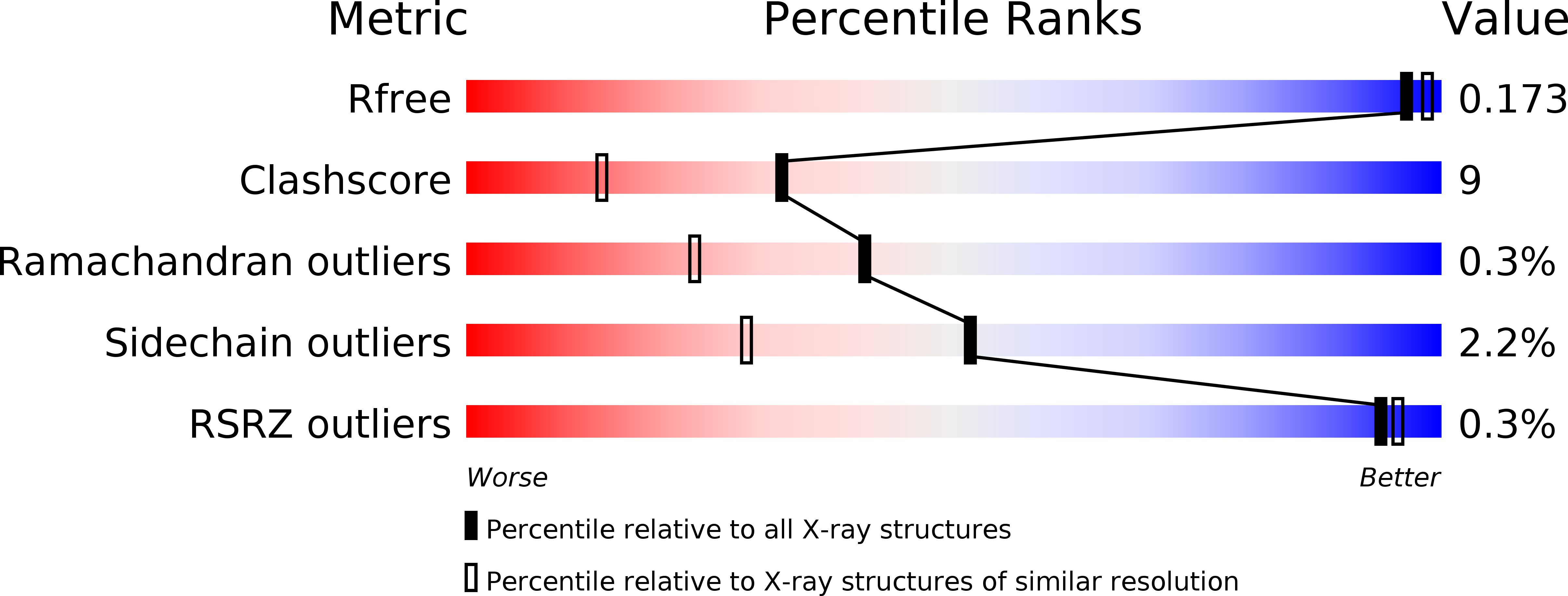
1.73 Å
R-Value Free:
0.17
R-Value Work:
0.15
R-Value Observed:
0.15
Space Group:
P 31 2 1
Macromolecular Entities
Structures with similar UniProt ID
Protein Blast
Polymer Type:polypeptide(L)
Molecule:OXALYL-COA DECARBOXYLASE
Gene (Uniprot):oxc
Chain IDs:A, B
Chain Length:568
Number of Molecules:2
Biological Source:OXALOBACTER FORMIGENES
Primary Citation
Structural Basis for Activation of the Thiamin Diphosphate-Dependent Enzyme Oxalyl-Coa Decarboxylase by Adenosine Diphosphate.
J.Biol.Chem. 280 41645 ? (2005)
PMID: 16216870 DOI: 10.1074/JBC.M509921200

Abstact

Oxalyl-coenzyme A decarboxylase is a thiamin diphosphate-dependent enzyme that plays an important role in the catabolism of the highly toxic compound oxalate. We have determined the crystal structure of the enzyme from Oxalobacter formigenes from a hemihedrally twinned crystal to 1.73 A resolution and characterized the steady-state kinetic behavior of the decarboxylase. The monomer of the tetrameric enzyme consists of three alpha/beta-type domains, commonly seen in this class of enzymes, and the thiamin diphosphate-binding site is located at the expected subunit-subunit interface between two of the domains with the cofactor bound in the conserved V-conformation. Although oxalyl-CoA decarboxylase is structurally homologous to acetohydroxyacid synthase, a molecule of ADP is bound in a region that is cognate to the FAD-binding site observed in acetohydroxyacid synthase and presumably fulfils a similar role in stabilizing the protein structure. This difference between the two enzymes may have physiological importance since oxalyl-CoA decarboxylation is an essential step in ATP generation in O. formigenes, and the decarboxylase activity is stimulated by exogenous ADP. Despite the significant degree of structural conservation between the two homologous enzymes and the similarity in catalytic mechanism to other thiamin diphosphate-dependent enzymes, the active site residues of oxalyl-CoA decarboxylase are unique. A suggestion for the reaction mechanism of the enzyme is presented.

Legend

Protein

Chemical

Disease

Primary Citation of related structures
Feedback Form
Name
Email
Institute
Feedback