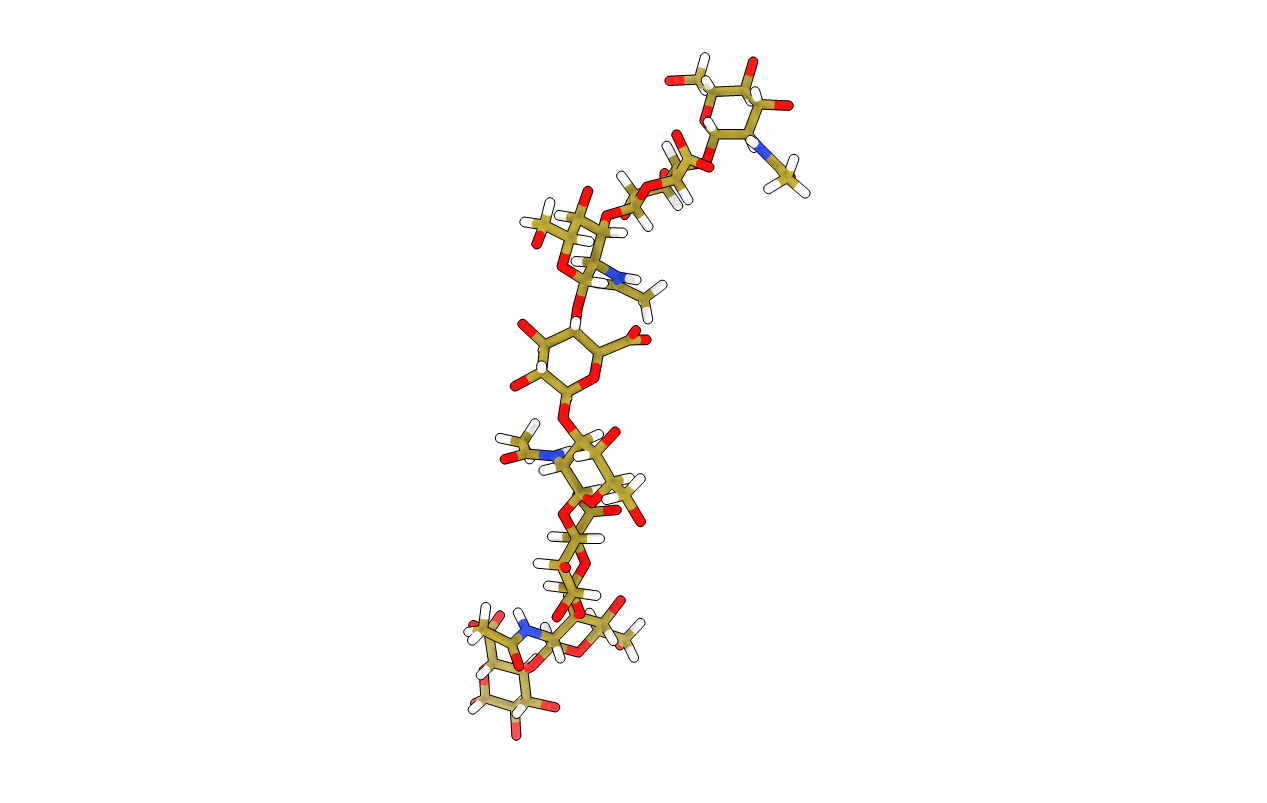
2BVK image
Deposition Date 2005-06-30
Release Date 2006-10-30
Last Version Date 2024-05-15
Entry Detail
PDB ID:
2BVK
Keywords:
Title:
Hyaluronan: the local solution conformation determined by NMR and computer modelling is close to a contracted left-handed four-fold helix
Biological Source:
Source Organism:
Method Details:
Experimental Method:
Conformers Calculated:
250000
Conformers Submitted:
1
Selection Criteria:
AVERAGE CONFORMATION FROM A 50 NAN MOLECULAR DYNAMICS TRAJECTORY THAT EXPLICIT SOLVENT WATER AND CHARGE SODIUM IONS. THE 1-3 AND 1-4 LINKA FIXED AT (50.78, 9.78) AND (47.98, RESPECTIVELY USING THE H1-C1-OX-HX NOMENCLATURE

Macromolecular Entities
Polymer Type:NA
Molecule:2-acetamido-2-deoxy-beta-D-glucopyranose-(1-4)-beta-D-glucopyranuronic acid-(1-3)-2-acetamido-2-deoxy-beta-D-glucopyranose-(1-4)-beta-D-glucopyranuronic acid-(1-3)-2-acetamido-2-deoxy-beta-D-glucopyranose-(1-4)-beta-D-glucopyranuronic acid-(1-3)-2-acetamido-2-deoxy-beta-D-glucopyranose-(1-4)-beta-D-glucopyranuronic acid
Chain IDs:NA
Chain Length:0
Number of Molecules:1
Biological Source:
Ligand Molecules
Primary Citation
Hyaluronan: The Local Solution Conformation Determined by NMR and Computer Modeling is Close to a Contracted Left-Handed 4-Fold Helix.
J.Mol.Biol. 358 1256 ? (2006)
PMID: 16584748 DOI: 10.1016/J.JMB.2006.02.077

Abstact

The polysaccharide hyaluronan (HA) is a ubiquitous component of the vertebrate extracellular matrix with diverse physiological roles from space-filling to acting as a scaffold for other macromolecules. The molecular interactions responsible for these solution properties have been the subject of much debate and, primarily due to the lack of residue-specific experimental data, no consensus model for the three-dimensional conformation nor dynamics of HA in solution has emerged. Here, the solution conformation of HA is investigated using molecular dynamics (MD) simulations and high-field nuclear magnetic resonance (NMR). In contrast to previous studies, MD simulations incorporated explicit water molecules and sodium ions, while NMR experiments utilized (15)N-enriched oligosaccharides to allow residue-specific information to be obtained. The resultant average conformation is predicted to be almost a contracted left-handed 4-fold helix; i.e. similar to that observed for sodium hyaluronate fibers by X-ray diffraction, but with the acetamido side-chain trans to H(2). The glycosidic linkages and acetamido side-chains are predicted to have standard deviation rotations of 13 degrees and 18 degrees around their mean conformations in free solution, respectively, and are not observed to be stabilized by strong intramolecular hydrogen bonds as X-ray fiber diffraction refinements describe for the solid-state. Rather, weak and transient hydrogen bonds that are in rapid interchange with solvent molecules are predicted. These predictions are quantitatively consistent with demanding residue-specific NMR data and correspond to an HA molecule that is rod-like as an oligosaccharide and behaves as a stiffened random coil at large molecular mass, in close agreement with previous hydrodynamic observations. This new description of the solution conformation of HA is consistent with all available experimental data and accounts for its viscoelastic space-filling properties. This representation can be used as a basis for modeling the association between HA and proteins, which will elucidate important aspects of extracellular matrix assembly.

Legend

Protein

Chemical

Disease

Primary Citation of related structures
Feedback Form
Name
Email
Institute
Feedback