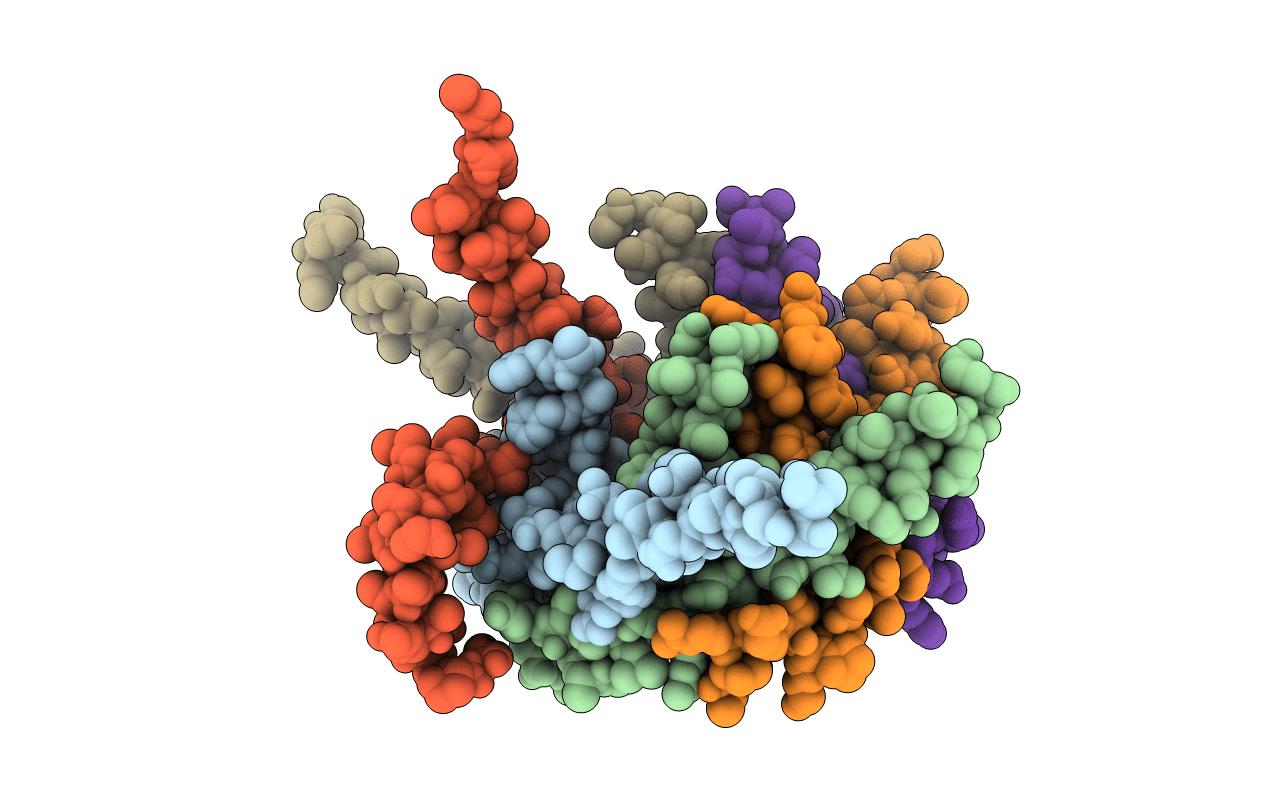
2BSK image
Deposition Date 2005-05-23
Release Date 2006-01-04
Last Version Date 2024-11-20
Entry Detail
PDB ID:
2BSK
Title:
Crystal structure of the TIM9 Tim10 hexameric complex
Biological Source:
Source Organism:
HOMO SAPIENS (Taxon ID: 9606)
Host Organism:
Method Details:
Experimental Method:
Resolution:
3.30 Å
R-Value Free:
0.31
R-Value Work:
0.26
R-Value Observed:
0.26
Space Group:
P 41 21 2

Macromolecular Entities
Structures with similar UniProt ID
Protein Blast
Polymer Type:polypeptide(L)
Molecule:MITOCHONDRIAL IMPORT INNER MEMBRANE TRANSLOCASE SUBUNIT TIM9 A
Gene (Uniprot):TIMM9
Chain IDs:A, C, E
Chain Length:89
Number of Molecules:3
Biological Source:HOMO SAPIENS
Structures with similar UniProt ID
Protein Blast
Polymer Type:polypeptide(L)
Molecule:MITOCHONDRIAL IMPORT INNER MEMBRANE TRANSLOCASE SUBUNIT TIM10
Gene (Uniprot):TIMM10
Chain IDs:B, D, F
Chain Length:90
Number of Molecules:3
Biological Source:HOMO SAPIENS
Modified Residue
Compound ID Chain ID Parent Comp ID Details 2D Image
MSE B MET SELENOMETHIONINE
Ligand Molecules
Primary Citation
Crystal Structure of the Mitochondrial Chaperone Tim910 Reveals a Six-Bladed Alpha-Propeller.
Mol.Cell 21 123 ? (2006)
PMID: 16387659 DOI: 10.1016/J.MOLCEL.2005.11.010

Abstact

Import of proteins into mitochondria occurs by coordinated actions of preprotein translocases in the outer and inner membranes. Tim9 and Tim10 are translocase components of the intermembrane space, related to deafness-dystonia peptide 1 (DDP1). They coassemble into a hexamer, TIM9.10, which captures and chaperones precursors of inner membrane metabolite carriers as they exit the TOM channel in the outer membrane. The crystal structure of TIM9.10 reveals a previously undescribed alpha-propeller topology in which helical "blades" radiate from a narrow central pore lined with polar residues. The propeller blades are reminiscent of "tentacles" in chaperones Skp and prefoldin. In each TIM9.10 subunit, a signature "twin CX3C" motif forms two intramolecular disulfides. There is no obvious binding pocket for precursors, which we suggest employ the chaperone-like tentacles of TIM9.10 as surrogate lipid contacts. The first reported crystal structure of a mitochondrial translocase assembly provides insights into selectivity and regulation of precursor import.

Legend

Protein

Chemical

Disease

Primary Citation of related structures
Feedback Form
Name
Email
Institute
Feedback