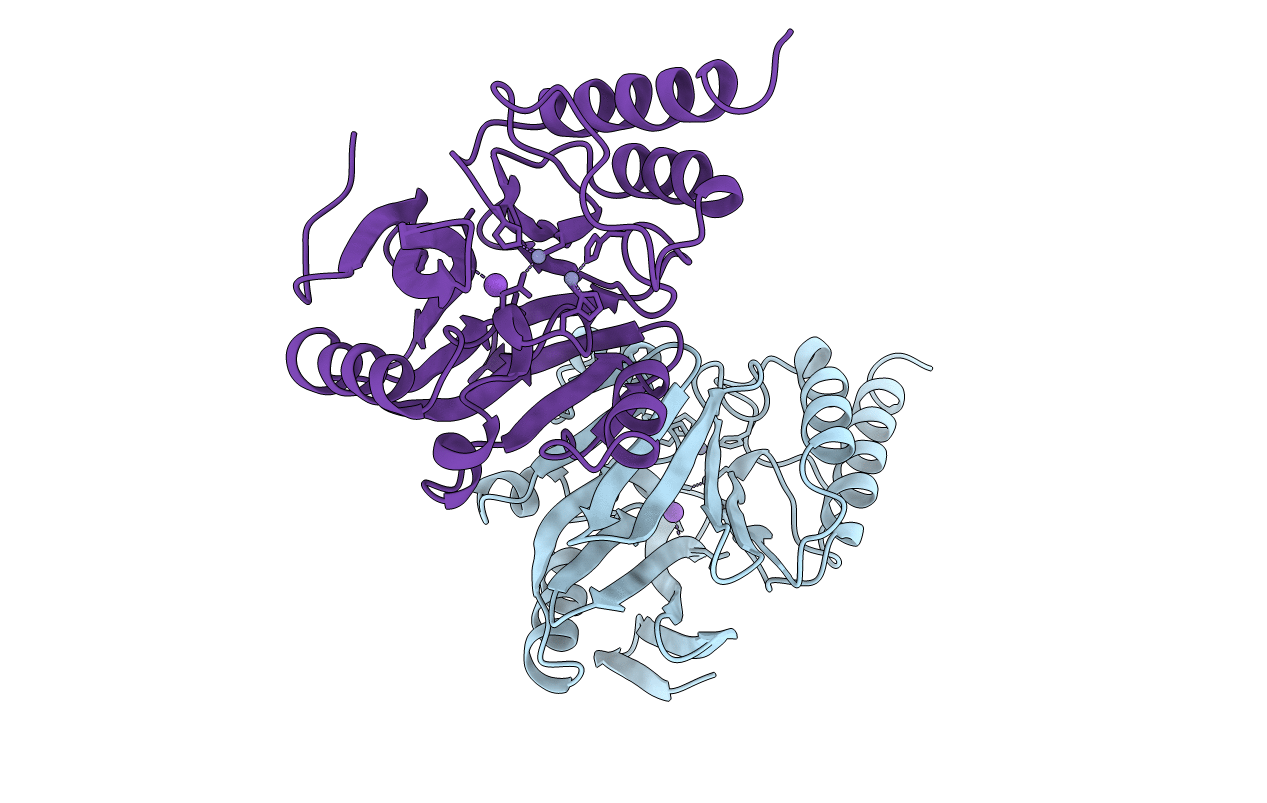
2BMI image
Deposition Date 1998-09-17
Release Date 1998-09-23
Last Version Date 2024-02-14
Entry Detail
PDB ID:
2BMI
Keywords:
Title:
METALLO-BETA-LACTAMASE
Biological Source:
Source Organism(s):
Expression System(s):
Method Details:
Experimental Method:
Resolution:
2.00 Å
R-Value Free:
0.26
R-Value Work:
0.19
R-Value Observed:
0.19
Space Group:
P 21 21 21

Macromolecular Entities
Structures with similar UniProt ID
Protein Blast
Polymer Type:polypeptide(L)
Molecule:PROTEIN (CLASS B BETA-LACTAMASE)
Gene (Uniprot):ccrA
Chain IDs:A, B
Chain Length:232
Number of Molecules:2
Biological Source:Bacteroides fragilis
Primary Citation
X-ray structure of the ZnII beta-lactamase from Bacteroides fragilis in an orthorhombic crystal form.
Acta Crystallogr.,Sect.D 54 45 57 (1998)
PMID: 9761816 DOI: 10.1107/S090744499700927X

Abstact

beta-Lactamases are extracellular or periplasmic bacterial enzymes which confer resistance to beta-lactam antibiotics. On the basis of their catalytic mechanisms, they can be divided into two major groups: active-site serine enzymes (classes A, C and D) and the ZnII enzymes (class B). The first crystal structure of a class B enzyme, the metallo-beta-lactamase from Bacillus cereus, has been solved at 2.5 A resolution [Carfi, Pares, Duée, Galleni, Duez, Frère & Dideberg (1995). EMBO J. 14, 4914-4921]. Recently, the crystal structure of the metallo-beta-lactamase from Bacteroides fragilis has been determined in a tetragonal space group [Concha, Rasmussen, Bush & Herzberg (1996). Structure, 4, 823-836]. The structure of the metallo-beta-lactamase from B. fragilis in an orthorhombic crystal form at 2.0 A resolution is reported here. The final crystallographic R is 0.196 for all the 32501 observed reflections in the range 10-2.0 A. The refined model includes 458 residues, 437 water molecules, four zinc and two sodium ions. These structures are discussed with reference to Zn binding and activity. A catalytic mechanism is proposed which is coherent with metallo-beta-lactamases being active with either one Zn ion (as in Aeromonas hydrophila) or two Zn ions (as in B. fragilis) bound to the protein.

Legend

Protein

Chemical

Disease

Primary Citation of related structures
Feedback Form
Name
Email
Institute
Feedback