2BM1 image
Deposition Date 2005-03-09
Release Date 2005-05-04
Last Version Date 2023-12-13
Entry Detail
PDB ID:
2BM1
Title:
Ribosomal elongation factor G (EF-G) Fusidic acid resistant mutant G16V
Biological Source:
Source Organism:
Host Organism:
Method Details:
Experimental Method:
Resolution:
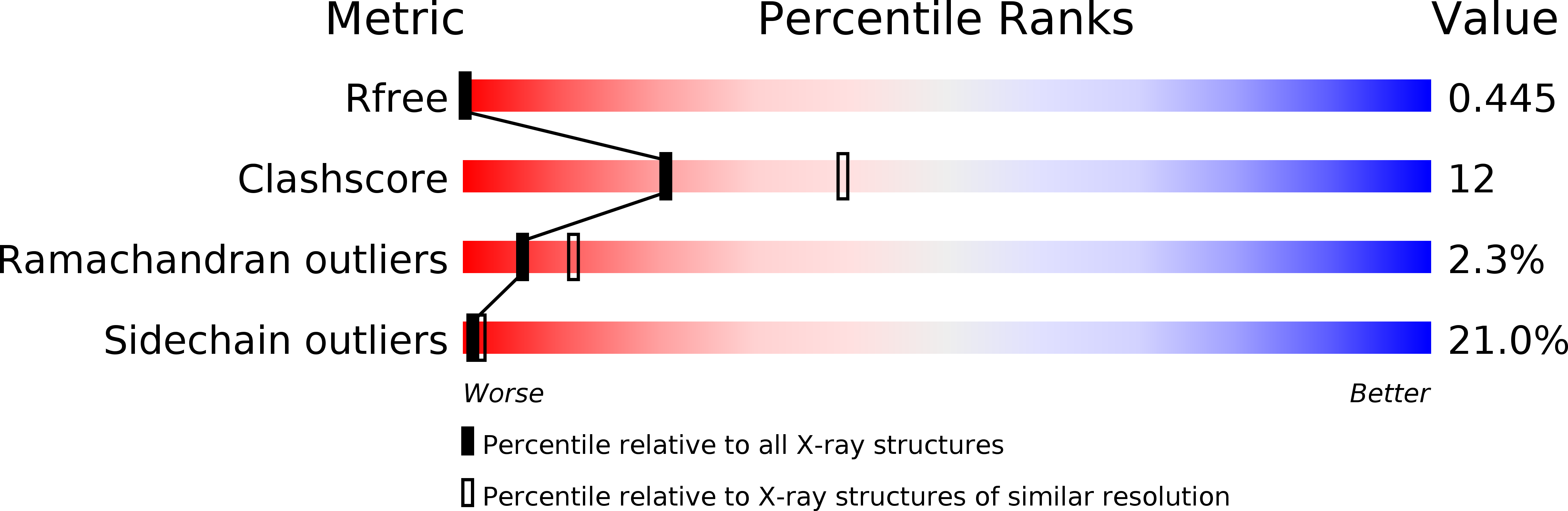
2.60 Å
R-Value Free:
0.29
R-Value Work:
0.22
R-Value Observed:
0.22
Space Group:
P 21 21 21
Macromolecular Entities
Structures with similar UniProt ID
Protein Blast
Polymer Type:polypeptide(L)
Molecule:ELONGATION FACTOR G
Gene (Uniprot):fusA
Mutagens:YES
Chain IDs:A
Chain Length:691
Number of Molecules:1
Biological Source:THERMUS THERMOPHILUS
Primary Citation

Abstact

Fusidic acid (FA) is a steroid antibiotic commonly used against Gram positive bacterial infections. It inhibits protein synthesis by stalling elongation factor G (EF-G) on the ribosome after translocation. A significant number of the mutations conferring strong FA resistance have been mapped at the interfaces between domains G, III and V of EF-G. However, direct information on how such mutations affect the structure has hitherto not been available. Here we present the crystal structures of two mutants of Thermus thermophilus EF-G, G16V and T84A, which exhibit FA hypersensitivity and resistance in vitro, respectively. These mutants also have higher and lower affinity for GTP respectively than wild-type EF-G. The mutations cause significant conformational changes in the switch II loop that have opposite effects on the position of a key residue, Phe90, which undergoes large conformational changes. This correlates with the importance of Phe90 in FA sensitivity reported in previous studies. These structures substantiate the importance of the domain G/domain III/domain V interfaces as a key component of the FA binding site. The mutations also cause subtle changes in the environment of the "P-loop lysine", Lys25. This led us to examine the conformation of the equivalent residue in all structures of translational GTPases, which revealed that EF-G and eEF2 form a group separate from the others and suggested that the role of Lys25 may be different in the two groups.

Legend

Protein

Chemical

Disease

Primary Citation of related structures
Feedback Form
Name
Email
Institute
Feedback