2AYJ image
Deposition Date 2005-09-07
Release Date 2006-08-22
Last Version Date 2024-05-22
Entry Detail
PDB ID:
2AYJ
Keywords:
Title:
Solution structure of 50S ribosomal protein L40e from Sulfolobus solfataricus
Biological Source:
Source Organism(s):
Expression System(s):
Method Details:
Experimental Method:
Conformers Calculated:
100
Conformers Submitted:
20
Selection Criteria:
structures with the lowest energy
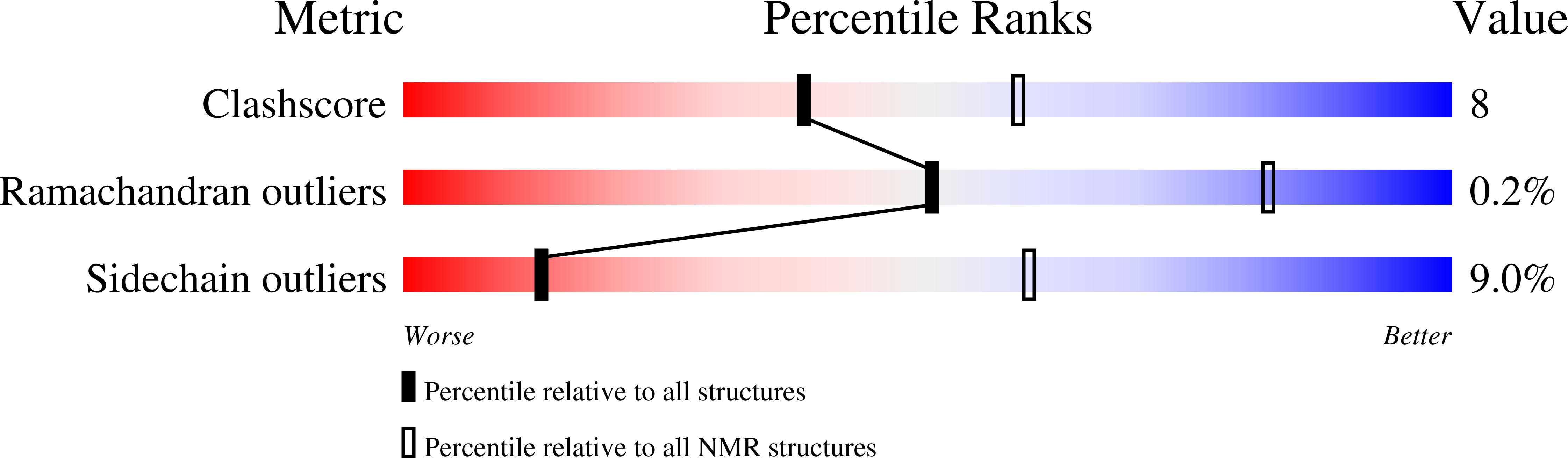
Macromolecular Entities
Structures with similar UniProt ID
Protein Blast
Polymer Type:polypeptide(L)
Molecule:50S ribosomal protein L40e
Gene (Uniprot):rpl40e
Chain IDs:A
Chain Length:56
Number of Molecules:1
Biological Source:Sulfolobus solfataricus
Ligand Molecules
Primary Citation
Solution structure of ribosomal protein L40E, a unique C4 zinc finger protein encoded by archaeon Sulfolobus solfataricus
Protein Sci. 17 589 596 (2008)
PMID: 18218710 DOI: 10.1110/ps.073273008

Abstact

The ribosomal protein L40E from archaeon Sulfolobus solfataricus is a component of the 50S ribosomal subunit. L40E is a 56-residue, highly basic protein that contains a C4 zinc finger motif, CRKC_X(10)_CRRC. Homologs are found in both archaea and eukaryotes but are not present in bacteria. Eukaryotic genomes encode L40E as a ubiquitin-fusion protein. L40E was absent from the crystal structure of euryarchaeota 50S ribosomal subunit. Here we report the three-dimensional solution structure of L40E by NMR spectroscopy. The structure of L40E is a three-stranded beta-sheet with a simple beta2beta1beta3 topology. There are two unique characteristics revealed by the structure. First, a large and ordered beta2-beta3 loop twists to pack across the one side of the protein. L40E contains a buried polar cluster comprising Lys19, Lys20, Cys22, Asn29, and Cys36. Second, the surface of L40E is almost entirely positively charged. Ten conserved basic residues are positioned on the two sides of the surface. It is likely that binding of zinc is essential in stabilizing the tertiary structure of L40E to act as a scaffold to create a broad positively charged surface for RNA and/or protein recognition.

Legend

Protein

Chemical

Disease

Primary Citation of related structures
Feedback Form
Name
Email
Institute
Feedback