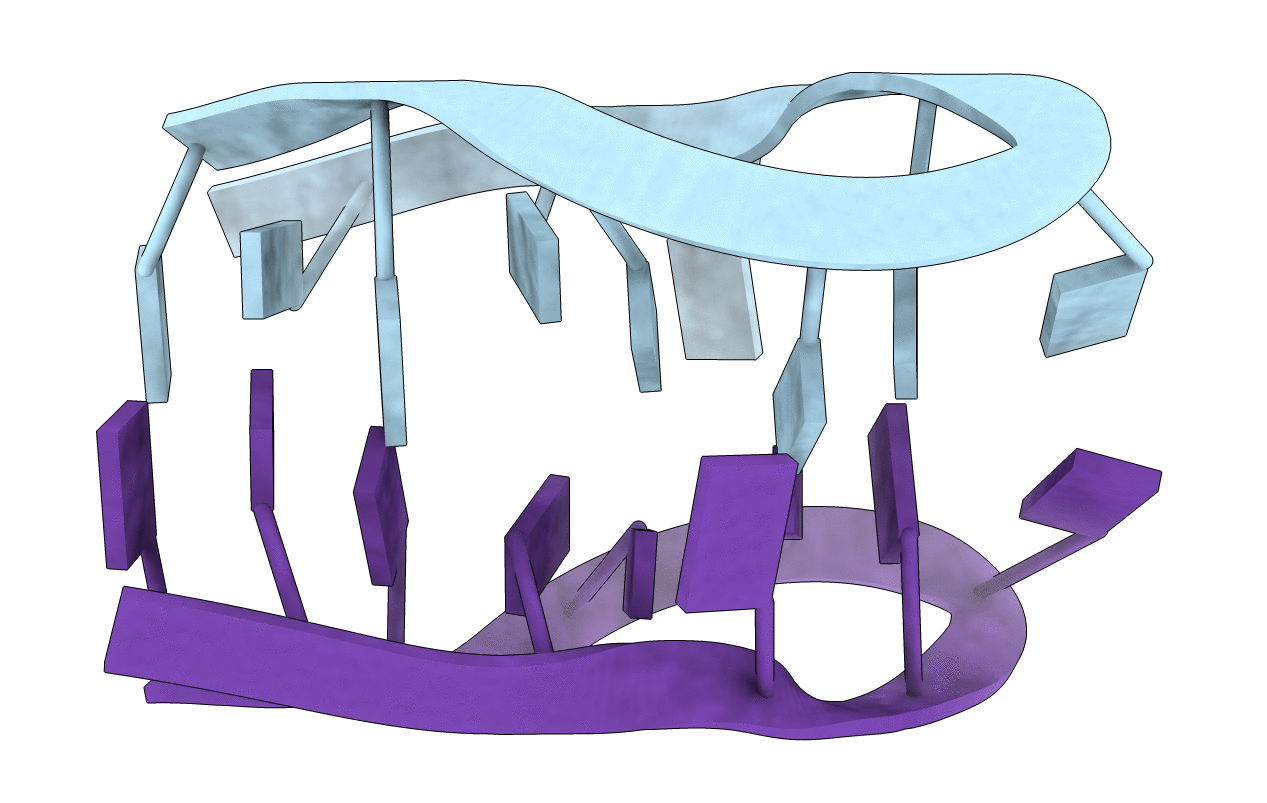
2AWV image
Deposition Date 2005-09-02
Release Date 2005-09-20
Last Version Date 2024-05-29
Entry Detail
PDB ID:
2AWV
Keywords:
Title:
NMR Structural Analysis of the dimer of 5MCCTCATCC
Biological Source:
Source Organism:
Method Details:
Experimental Method:
Conformers Calculated:
10
Conformers Submitted:
1
Selection Criteria:
back calculated data agree with experimental NOESY spectrum
Macromolecular Entities
Polymer Type:polydeoxyribonucleotide
Molecule:5'-D(*(MCY)P*CP*TP*CP*AP*CP*TP*CP*C)-3'
Chain IDs:A, B
Chain Length:9
Number of Molecules:2
Biological Source:
Modified Residue
Compound ID Chain ID Parent Comp ID Details 2D Image
MCY A DC 5-METHYL-2'-DEOXYCYTIDINE
Ligand Molecules
Primary Citation
Structure, internal motions and association-dissociation kinetics of the i-motif dimer of d(5mCCTCACTCC).
Nucleic Acids Res. 33 5471 5481 (2005)
PMID: 16204453 DOI: 10.1093/nar/gki843

Abstact

At slightly acidic pH, the association of two d(5mCCTCACTCC) strands results in the formation of an i-motif dimer. Using NMR methods, we investigated the structure of [d(5mCCTCACTCC)]2, the internal motion of the base pairs stacked in the i-motif core, the dimer formation and dissociation kinetics versus pH. The excellent resolution of the 1H and 31P spectra provided the determination of dihedral angles, which together with a large set of distance restraints, improve substantially the definition of the sugar-phosphate backbone by comparison with previous NMR studies of i-motif structures. [d(5mCCTCACTCC)]2 is built by intercalation of two symmetrical hairpins held together by six symmetrical C*C+ pairs and by pair T7*T7. The hairpin loops that are formed by a single residue, A5, cross the narrow grooves on the same side of the i-motif core. The base pair intercalation order is C9*C9+/5mC1*5mC1+/C8*C8+/C2*C2+/T7.T7/C6*C6+/C4*C4+. The T3 bases are flipped out in the wide grooves. The core of the structure includes four long-lived pairs whose lifetimes at 15 degrees C range from 100 s (C8*C8+) to 0.18 s (T7*T7). The formation rate and the lifetime of [d(5mCCTCACTCC)]2 were measured between pH 6.8 and 4.8. The dimer formation rate is three to four magnitude orders slower than that of a B-DNA duplex. It depends on pH, as it must occur for a bimolecular process involving non cooperative association of neutral and protonated residues. In the range of pH investigated, the dimer lifetime, 500 s at 0 degrees C, pH 6.8, varies approximately as 10(-pH).

Legend

Protein

Chemical

Disease

Primary Citation of related structures
Feedback Form
Name
Email
Institute
Feedback