2AHE image
Deposition Date 2005-07-28
Release Date 2005-08-16
Last Version Date 2023-10-25
Entry Detail
PDB ID:
2AHE
Keywords:
Title:
Crystal structure of a soluble form of CLIC4. intercellular chloride ion channel
Biological Source:
Source Organism:
Homo sapiens (Taxon ID: 9606)
Host Organism:
Method Details:
Experimental Method:
Resolution:
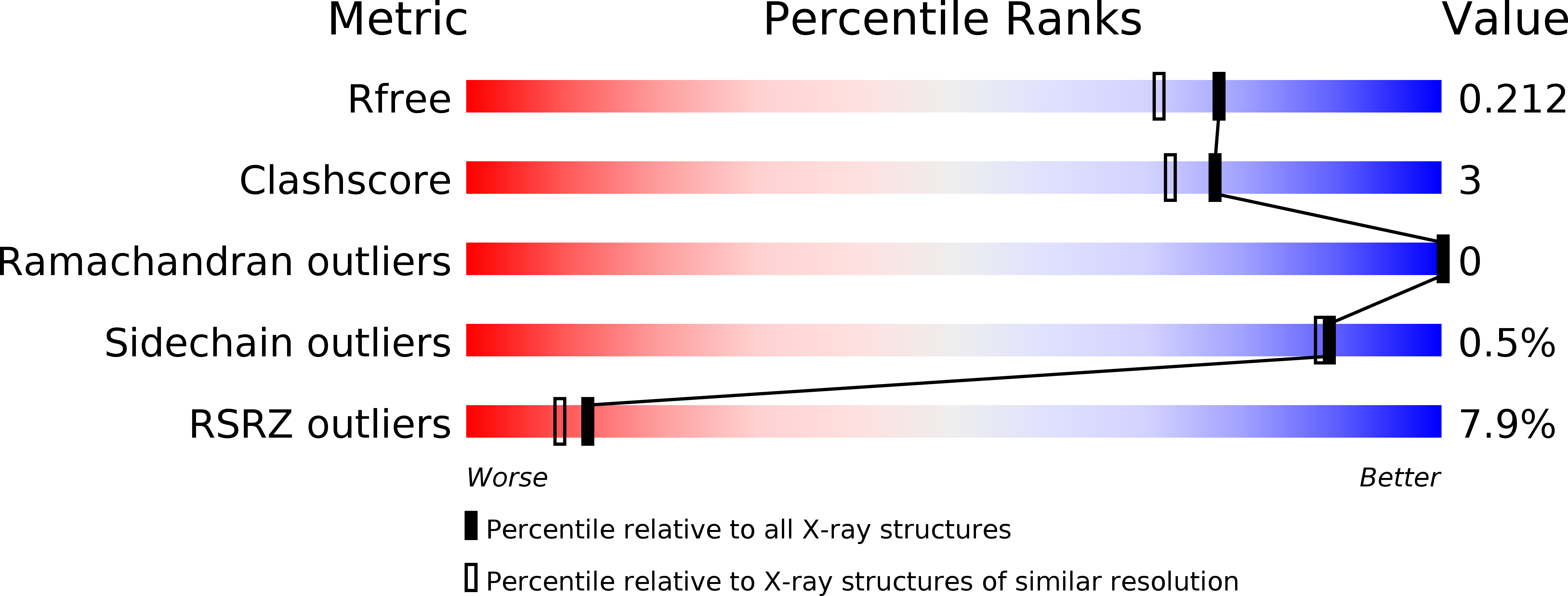
1.80 Å
R-Value Free:
0.22
R-Value Work:
0.19
R-Value Observed:
0.19
Space Group:
P 21 21 2
Macromolecular Entities
Structures with similar UniProt ID
Protein Blast
Polymer Type:polypeptide(L)
Molecule:Chloride intracellular channel protein 4
Gene (Uniprot):CLIC4
Chain IDs:A
Chain Length:267
Number of Molecules:1
Biological Source:Homo sapiens
Primary Citation
Crystal structure of the soluble form of the redox-regulated chloride ion channel protein CLIC4.
FEBS J. 272 4996 5007 (2005)
PMID: 16176272 DOI: 10.1111/j.1742-4658.2005.04909.x

Abstact

The structure of CLIC4, a member of the CLIC family of putative intracellular chloride ion channel proteins, has been determined at 1.8 Angstroms resolution by X-ray crystallography. The protein is monomeric and it is structurally similar to CLIC1, belonging to the GST fold class. Differences between the structures of CLIC1 and CLIC4 are localized to helix 2 in the glutaredoxin-like N-terminal domain, which has previously been shown to undergo a dramatic structural change in CLIC1 upon oxidation. The structural differences in this region correlate with the sequence differences, where the CLIC1 sequence appears to be atypical of the family. Purified, recombinant, wild-type CLIC4 is shown to bind to artificial lipid bilayers, induce a chloride efflux current when associated with artificial liposomes and produce an ion channel in artificial bilayers with a conductance of 30 pS. Membrane binding is enhanced by oxidation of CLIC4 while no channels were observed via tip-dip electrophysiology in the presence of a reducing agent. Thus, recombinant CLIC4 appears to be able to form a redox-regulated ion channel in the absence of any partner proteins.

Legend

Protein

Chemical

Disease

Primary Citation of related structures
Feedback Form
Name
Email
Institute
Feedback