2ABZ image
Deposition Date 2005-07-18
Release Date 2006-01-31
Last Version Date 2024-10-30
Entry Detail
PDB ID:
2ABZ
Title:
Crystal structure of C19A/C43A mutant of leech carboxypeptidase inhibitor in complex with bovine carboxypeptidase A
Biological Source:
Source Organism:
Bos taurus (Taxon ID: 9913)
Hirudo medicinalis (Taxon ID: 6421)
Host Organism:
Method Details:
Experimental Method:
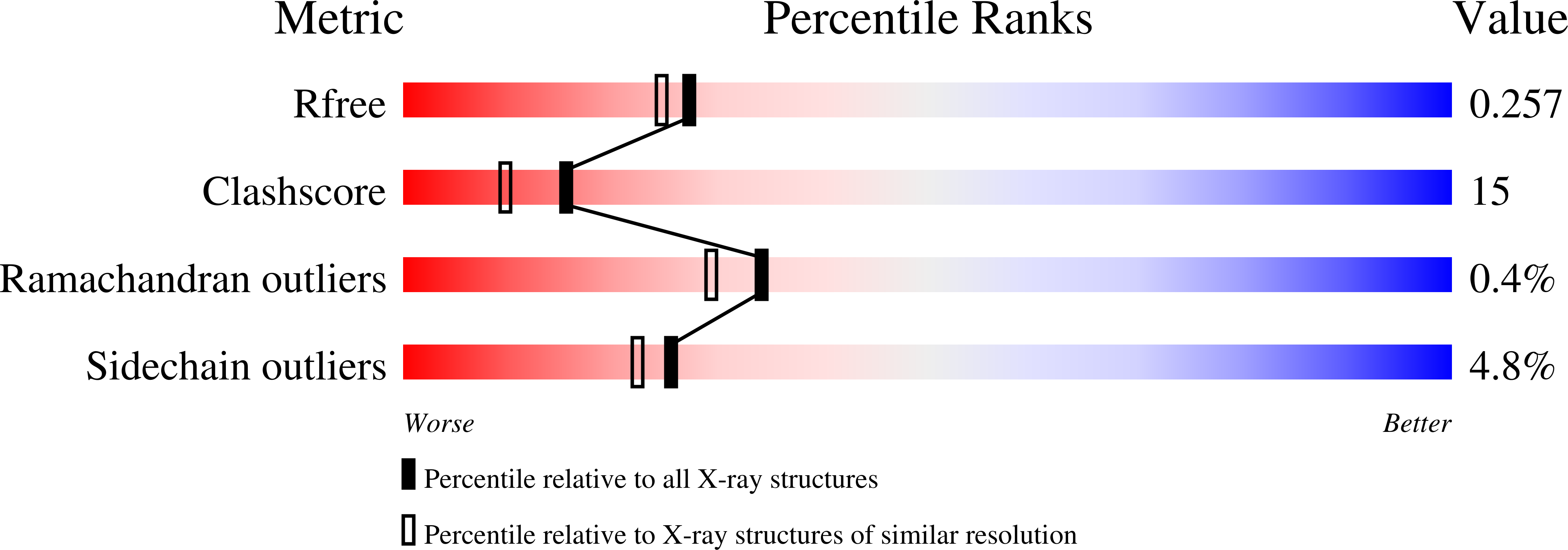
Resolution:
2.16 Å
R-Value Free:
0.23
R-Value Work:
0.18
R-Value Observed:
0.19
Space Group:
P 43 21 2
Macromolecular Entities
Structures with similar UniProt ID
Protein Blast
Polymer Type:polypeptide(L)
Molecule:Carboxypeptidase A1
Gene (Uniprot):CPA1
Chain IDs:A, B
Chain Length:309
Number of Molecules:2
Biological Source:Bos taurus
Structures with similar UniProt ID
Protein Blast
Polymer Type:polypeptide(L)
Molecule:Metallocarboxypeptidase inhibitor
Mutagens:C19A/C43A
Chain IDs:C, D, E, F
Chain Length:67
Number of Molecules:4
Biological Source:Hirudo medicinalis
Ligand Molecules
Primary Citation
Study of a major intermediate in the oxidative folding of leech carboxypeptidase inhibitor: contribution of the fourth disulfide bond
J.Mol.Biol. 352 961 975 (2005)
PMID: 16126224 DOI: 10.1016/j.jmb.2005.07.065

Abstact

The oxidative folding pathway of leech carboxypeptidase inhibitor (LCI; four disulfide bonds) proceeds through the formation of two major intermediates (III-A and III-B) that contain three native disulfide bonds and act as strong kinetic traps in the folding process. The III-B intermediate lacks the Cys19-Cys43 disulfide bond that links the beta-sheet core with the alpha-helix in wild-type LCI. Here, an analog of this intermediate was constructed by replacing Cys19 and Cys43 with alanine residues. Its oxidative folding follows a rapid sequential flow through one, two, and three disulfide species to reach the native form; the low accumulation of two disulfide intermediates and three disulfide (scrambled) isomers accounts for a highly efficient reaction. The three-dimensional structure of this analog, alone and in complex with carboxypeptidase A (CPA), was determined by X-ray crystallography at 2.2A resolution. Its overall structure is very similar to that of wild-type LCI, although the residues in the region adjacent to the mutation sites show an increased flexibility, which is strongly reduced upon binding to CPA. The structure of the complex also demonstrates that the analog and the wild-type LCI bind to the enzyme in the same manner, as expected by their inhibitory capabilities, which were similar for all enzymes tested. Equilibrium unfolding experiments showed that this mutant is destabilized by approximately 1.5 kcal mol(-1) (40%) relative to the wild-type protein. Together, the data indicate that the fourth disulfide bond provides LCI with both high stability and structural specificity.

Legend

Protein

Chemical

Disease

Primary Citation of related structures
Feedback Form
Name
Email
Institute
Feedback