1s1q image
Deposition Date 2004-01-07
Release Date 2004-05-04
Last Version Date 2024-10-30
Entry Detail
PDB ID:
1S1Q
Title:
TSG101(UEV) domain in complex with Ubiquitin
Biological Source:
Source Organism:
Homo sapiens (Taxon ID: 9606)
Host Organism:
Method Details:
Experimental Method:
Resolution:
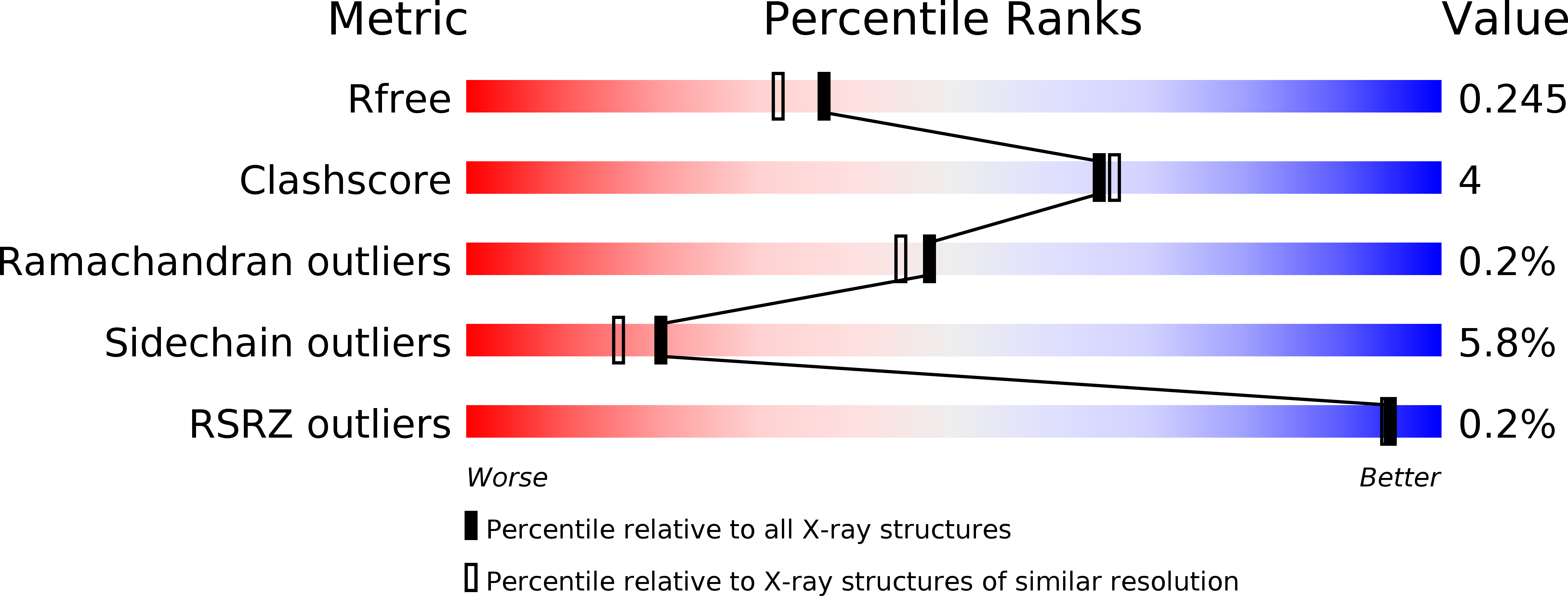
2.00 Å
R-Value Free:
0.23
R-Value Work:
0.20
R-Value Observed:
0.20
Space Group:
C 1 2 1
Macromolecular Entities
Structures with similar UniProt ID
Protein Blast
Polymer Type:polypeptide(L)
Molecule:Tumor susceptibility gene 101 protein
Gene (Uniprot):TSG101
Chain IDs:A, C
Chain Length:145
Number of Molecules:2
Biological Source:Homo sapiens
Structures with similar UniProt ID
Protein Blast
Polymer Type:polypeptide(L)
Molecule:ubiquitin
Chain IDs:B, D
Chain Length:76
Number of Molecules:2
Biological Source:Homo sapiens
Modified Residue
Compound ID Chain ID Parent Comp ID Details 2D Image
MSE A MET SELENOMETHIONINE
Primary Citation
Ubiquitin recognition by the human TSG101 protein
Mol.Cell 13 783 789 (2004)
PMID: 15053872 DOI: 10.1016/S1097-2765(04)00129-7

Abstact

The UEV domain of the TSG101 protein functions in both HIV-1 budding and the vacuolar protein sorting (VPS) pathway, where it binds ubiquitylated proteins as they are sorted into vesicles that bud into late endosomal compartments called multivesicular bodies (MVBs). TSG101 UEV-ubiquitin interactions are therefore important for delivery of both substrates and hydrolytic enzymes to lysosomes, which receive proteins via fusion with MVBs. Here, we report the crystal structure of the TSG101 UEV domain in complex with ubiquitin at 2.0 A resolution. TSG101 UEV contacts the Ile44 surface and an adjacent loop of ubiquitin through a highly solvated interface. Mutations that disrupt the interface inhibit MVB sorting, and the structure also explains how the TSG101 UEV can independently bind its ubiquitin and Pro-Thr/Ser-Ala-Pro peptide ligands. Remarkably, comparison with mapping data from other UEV and related E2 proteins indicates that although the different E2/UEV domains share the same structure and have conserved ubiquitin binding activity, they bind through very different interfaces.

Legend

Protein

Chemical

Disease

Primary Citation of related structures
Feedback Form
Name
Email
Institute
Feedback