1owa image
Deposition Date 2003-03-28
Release Date 2004-03-30
Last Version Date 2024-05-22
Entry Detail
PDB ID:
1OWA
Keywords:
Title:
Solution Structural Studies on Human Erythrocyte Alpha Spectrin N Terminal Tetramerization Domain
Biological Source:
Source Organism:
Homo sapiens (Taxon ID: 9606)
Host Organism:
Method Details:
Experimental Method:
Conformers Calculated:
200
Conformers Submitted:
10
Selection Criteria:
Lowest Energy conformers
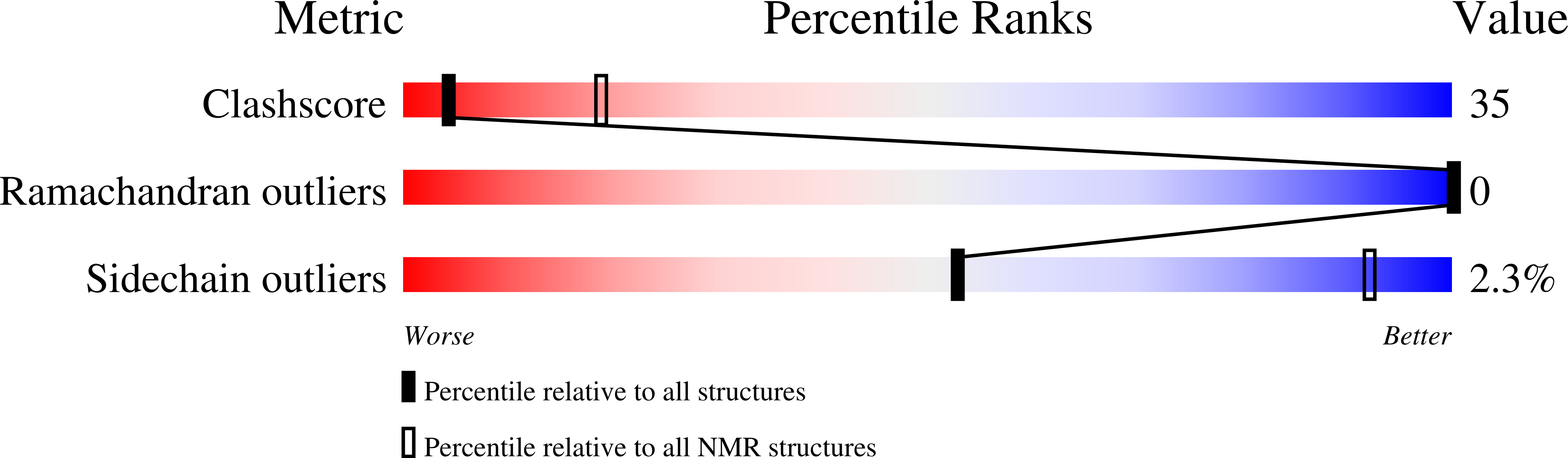
Macromolecular Entities
Structures with similar UniProt ID
Protein Blast
Polymer Type:polypeptide(L)
Molecule:Spectrin alpha chain, erythrocyte
Gene (Uniprot):SPTA1
Chain IDs:A
Chain Length:156
Number of Molecules:1
Biological Source:Homo sapiens
Ligand Molecules
Primary Citation
Solution structural studies on human erythrocyte alpha-spectrin tetramerization site.
J.Biol.Chem. 278 21837 21844 (2003)
PMID: 12672815 DOI: 10.1074/jbc.M300617200

Abstact

We have determined the solution NMR structure of a recombinant peptide that consists of the first 156 residues of erythroid alpha-spectrin. The first 20 residues preceding the first helix (helix C') are in a disordered conformation. The subsequent three helices (helices A1, B1, and C1) form a triple helical bundle structural domain that is similar, but not identical, to previously published structures for spectrin from Drosophila and chicken brain. Paramagnetic spin label-induced NMR resonance broadening shows that helix C', the partial domain involved in alpha- and beta-spectrin association, exhibits little interaction with the structural domain. Surprisingly, helix C' is connected to helix A1 of the structural domain by a segment of 7 residues (the junction region) that exhibits a flexible disordered conformation, in contrast to the predicted rigid helical structure. We suggest that the flexibility of this particular junction region may play an important role in modulating the association affinity of alpha- and beta-spectrin at the tetramerization site of different isoforms, such as erythroid spectrin and brain spectrin. These findings may provide insight for explaining various physiological and pathological conditions that are a consequence of varying alpha- and beta-subunit self-association affinities in their formation of the various spectrin tetramers.

Legend

Protein

Chemical

Disease

Primary Citation of related structures
Feedback Form
Name
Email
Institute
Feedback