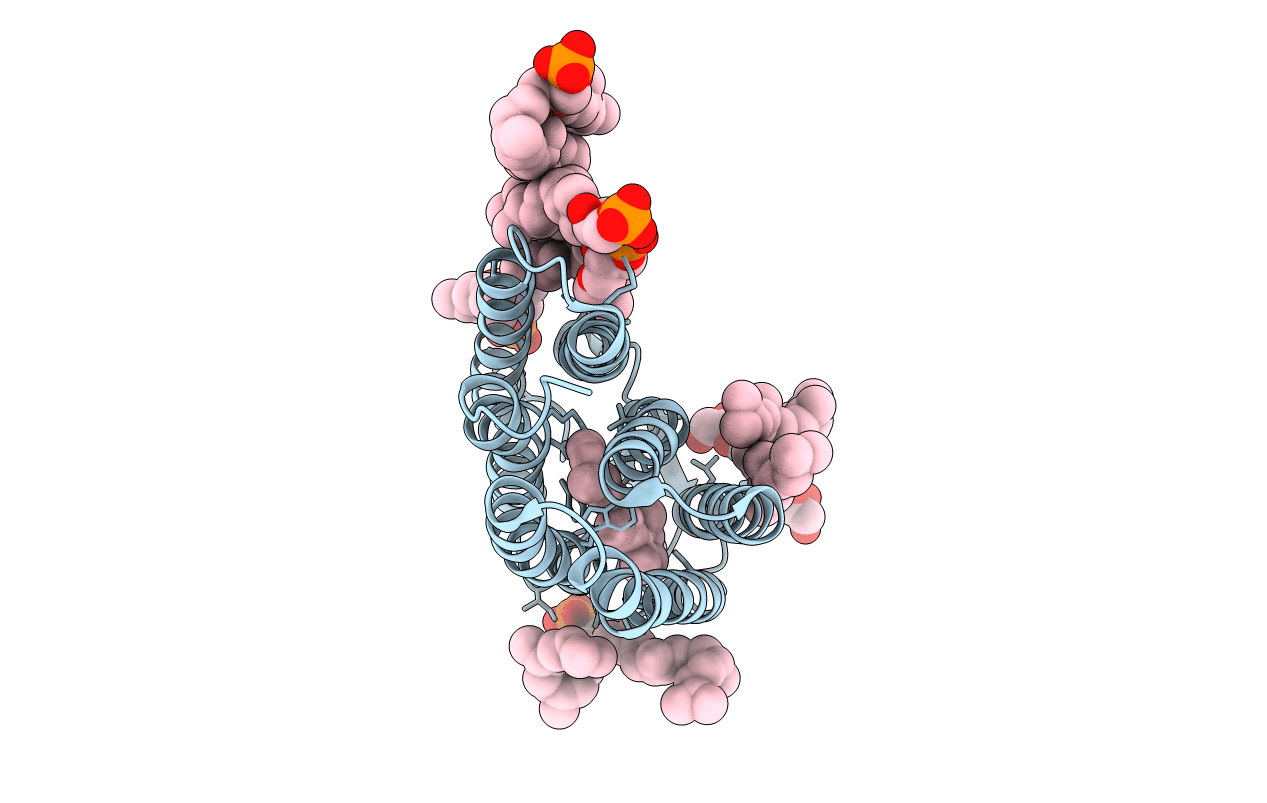
1iw9 image
Deposition Date 2002-04-25
Release Date 2003-12-23
Last Version Date 2024-10-30
Entry Detail
PDB ID:
1IW9
Title:
Crystal Structure of the M Intermediate of Bacteriorhodopsin
Biological Source:
Source Organism:
Method Details:
Experimental Method:
Resolution:
2.50 Å
R-Value Free:
0.27
R-Value Work:
0.22
R-Value Observed:
0.22
Space Group:
P 6 2 2

Macromolecular Entities
Structures with similar UniProt ID
Protein Blast
Polymer Type:polypeptide(L)
Molecule:bacteriorhodopsin
Gene (Uniprot):bop
Chain IDs:A
Chain Length:248
Number of Molecules:1
Biological Source:Halobacterium salinarum
Primary Citation
Crystal structure of the M intermediate of bacteriorhodopsin: allosteric structural changes mediated by sliding movement of a transmembrane helix
J.Mol.Biol. 341 1023 1037 (2004)
PMID: 15328615 DOI: 10.1016/j.jmb.2004.06.080

Abstact

Structural changes in the proton pumping cycle of wild-type bacteriorhodopsin were investigated by using a 3D crystal (space group P622)prepared by the membrane fusion method. Protein-protein contacts in the crystal elongate the lifetime of the M intermediate by a factor of approximately 100,allowing high levels of the M intermediate to accumulate under continuous illumination. When the M intermediate generated at room temperature was exposed to a low flux of X-rays (approximately 10(14) photons/mm2), this yellow intermediate was converted into a blue species having an absorption maximum at 650 nm. This color change is suggested to accompany a configuration change in the retinal-Lys216 chain. The true conformational change associated with formation of the M intermediate was analyzed by taking the X-radiation-induced structural change into account. Our result indicates that, upon formation of the M intermediate, helix G move stowards the extra-cellular side by, on average, 0.5 angstroms. This movement is coupled with several reactions occurring at distal sites in the protein: (1) reorientation of the side-chain of Leu93 contacting the C13 methyl group of retinal, which is accompanied by detachment of a water molecule from the Schiff base; (2) a significant distortion in the F-G loop, triggering destruction of a hydrogen bonding interaction between a pair of glutamate groups (Glu194 and Glu204); (3) formation of a salt bridge between the carboxylate group of Glu204 and the guanidinium ion of Arg82, which is accompanied by a large distortion in the extra-cellular half of helix C; (4)noticeable movements of the AB loop and the cytoplasmic end of helix B. But, no appreciable change is induced in the peptide backbone of helices A,D, E and F. These structural changes are discussed from the viewpoint of translocation of water molecules.

Legend

Protein

Chemical

Disease

Primary Citation of related structures
Feedback Form
Name
Email
Institute
Feedback