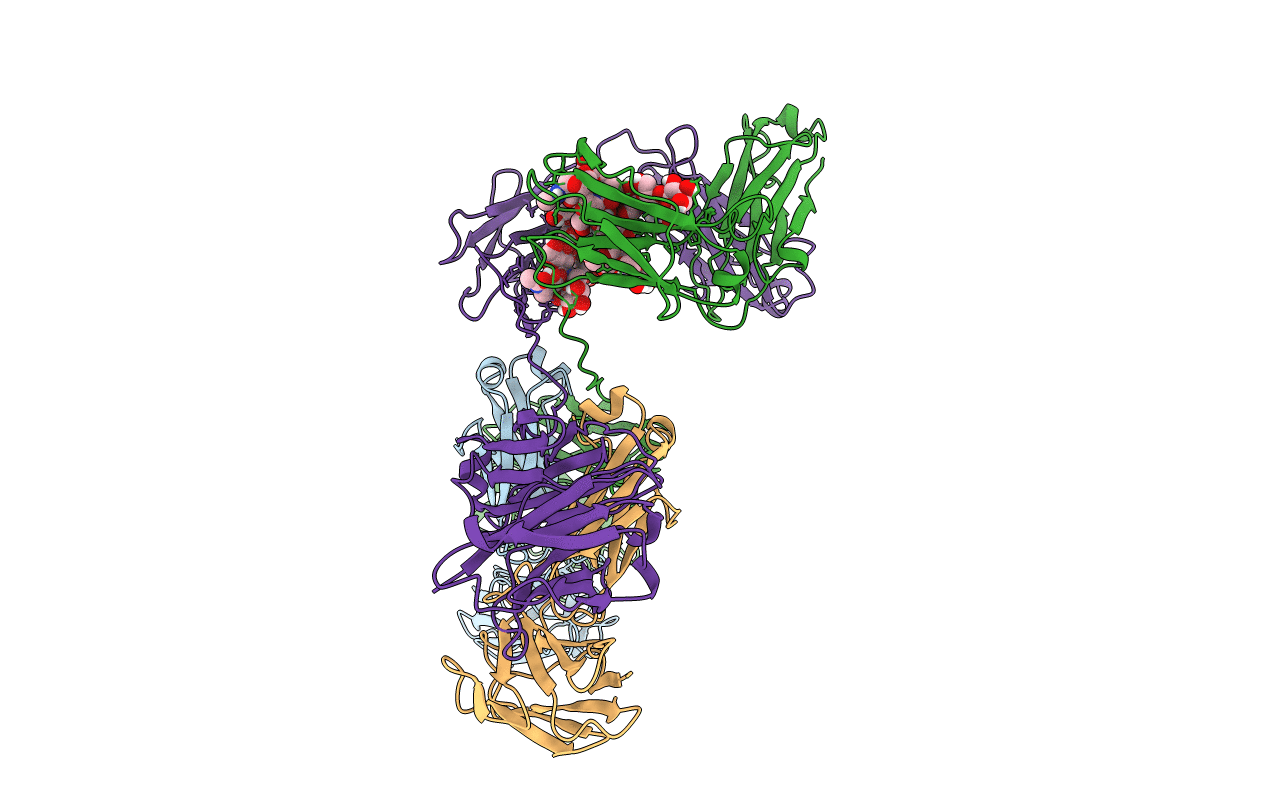
1igy image
Deposition Date 1997-10-09
Release Date 1998-04-15
Last Version Date 2024-10-23
Entry Detail
PDB ID:
1IGY
Keywords:
Title:
STRUCTURE OF IMMUNOGLOBULIN
Biological Source:
Source Organism:
Mus musculus (Taxon ID: 10090)
Method Details:
Experimental Method:
Resolution:
3.20 Å
R-Value Free:
0.32
R-Value Work:
0.21
R-Value Observed:
0.21
Space Group:
P 1 21 1

Macromolecular Entities
Structures with similar UniProt ID
Protein Blast
Polymer Type:polypeptide(L)
Molecule:IGG1 INTACT ANTIBODY MAB61.1.3
Chain IDs:A, C
Chain Length:213
Number of Molecules:2
Biological Source:Mus musculus
Structures with similar UniProt ID
Protein Blast
Polymer Type:polypeptide(L)
Molecule:IGG1 INTACT ANTIBODY MAB61.1.3
Chain IDs:B, D
Chain Length:434
Number of Molecules:2
Biological Source:Mus musculus
Modified Residue
Compound ID Chain ID Parent Comp ID Details 2D Image
ASN B ASN GLYCOSYLATION SITE
Ligand Molecules
Primary Citation
Crystallographic structure of an intact IgG1 monoclonal antibody.
J.Mol.Biol. 275 861 872 (1998)
PMID: 9480774 DOI: 10.1006/jmbi.1997.1508

Abstact

The structure of an intact monoclonal antibody for phenobarbital, subclass IgG1, has been determined to 3.2 A resolution by X-ray crystallography. The molecule was visualized in a monoclinic unit cell having an entire immunoglobulin as the asymmetric unit. The two Fab segments, both with elbow angles of 155 degrees , were related by a rotation of 179.7 degrees plus a translation along the approximate dyad of 9 A. This is the first observation of such an Fab translation in a structurally defined antibody. The approximate 2-fold of the Fc was independent of that relating Fabs, making an angle of 107 degrees with the Fab dyad. The angle between long axes of the Fabs was 115 degrees, the most acute angle yet observed, yielding a distorted Y shaped molecule. This is in contrast to the distorted T shape of the only other intact IgG (2a) whose complete structure is known. Primary lattice interactions arise through formation of VH antiparallel beta ribbons whose strands are contributed by pseudo dyad related H2, and by L3 hypervariable loops from neighboring molecules. While one CH2 domain was mobile, Fabs and three domains of the Fc were well defined, as were hinge polypeptides connecting Fabs to the Fc, and the covalently attached oligosaccharides. Direct interactions are observed between hinge polypeptides, the glycosylated loop of one CH2 domain, and the oligosaccharide. Lattice interactions clearly influence, perhaps even determine the overall conformation of the antibody observed in this crystal. Comparison of this IgG1 with previously determined intact antibody structures extends the conformational range arising from segmental flexibility.

Legend

Protein

Chemical

Disease

Primary Citation of related structures
Feedback Form
Name
Email
Institute
Feedback