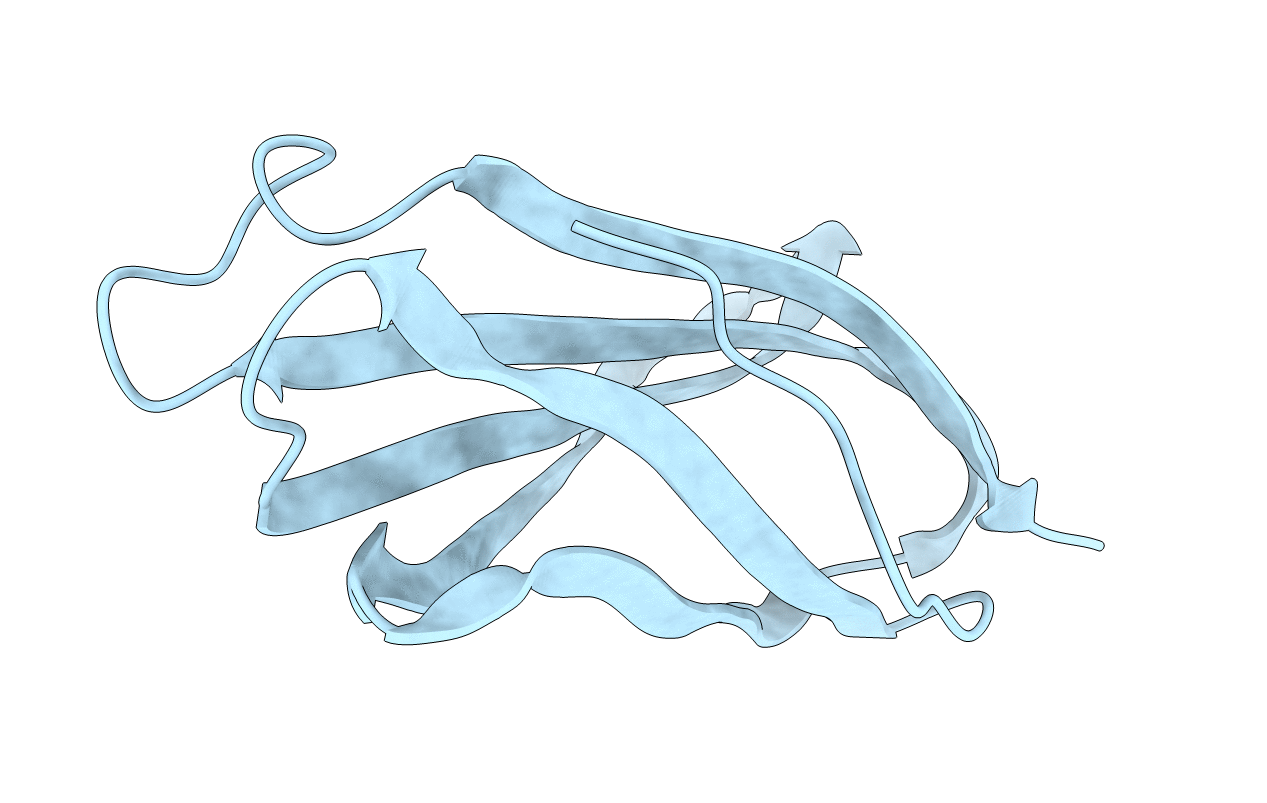
1fna image
Deposition Date 1994-01-11
Release Date 1994-04-30
Last Version Date 2024-02-07
Entry Detail
PDB ID:
1FNA
Title:
CRYSTAL STRUCTURE OF THE TENTH TYPE III CELL ADHESION MODULE OF HUMAN FIBRONECTIN
Biological Source:
Source Organism:
Homo sapiens (Taxon ID: 9606)
Method Details:
Experimental Method:
Resolution:
1.80 Å
R-Value Observed:
0.18
Space Group:
P 1 21 1
Macromolecular Entities
Structures with similar UniProt ID
Protein Blast
Polymer Type:polypeptide(L)
Molecule:FIBRONECTIN CELL-ADHESION MODULE TYPE III-10
Gene (Uniprot):FN1
Chain IDs:A
Chain Length:91
Number of Molecules:1
Biological Source:Homo sapiens
Ligand Molecules
Primary Citation
Crystal structure of the tenth type III cell adhesion module of human fibronectin.
J.Mol.Biol. 236 1079 1092 (1994)
PMID: 8120888 DOI: 10.1016/0022-2836(94)90013-2

Abstact

The crystal structure of the cell adhesion module of fibronectin (FNIII10) has been determined at 1.8 A resolution. A recombinant fragment corresponding to the tenth type III module of human fibronectin was crystallized in space group P2(1) with a = 30.7, b = 35.1 and c = 37.7 A and beta = 107 degrees. The structure was determined by molecular replacement and refined by least squares methods. The crystallographic R-factor for the final model of the 91 amino acid module plus 56 solvent atoms is 0.18 for 10 to 1.8 A data. The module consists of two layers of beta-sheet, one with three antiparallel strands and the other with four antiparallel strands. The beta-sheets enclose a hydrophobic core of 24 amino acid side-chains. The module contains the RGD cell recognition sequence in a flexible loop connecting two beta-strands. The tertiary structure of the FNIII10 module has been used to develop a structure-based sequence alignment of 17 type III modules in fibronectin based on the striking conservation of homologous hydrophobic residues. A similar pattern of homologous alternating hydrophobic residues is also evident in a comparison of type III modules in proteins unrelated to fibronectin such as cytokine receptors and muscle proteins.

Legend

Protein

Chemical

Disease

Primary Citation of related structures
Feedback Form
Name
Email
Institute
Feedback