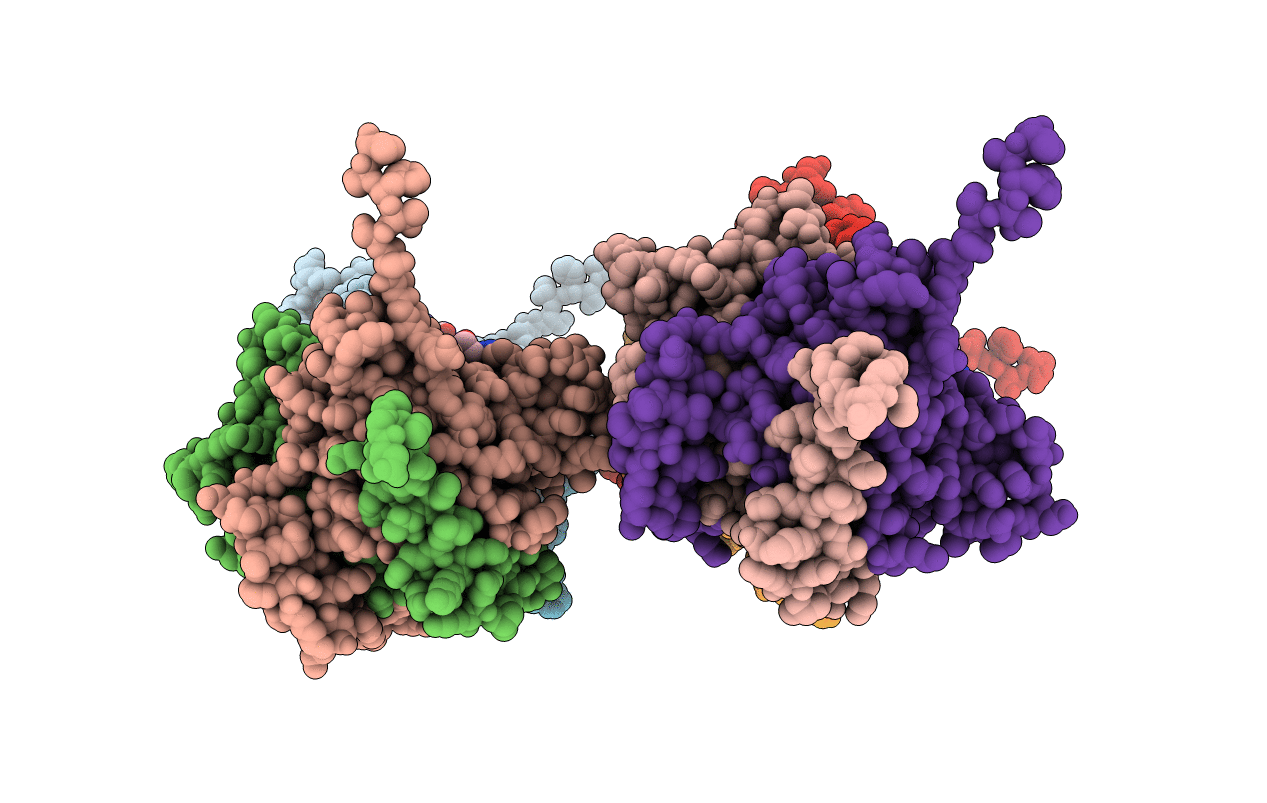
1ekj image
Deposition Date 2000-03-08
Release Date 2000-06-07
Last Version Date 2024-02-07
Entry Detail
PDB ID:
1EKJ
Keywords:
Title:
THE X-RAY CRYSTALLOGRAPHIC STRUCTURE OF BETA CARBONIC ANHYDRASE FROM THE C3 DICOT PISUM SATIVUM
Biological Source:
Source Organism:
Pisum sativum (Taxon ID: 3888)
Method Details:
Experimental Method:
Resolution:
1.93 Å
R-Value Free:
0.25
R-Value Work:
0.22
R-Value Observed:
0.22
Space Group:
C 2 2 2

Macromolecular Entities
Structures with similar UniProt ID
Protein Blast
Polymer Type:polypeptide(L)
Molecule:BETA-CARBONIC ANHYDRASE
Chain IDs:A, B, C, D, E, F, G, H
Chain Length:221
Number of Molecules:8
Biological Source:Pisum sativum
Primary Citation
The active site architecture of Pisum sativum beta-carbonic anhydrase is a mirror image of that of alpha-carbonic anhydrases.
EMBO J. 19 1407 1418 (2000)
PMID: 10747009 DOI: 10.1093/emboj/19.7.1407

Abstact

We have determined the structure of the beta-carbonic anhydrase from the dicotyledonous plant Pisum sativum at 1.93 A resolution, using a combination of multiple anomalous scattering off the active site zinc ion and non-crystallographic symmetry averaging. The mol- ecule assembles as an octamer with a novel dimer of dimers of dimers arrangement. Two distinct patterns of conservation of active site residues are observed, implying two potentially mechanistically distinct classes of beta-carbonic anhydrases. The active site is located at the interface between two monomers, with Cys160, His220 and Cys223 binding the catalytic zinc ion and residues Asp162 (oriented by Arg164), Gly224, Gln151, Val184, Phe179 and Tyr205 interacting with the substrate analogue, acetic acid. The substrate binding groups have a one to one correspondence with the functional groups in the alpha-carbonic anhydrase active site, with the corresponding residues being closely superimposable by a mirror plane. Therefore, despite differing folds, alpha- and beta-carbonic anhydrase have converged upon a very similar active site design and are likely to share a common mechanism.

Legend

Protein

Chemical

Disease

Primary Citation of related structures
Feedback Form
Name
Email
Institute
Feedback