1a12 image
Deposition Date 1997-12-19
Release Date 1999-01-13
Last Version Date 2024-02-07
Entry Detail
PDB ID:
1A12
Title:
REGULATOR OF CHROMOSOME CONDENSATION (RCC1) OF HUMAN
Biological Source:
Source Organism(s):
Homo sapiens (Taxon ID: 9606)
Expression System(s):
Method Details:
Experimental Method:
Resolution:
1.70 Å
R-Value Free:
0.21
R-Value Work:
0.18
R-Value Observed:
0.18
Space Group:
P 1
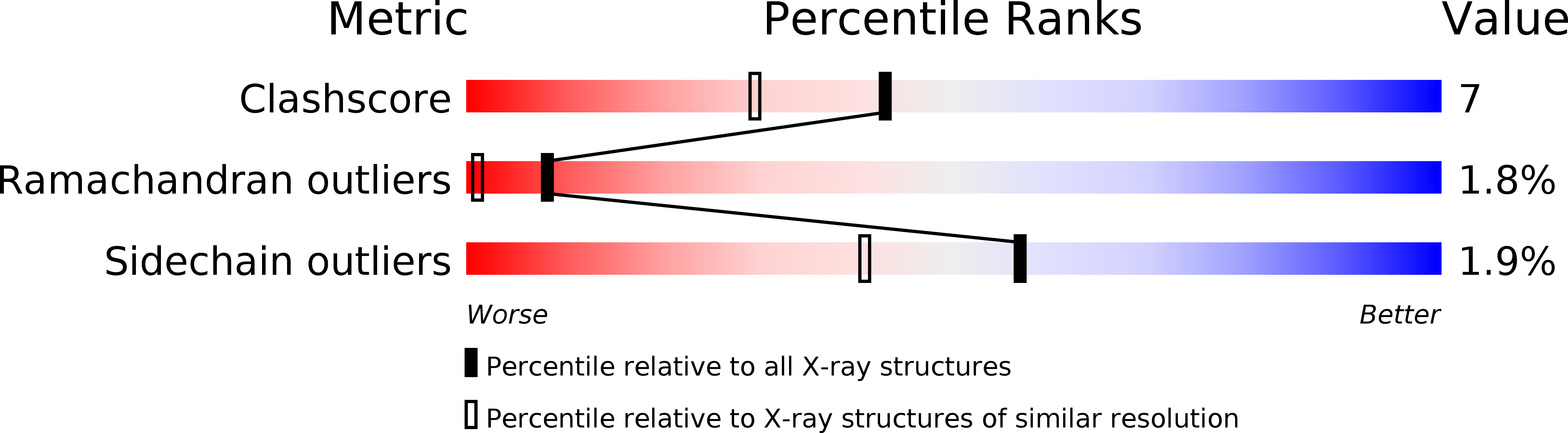
Macromolecular Entities
Structures with similar UniProt ID
Protein Blast
Polymer Type:polypeptide(L)
Molecule:REGULATOR OF CHROMOSOME CONDENSATION 1
Gene (Uniprot):RCC1
Chain IDs:A, B, C
Chain Length:413
Number of Molecules:3
Biological Source:Homo sapiens
Primary Citation
The 1.7 A crystal structure of the regulator of chromosome condensation (RCC1) reveals a seven-bladed propeller.
Nature 392 97 101 (1998)
PMID: 9510255 DOI: 10.1038/32204

Abstact

The gene encoding the regulator of chromosome condensation (RCC1) was cloned by virtue of its ability to complement the temperature-sensitive phenotype of the hamster cell line tsBN2, which undergoes premature chromosome condensation or arrest in the G1 phase of the cell cycle at non-permissive temperatures. RCC1 homologues have been identified in many eukaryotes, including budding and fission yeast. Mutations in the gene affect pre-messenger RNA processing and transport, mating, initiation of mitosis and chromatin decondensation, suggesting that RCC1 is important in the control of nucleo-cytoplasmic transport and the cell cycle. Biochemically, RCC1 is a guanine-nucleotide-exchange factor for the nuclear Ras homologue Ran; it increases the dissociation of Ran-bound GDP by 10(5)-fold. It may also bind to DNAvia a protein-protein complex. Here we show that the structure of human RCC1, solved to 1.7-A resolution by X-ray crystallography, consists of a seven-bladed propeller formed from internal repeats of 51-68 residues per blade. The sequence and structure of the repeats differ from those of WD40-domain proteins, which also form seven-bladed propellers and include the beta-subunits of G proteins. The nature of the structure explains the consequences of a wide range of known mutations. The region of the protein that is involved in guanine-nucleotide exchange is located opposite the region that is thought to be involved in chromosome binding.

Legend

Protein

Chemical

Disease

Primary Citation of related structures
Feedback Form
Name
Email
Institute
Feedback