1ZZD image
Deposition Date 2005-06-13
Release Date 2006-03-07
Last Version Date 2024-10-30
Entry Detail
PDB ID:
1ZZD
Keywords:
Title:
Structures of Yeast Ribonucleotide Reductase I
Biological Source:
Source Organism:
Method Details:
Experimental Method:
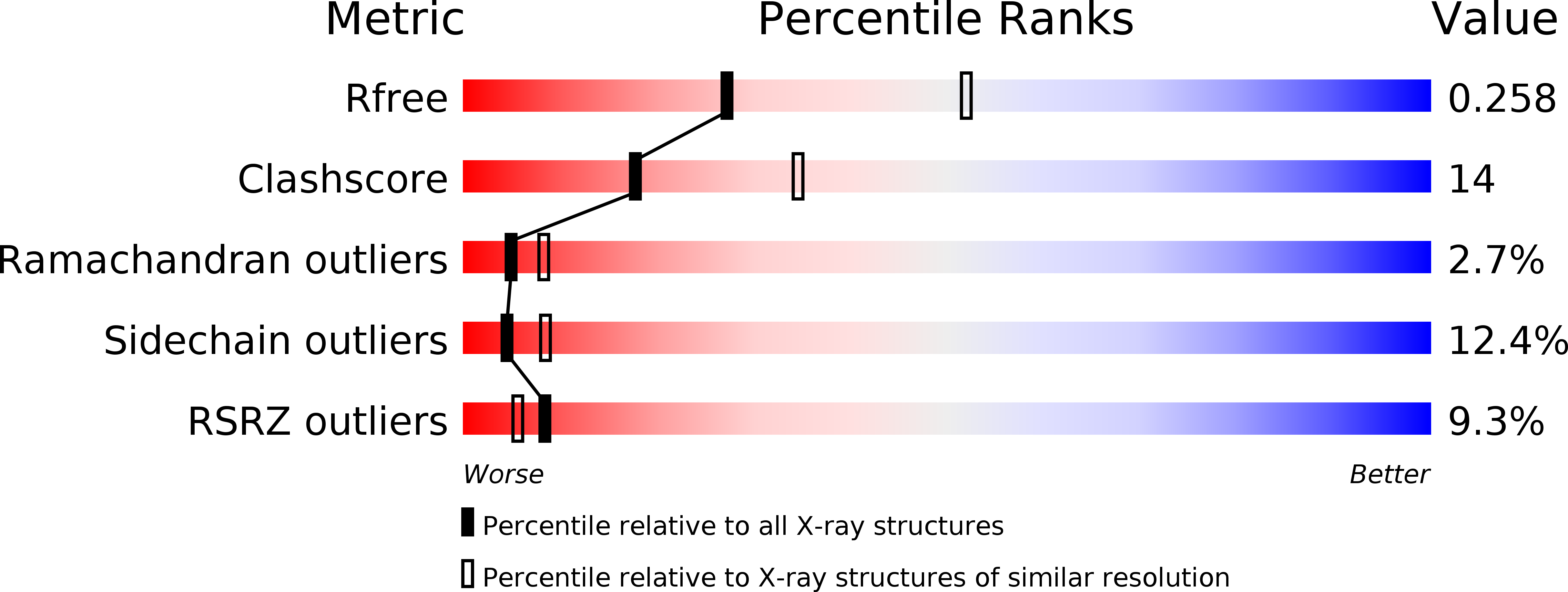
Resolution:
2.60 Å
R-Value Free:
0.26
R-Value Work:
0.20
R-Value Observed:
0.20
Space Group:
P 21 21 2
Macromolecular Entities
Structures with similar UniProt ID
Protein Blast
Polymer Type:polypeptide(L)
Molecule:Ribonucleoside-diphosphate reductase large chain 1
Gene (Uniprot):RNR1
Chain IDs:A
Chain Length:888
Number of Molecules:1
Biological Source:Saccharomyces cerevisiae
Structures with similar UniProt ID
Protein Blast
Polymer Type:polypeptide(L)
Molecule:Ribonucleoside-diphosphate reductase small chain 2
Gene (Uniprot):RNR4
Chain IDs:B
Chain Length:9
Number of Molecules:1
Biological Source:
Primary Citation
Structures of eukaryotic ribonucleotide reductase I provide insights into dNTP regulation
Proc.Natl.Acad.Sci.Usa 103 4022 4027 (2006)
PMID: 16537479 DOI: 10.1073/pnas.0600443103

Abstact

Ribonucleotide reductase catalyzes a crucial step in de novo DNA synthesis and is allosterically controlled by relative levels of dNTPs to maintain a balanced pool of deoxynucleoside triphosphates in the cell. In eukaryotes, the enzyme comprises a heterooligomer of alpha(2) and beta(2) subunits. The alpha subunit, Rnr1, contains catalytic and regulatory sites. Here, we report the only x-ray structures of the eukaryotic alpha subunit of ribonucleotide reductase from Saccharomyces cerevisiae. The structures of the apo-, AMPPNP only-, AMPPNP-CDP-, AMPPNP-UDP-, dGTP-ADP- and TTP-GDP-bound complexes give insight into substrate and effector binding and specificity cross-talk. These are Class I structures with the only fully ordered catalytic sites, including loop 2, a stretch of polypeptide that spans specificity and catalytic sites, conferring specificity. Binding of specificity effector rearranges loop 2; in our structures, this rearrangement moves P294, a residue unique to eukaryotes, out of the catalytic site, accommodating substrate binding. Substrate binding further rearranges loop 2. Cross-talk, by which effector binding regulates substrate preference, occurs largely through R293 and Q288 of loop 2, which are analogous to residues in Thermotoga maritima that mediate cross-talk. However loop-2 conformations and residue-substrate interactions differ substantially between yeast and T. maritima. In most effector-substrate complexes, water molecules help mediate substrate-loop 2 interactions. Finally, the substrate ribose binds with its 3' hydroxyl closer than its 2' hydroxyl to C218 of the catalytic redox pair. We also see a conserved water molecule at the catalytic site in all our structures, near the ribose 2' hydroxyl.

Legend

Protein

Chemical

Disease

Primary Citation of related structures
Feedback Form
Name
Email
Institute
Feedback