1ZTU image
Deposition Date 2005-05-27
Release Date 2005-11-15
Last Version Date 2024-11-06
Entry Detail
PDB ID:
1ZTU
Keywords:
Title:
Structure of the chromophore binding domain of bacterial phytochrome
Biological Source:
Source Organism:
Host Organism:
Method Details:
Experimental Method:
Resolution:
2.50 Å
R-Value Free:
0.26
R-Value Work:
0.23
R-Value Observed:
0.23
Space Group:
P 21 21 2
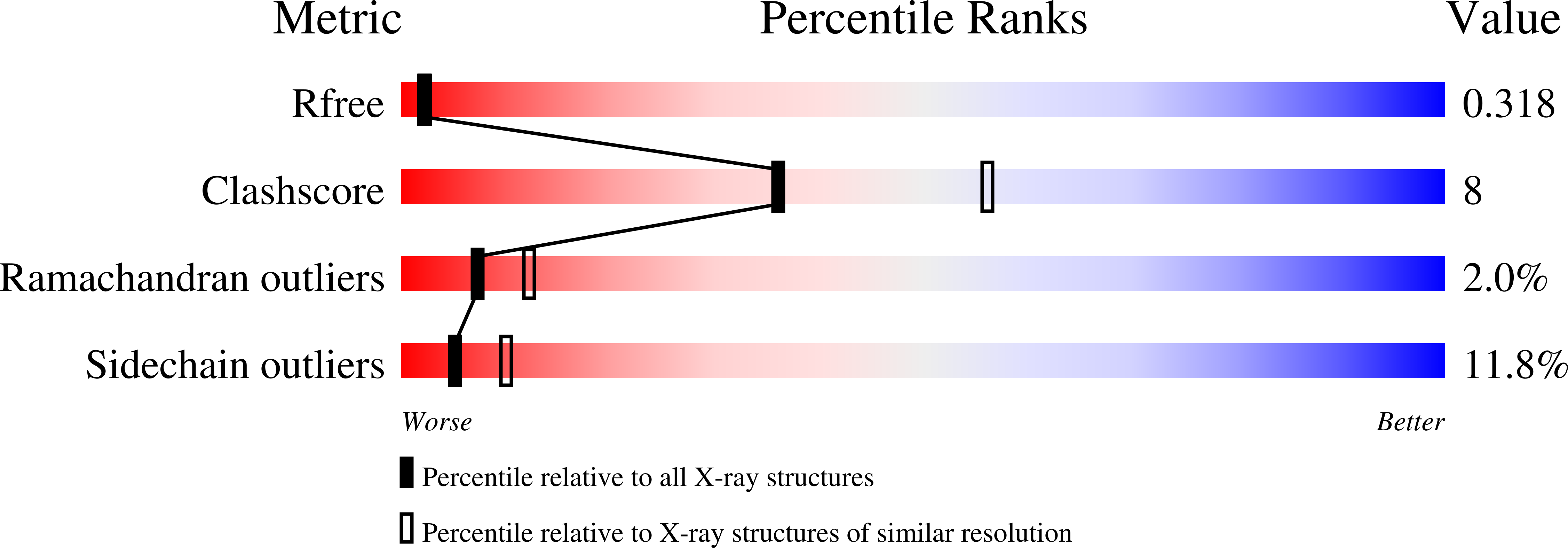
Macromolecular Entities
Structures with similar UniProt ID
Protein Blast
Polymer Type:polypeptide(L)
Molecule:Bacteriophytochrome
Gene (Uniprot):bphP
Mutagens:P240T
Chain IDs:A
Chain Length:341
Number of Molecules:1
Biological Source:Deinococcus radiodurans
Modified Residue
Compound ID Chain ID Parent Comp ID Details 2D Image
MSE A MET SELENOMETHIONINE
Ligand Molecules
Primary Citation
A light-sensing knot revealed by the structure of the chromophore-binding domain of phytochrome.
Nature 438 325 331 (2005)
PMID: 16292304 DOI: 10.1038/nature04118

Abstact

Phytochromes are red/far-red light photoreceptors that direct photosensory responses across the bacterial, fungal and plant kingdoms. These include photosynthetic potential and pigmentation in bacteria as well as chloroplast development and photomorphogenesis in plants. Phytochromes consist of an amino-terminal region that covalently binds a single bilin chromophore, followed by a carboxy-terminal dimerization domain that often transmits the light signal through a histidine kinase relay. Here we describe the three-dimensional structure of the chromophore-binding domain of Deinococcus radiodurans phytochrome assembled with its chromophore biliverdin in the Pr ground state. Our model, refined to 2.5 A resolution, reaffirms Cys 24 as the chromophore attachment site, locates key amino acids that form a solvent-shielded bilin-binding pocket, and reveals an unusually formed deep trefoil knot that stabilizes this region. The structure provides the first three-dimensional glimpse into the photochromic behaviour of these photoreceptors and helps to explain the evolution of higher plant phytochromes from prokaryotic precursors.

Legend

Protein

Chemical

Disease

Primary Citation of related structures
Feedback Form
Name
Email
Institute
Feedback