1ZRU image
Deposition Date 2005-05-22
Release Date 2006-03-28
Last Version Date 2023-08-23
Entry Detail
PDB ID:
1ZRU
Keywords:
Title:
structure of the lactophage p2 receptor binding protein in complex with glycerol
Biological Source:
Source Organism:
Host Organism:
Method Details:
Experimental Method:
Resolution:
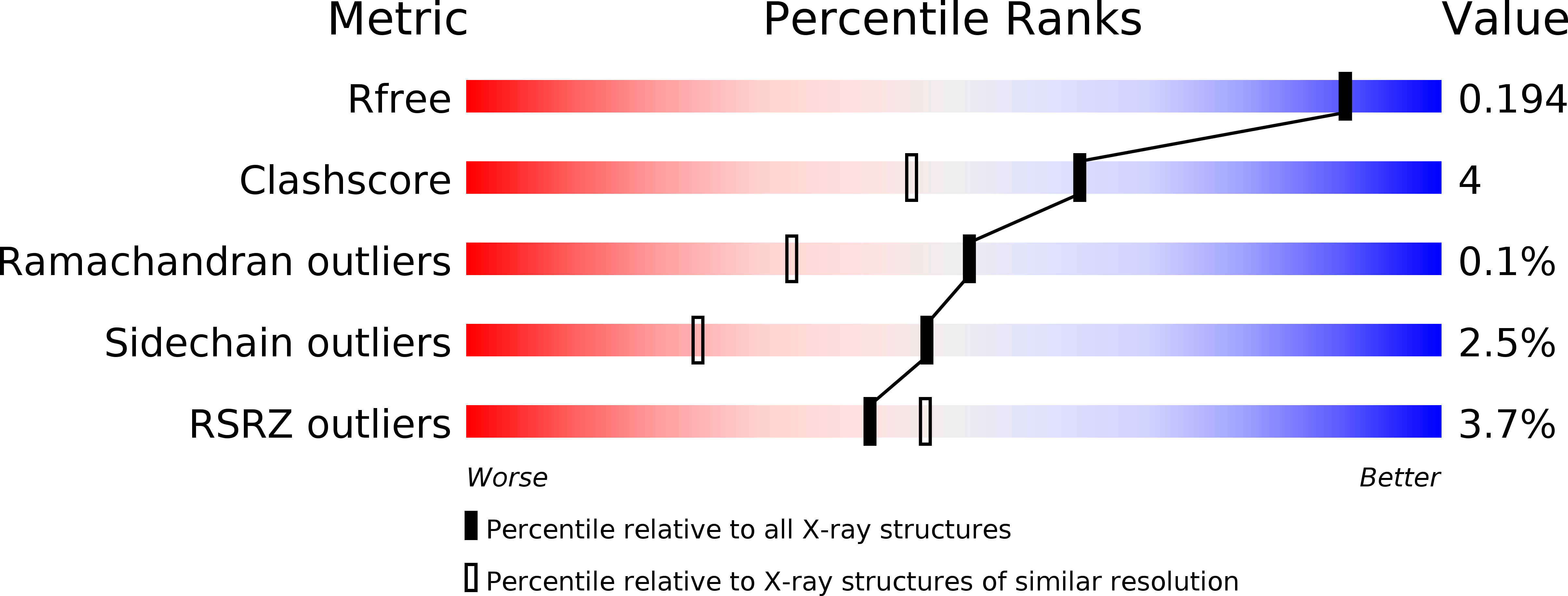
1.73 Å
R-Value Free:
0.19
R-Value Work:
0.17
R-Value Observed:
0.17
Space Group:
P 21 21 21
Macromolecular Entities
Structures with similar UniProt ID
Protein Blast
Polymer Type:polypeptide(L)
Molecule:lactophage p2 receptor binding protein
Gene (Uniprot):rbp
Chain IDs:A, B, C
Chain Length:264
Number of Molecules:3
Biological Source:Lactococcus lactis phage p2
Ligand Molecules
Primary Citation
Receptor-binding protein of Lactococcus lactis phages: identification and characterization of the saccharide receptor-binding site.
J.Bacteriol. 188 2400 2410 (2006)
PMID: 16547026 DOI: 10.1128/JB.188.7.2400-2410.2006

Abstact

Phage p2, a member of the lactococcal 936 phage species, infects Lactococcus lactis strains by binding initially to specific carbohydrate receptors using its receptor-binding protein (RBP). The structures of p2 RBP, a homotrimeric protein composed of three domains, and of its complex with a neutralizing llama VH domain (VHH5) have been determined (S. Spinelli, A. Desmyter, C. T. Verrips, H. J. de Haard, S. Moineau, and C. Cambillau, Nat. Struct. Mol. Biol. 13:85-89, 2006). Here, we show that VHH5 was able to neutralize 12 of 50 lactococcal phages belonging to the 936 species. Moreover, escape phage mutants no longer neutralized by VHH5 were isolated from 11 of these phages. All of the mutations (but one) cluster in the RBP/VHH5 interaction surface that delineates the receptor-binding area. A glycerol molecule, observed in the 1.7-A resolution structure of RBP, was found to bind tightly (Kd= 0.26 microM) in a crevice located in this area. Other saccharides bind RBP with comparable high affinity. These data prove the saccharidic nature of the bacterial receptor recognized by phage p2 and identify the position of its binding site in the RBP head domain.

Legend

Protein

Chemical

Disease

Primary Citation of related structures
Feedback Form
Name
Email
Institute
Feedback