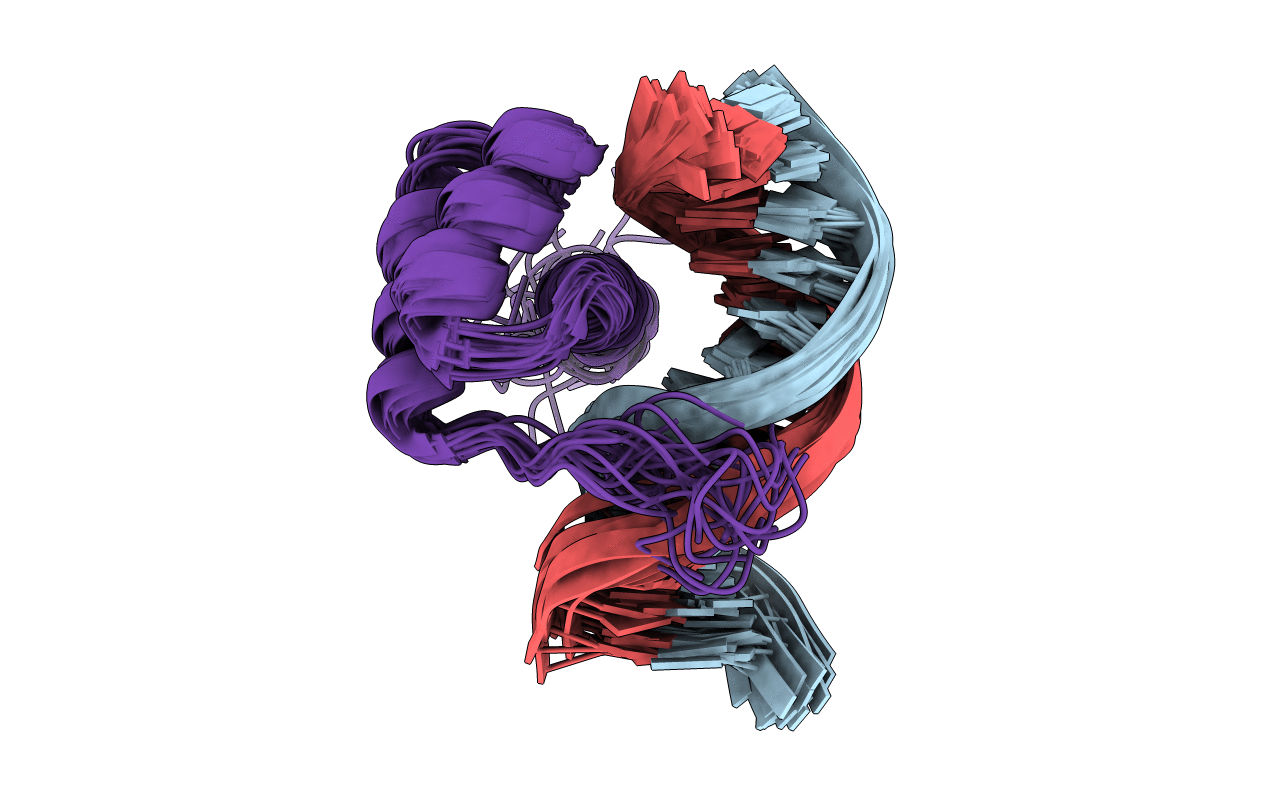
1ZQ3 image
Deposition Date 2005-05-18
Release Date 2006-02-14
Last Version Date 2024-05-22
Entry Detail
PDB ID:
1ZQ3
Title:
NMR Solution Structure of the Bicoid Homeodomain Bound to the Consensus DNA Binding Site TAATCC
Biological Source:
Source Organism:
Host Organism:
Method Details:
Experimental Method:
Conformers Calculated:
100
Conformers Submitted:
20
Selection Criteria:
structures with the lowest energy
Macromolecular Entities
Structures with similar UniProt ID
Protein Blast
Polymer Type:polypeptide(L)
Molecule:Homeotic bicoid protein
Chain IDs:C (auth: P)
Chain Length:68
Number of Molecules:1
Biological Source:Drosophila melanogaster
Ligand Molecules
Primary Citation
The solution structure of the native K50 Bicoid homeodomain bound to the consensus TAATCC DNA-binding site.
J.Mol.Biol. 356 1137 1151 (2006)
PMID: 16406070 DOI: 10.1016/j.jmb.2005.12.007

Abstact

The solution structure of the homeodomain of the Drosophila morphogenic protein Bicoid (Bcd) complexed with a TAATCC DNA site is described. Bicoid is the only known protein that uses a homeodomain to regulate translation, as well as transcription, by binding to both RNA and DNA during early Drosophila development; in addition, the Bcd homeodomain can recognize an array of different DNA sites. The dual functionality and broad recognition capabilities signify that the Bcd homeodomain may possess unique structural/dynamic properties. Bicoid is the founding member of the K50 class of homeodomain proteins, containing a lysine residue at the critical 50th position (K50) of the homeodomain sequence, a residue required for DNA and RNA recognition; Bcd also has an arginine residue at the 54th position (R54), which is essential for RNA recognition. Bcd is the only known homeodomain with the K50/R54 combination of residues. The Bcd structure indicates that this homeodomain conforms to the conserved topology of the homeodomain motif, but exhibits a significant variation from other homeodomain structures at the end of helix 1. A key result is the observation that the side-chains of the DNA-contacting residues K50, N51 and R54 all show strong signs of flexibility in the protein-DNA interface. This finding is supportive of the adaptive-recognition theory of protein-DNA interactions.

Legend

Protein

Chemical

Disease

Primary Citation of related structures
Feedback Form
Name
Email
Institute
Feedback