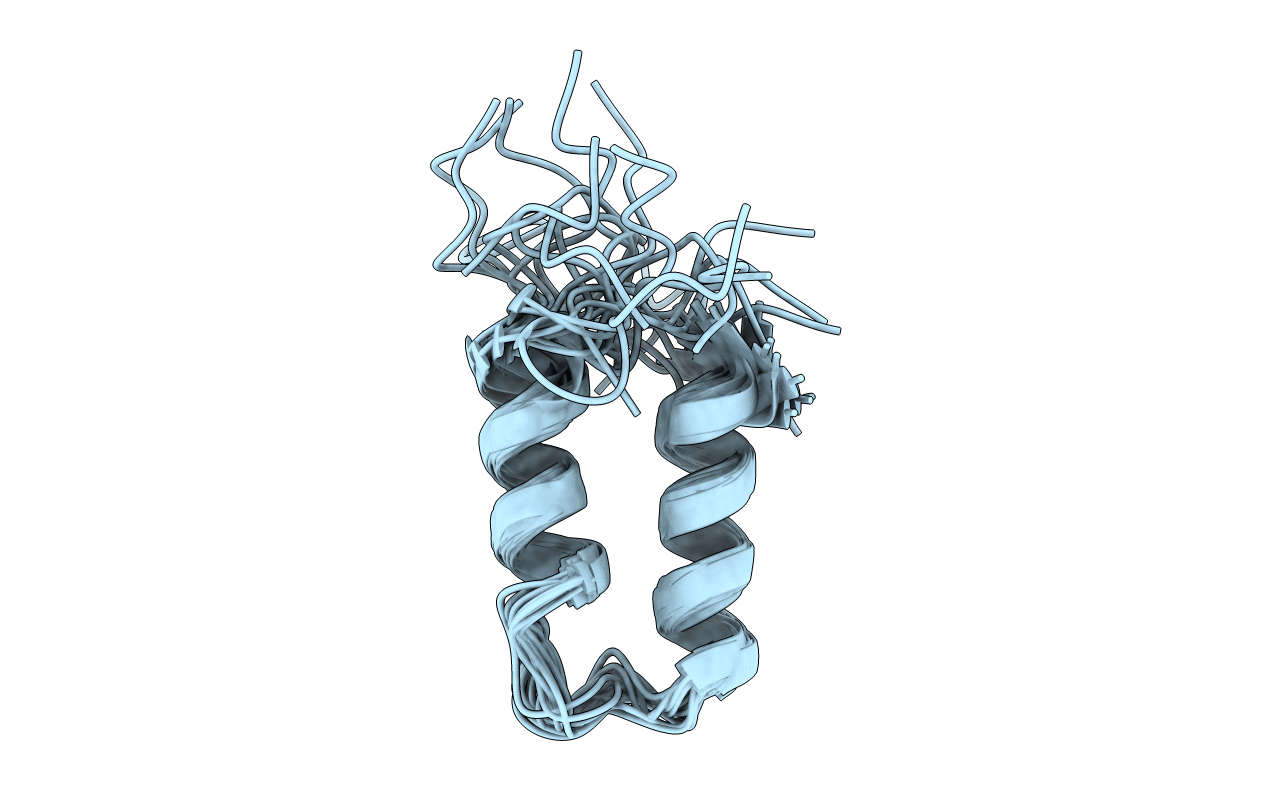
1ZDA image
Deposition Date 1997-07-09
Release Date 1997-09-17
Last Version Date 2024-05-22
Entry Detail
PDB ID:
1ZDA
Title:
PHAGE-SELECTED MINI PROTEIN A DOMAIN, Z38, NMR, 24 STRUCTURES
Biological Source:
Source Organism:
Method Details:
Experimental Method:
Conformers Calculated:
56
Conformers Submitted:
24
Selection Criteria:
LOWEST RESTRAINT VIOLATION ENERGY
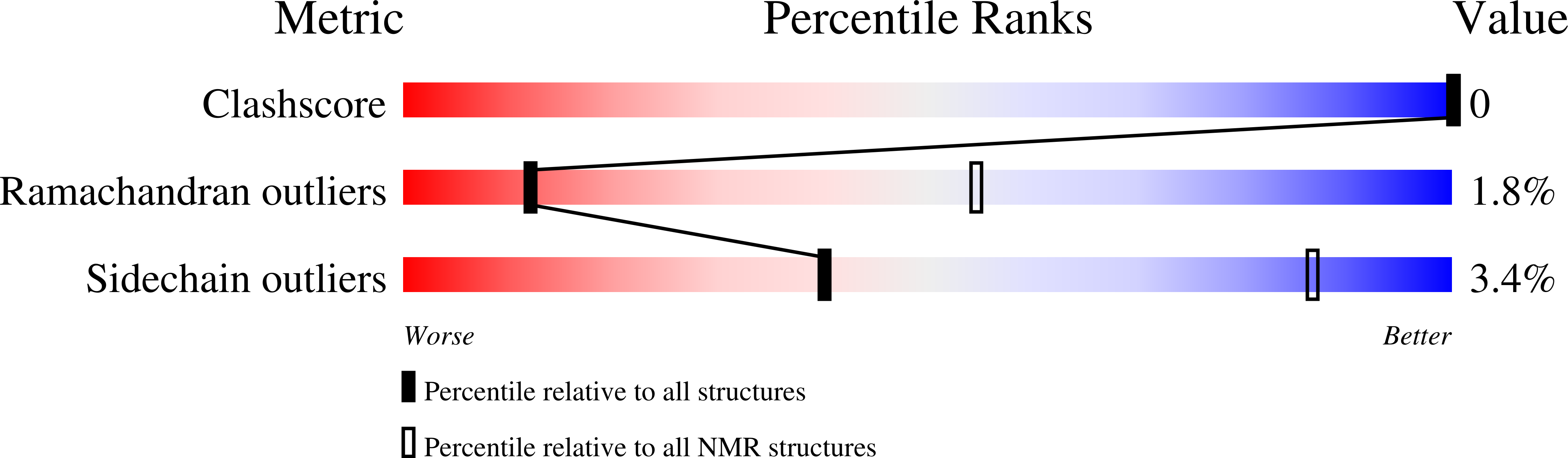
Macromolecular Entities
Polymer Type:polypeptide(L)
Molecule:MINI PROTEIN A DOMAIN, Z38
Chain IDs:A
Chain Length:38
Number of Molecules:1
Biological Source:synthetic construct
Ligand Molecules
Primary Citation
Structural mimicry of a native protein by a minimized binding domain.
Proc.Natl.Acad.Sci.USA 94 10080 10085 (1997)
PMID: 9294166 DOI: 10.1073/pnas.94.19.10080

Abstact

The affinity between molecules depends both on the nature and presentation of the contacts. Here, we observe coupling of functional and structural elements when a protein binding domain is evolved to a smaller functional mimic. Previously, a 38-residue form of the 59-residue B-domain of protein A, termed Z38, was selected by phage display. Z38 contains 13 mutations and binds IgG only 10-fold weaker than the native B-domain. We present the solution structure of Z38 and show that it adopts a tertiary structure remarkably similar to that observed for the first two helices of B-domain in the B-domain/Fc complex [Deisenhofer, J. (1981) Biochemistry 20, 2361-2370], although it is significantly less stable. Based on this structure, we have improved on Z38 by designing a 34-residue disulfide-bonded variant (Z34C) that has dramatically enhanced stability and binds IgG with 9-fold higher affinity. The improved stability of Z34C led to NMR spectra with much greater chemical shift dispersion, resulting in a more precisely determined structure. Z34C, like Z38, has a structure virtually identical to the equivalent region from native protein A domains. The well-defined hydrophobic core of Z34C reveals key structural features that have evolved in this small, functional domain. Thus, the stabilized two-helix peptide, about half the size and having one-third of the remaining residues altered, accurately mimics both the structure and function of the native domain.

Legend

Protein

Chemical

Disease

Primary Citation of related structures
Feedback Form
Name
Email
Institute
Feedback