1ZCH image
Deposition Date 2005-04-12
Release Date 2005-11-01
Last Version Date 2023-10-25
Entry Detail
PDB ID:
1ZCH
Keywords:
Title:
Structure of the hypothetical oxidoreductase YcnD from Bacillus subtilis
Biological Source:
Source Organism:
Host Organism:
Method Details:
Experimental Method:
Resolution:
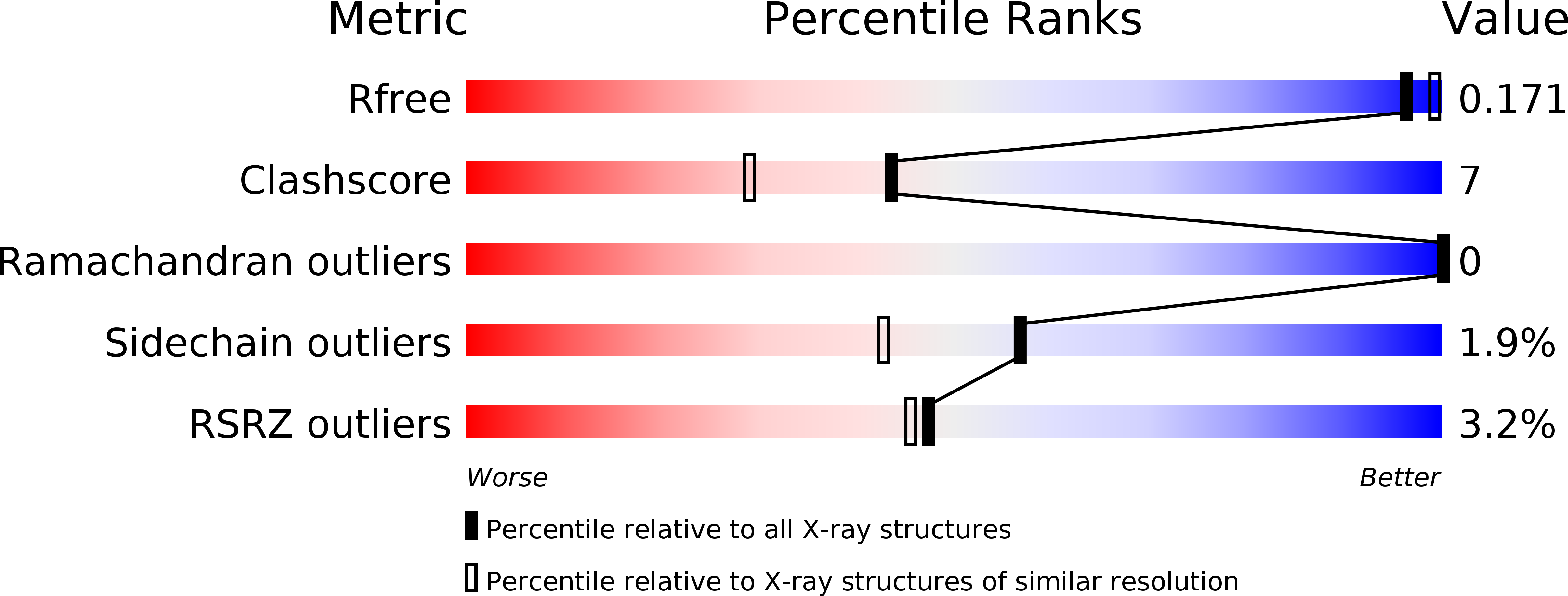
1.85 Å
R-Value Free:
0.19
R-Value Work:
0.17
R-Value Observed:
0.17
Space Group:
C 2 2 21
Macromolecular Entities
Structures with similar UniProt ID
Protein Blast
Polymer Type:polypeptide(L)
Molecule:Hypothetical oxidoreductase ycnD
Gene (Uniprot):nfrA2
Chain IDs:A
Chain Length:255
Number of Molecules:1
Biological Source:Bacillus subtilis
Primary Citation
Structure and Function of YcnD from Bacillus subtilis, a Flavin-Containing Oxidoreductase(,).
Biochemistry 44 13724 13733 (2005)
PMID: 16229462 DOI: 10.1021/bi0510835

Abstact

YcnD from the gram-positive bacterium Bacillus subtilis is a member of a family of bacterial proteins that act as NADH- and/or NADPH-dependent oxidoreductases. Here, we report for the first time on the biochemical characterization of the purified protein, demonstrating that YcnD is an FMN-containing enzyme that can be reduced by NADH or NADPH (Km = 6.4 and 4.4 microM, respectively). In the presence of free FMN as the electron-accepting substrate, the latter reductant showed a ping-pong Bi-Bi reaction mechanism, whereas utilization of NADH is competitively inhibited by this substrate. This finding suggests that NADPH is the physiological reductant of the enzyme. We also show that YcnD reduces nitro-organic compounds, chromate, and a series of azo dyes. The reduction of azo dyes appears to be mediated by free reduced FMN because the reaction is considerably slower in its absence. Structure determination by X-ray crystallography revealed that YcnD folds into a three layer alpha-beta-alpha sandwich strongly resembling the topology of the NADH oxidase superfamily. Similar to homologous bacterial oxidoreductase, YcnD forms homodimers with an extended dimer interface. The biochemical data and the structure are discussed in light of the putative physiological function of YcnD as an oxidoreductase delivering reduced FMN to enzymes that require the reduced cofactor for activity.

Legend

Protein

Chemical

Disease

Primary Citation of related structures
Feedback Form
Name
Email
Institute
Feedback