1Z68 image
Deposition Date 2005-03-21
Release Date 2005-04-12
Last Version Date 2024-12-25
Entry Detail
PDB ID:
1Z68
Keywords:
Title:
Crystal Structure Of Human Fibroblast Activation Protein alpha
Biological Source:
Source Organism:
Homo sapiens (Taxon ID: 9606)
Host Organism:
Method Details:
Experimental Method:
Resolution:
2.60 Å
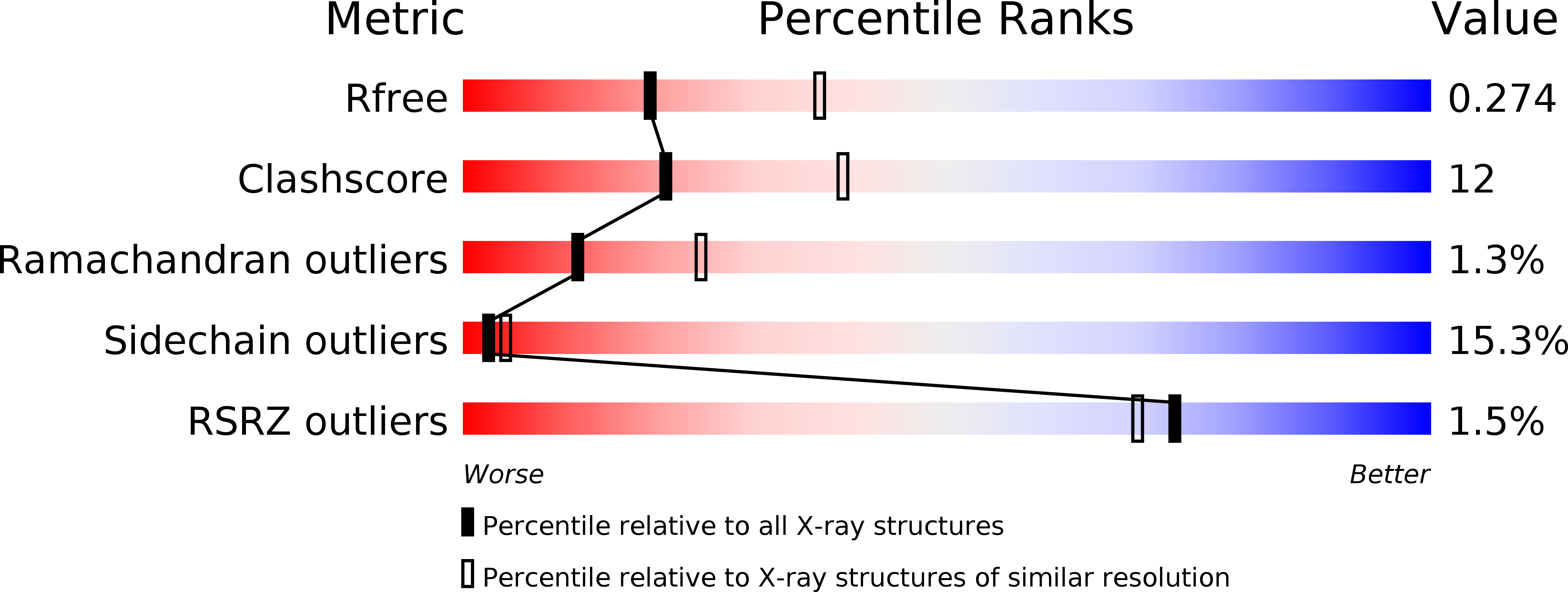
R-Value Free:
0.28
R-Value Work:
0.22
R-Value Observed:
0.22
Space Group:
P 21 21 21
Macromolecular Entities
Structures with similar UniProt ID
Protein Blast
Polymer Type:polypeptide(L)
Molecule:fibroblast activation protein, alpha subunit
Gene (Uniprot):FAP
Chain IDs:A, B
Chain Length:719
Number of Molecules:2
Biological Source:Homo sapiens
Modified Residue
Compound ID Chain ID Parent Comp ID Details 2D Image
ASN A ASN GLYCOSYLATION SITE
Ligand Molecules
Primary Citation
Structural and kinetic analysis of the substrate specificity of human fibroblast activation protein alpha.
J.Biol.Chem. 280 19441 19444 (2005)
PMID: 15809306 DOI: 10.1074/jbc.C500092200

Abstact

Fibroblast activation protein alpha (FAPalpha) is highly expressed in epithelial cancers and has been implicated in extracellular matrix remodeling, tumor growth, and metastasis. We present the first high resolution structure for the apoenzyme as well as kinetic data toward small dipeptide substrates. FAPalpha exhibits a dipeptidyl peptidase IV (DPPIV)-like fold, featuring an alpha/beta-hydrolase domain and an eight-bladed beta-propeller domain. Known DPPIV dipeptides are cleaved by FAPalpha with an approximately 100-fold decrease in catalytic efficiency compared with DPPIV. Moreover, FAPalpha, but not DPPIV, possesses endopeptidase activity toward N-terminal benzyloxycarbonyl (Z)-blocked peptides. Comparison of the crystal structures of FAPalpha and DPPIV revealed one major difference in the vicinity of the Glu motif (Glu(203)-Glu(204) for FAPalpha; Glu(205)-Glu(206) for DPPIV) within the active site of the enzyme. Ala(657) in FAPalpha, instead of Asp(663) as in DP-PIV, reduces the acidity in this pocket, and this change could explain the lower affinity for N-terminal amines by FAPalpha. This hypothesis was tested by kinetic analysis of the mutant FAPalpha/A657D, which shows on average an approximately 60-fold increase in the catalytic efficiency, as measured by k(cat)/K(m), for the cleavage of dipeptide substrates. Furthermore, the catalytic efficiency of the mutant is reduced by approximately 350-fold for cleavage of Z-Gly-Pro-7-amino-4-methylcoumarin. Our data provide a clear understanding of the molecular determinants responsible for the substrate specificity and endopeptidase activity of FAPalpha.

Legend

Protein

Chemical

Disease

Primary Citation of related structures
Feedback Form
Name
Email
Institute
Feedback