1Z5V image
Deposition Date 2005-03-20
Release Date 2005-05-31
Last Version Date 2023-08-23
Entry Detail
PDB ID:
1Z5V
Title:
Crystal structure of human gamma-tubulin bound to GTPgammaS
Biological Source:
Source Organism:
Homo sapiens (Taxon ID: 9606)
Host Organism:
Method Details:
Experimental Method:
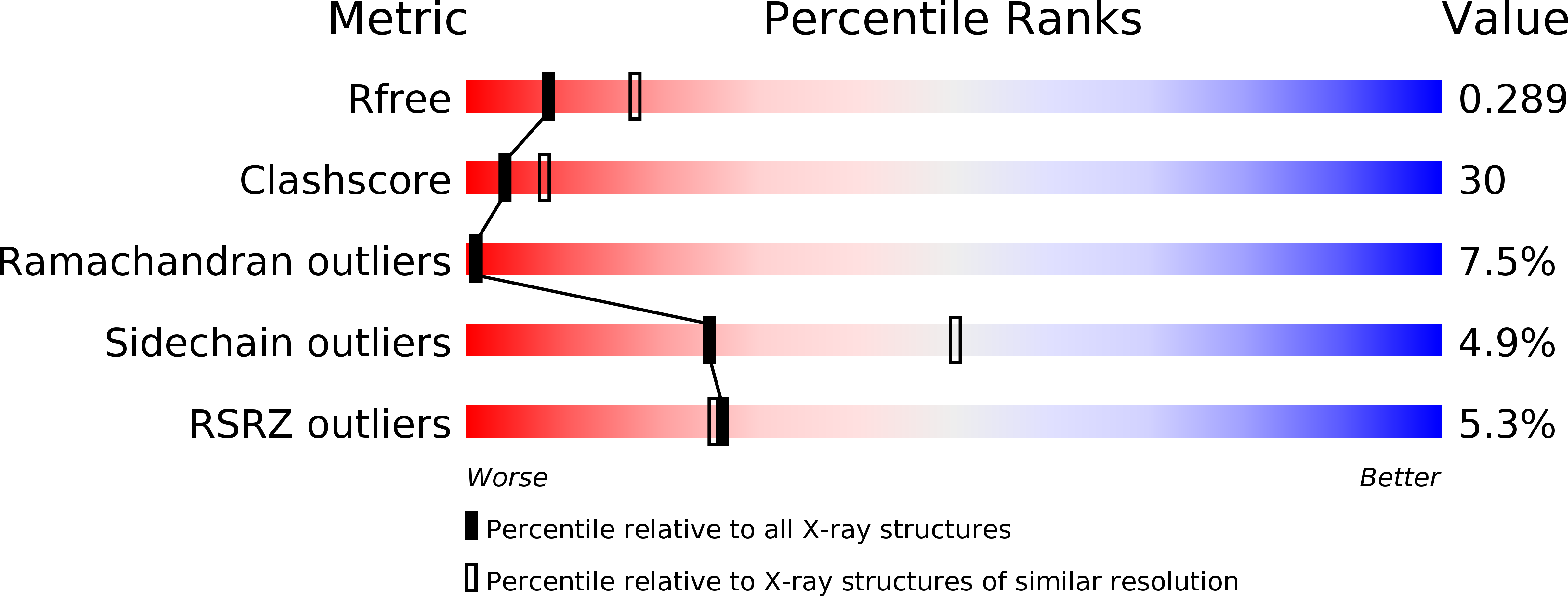
Resolution:
2.71 Å
R-Value Free:
0.29
R-Value Work:
0.23
R-Value Observed:
0.23
Space Group:
P 1 21 1
Macromolecular Entities
Structures with similar UniProt ID
Protein Blast
Polymer Type:polypeptide(L)
Molecule:Tubulin gamma-1 chain
Gene (Uniprot):TUBG1
Chain IDs:A
Chain Length:474
Number of Molecules:1
Biological Source:Homo sapiens
Primary Citation
Insights into microtubule nucleation from the crystal structure of human gamma-tubulin.
Nature 435 523 527 (2005)
PMID: 15917813 DOI: 10.1038/nature03586

Abstact

Microtubules are hollow polymers of alphabeta-tubulin that show GTP-dependent assembly dynamics and comprise a critical part of the eukaryotic cytoskeleton. Initiation of new microtubules in vivo requires gamma-tubulin, organized as an oligomer within the 2.2-MDa gamma-tubulin ring complex (gamma-TuRC) of higher eukaryotes. Structural insight is lacking regarding gamma-tubulin, its oligomerization and how it promotes microtubule assembly. Here we report the 2.7-A crystal structure of human gamma-tubulin bound to GTP-gammaS (a non-hydrolysable GTP analogue). We observe a 'curved' conformation for gamma-tubulin-GTPgammaS, similar to that seen for GDP-bound, unpolymerized alphabeta-tubulin. Tubulins are thought to represent a distinct class of GTP-binding proteins, and conformational switching in gamma-tubulin might differ from the nucleotide-dependent switching of signalling GTPases. A crystal packing interaction replicates the lateral contacts between alpha- and beta-tubulins in the microtubule, and this association probably forms the basis for gamma-tubulin oligomerization within the gamma-TuRC. Laterally associated gamma-tubulins in the gamma-TuRC might promote microtubule nucleation by providing a template that enhances the intrinsically weak lateral interaction between alphabeta-tubulin heterodimers. Because they are dimeric, alphabeta-tubulins cannot form microtubule-like lateral associations in the curved conformation. The lateral array of gamma-tubulins we observe in the crystal reveals a unique functional property of a monomeric tubulin.

Legend

Protein

Chemical

Disease

Primary Citation of related structures
Feedback Form
Name
Email
Institute
Feedback