1Z23 image
Deposition Date 2005-03-07
Release Date 2005-04-05
Last Version Date 2024-05-22
Entry Detail
PDB ID:
1Z23
Keywords:
Title:
The serine-rich domain from Crk-associated substrate (p130Cas)
Biological Source:
Source Organism:
Method Details:
Experimental Method:
Conformers Calculated:
99
Conformers Submitted:
20
Selection Criteria:
structures with the lowest energy
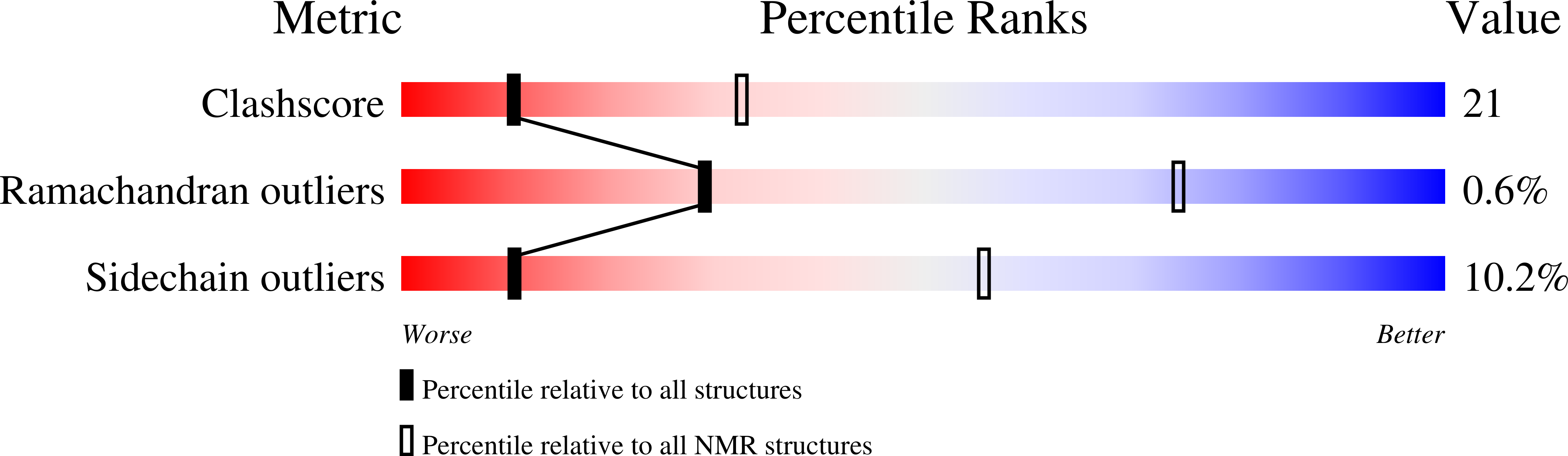
Macromolecular Entities
Structures with similar UniProt ID
Protein Blast
Polymer Type:polypeptide(L)
Molecule:CRK-associated substrate
Gene (Uniprot):Bcar1
Mutagens:V546G P547S
Chain IDs:A
Chain Length:163
Number of Molecules:1
Biological Source:Rattus norvegicus
Ligand Molecules
Primary Citation
The serine-rich domain from Crk-associated substrate (p130cas) is a four-helix bundle.
J.Biol.Chem. 280 21908 21914 (2005)
PMID: 15795225 DOI: 10.1074/jbc.M501258200

Abstact

p130(cas) (Crk-associated substrate) is a docking protein that is involved in assembly of focal adhesions and concomitant cellular signaling. It plays a role in physiological regulation of cell adhesion, migration, survival, and proliferation, as well as in oncogenic transformation. The molecule consists of multiple protein-protein interaction motifs, including a serine-rich region that is positioned between Crk and Src-binding sites. This study reports the first structure of a functional domain of Cas. The solution structure of the serine-rich region has been determined by NMR spectroscopy, demonstrating that this is a stable domain that folds as a four-helix bundle, a protein-interaction motif. The serine-rich region bears strong structural similarity to four-helix bundles found in other adhesion components like focal adhesion kinase, alpha-catenin, or vinculin. Potential sites for phosphorylation and interaction with the 14-3-3 family of cellular regulators are identified in the domain and characterized by site-directed mutagenesis and binding assays. Mapping the degree of amino acid conservation onto the molecular surface reveals a patch of invariant residues near the C terminus of the bundle, which may represent a previously unidentified site for protein interaction.

Legend

Protein

Chemical

Disease

Primary Citation of related structures
Feedback Form
Name
Email
Institute
Feedback