1Z1C image
Deposition Date 2005-03-03
Release Date 2005-09-06
Last Version Date 2024-04-03
Entry Detail
PDB ID:
1Z1C
Keywords:
Title:
Structural Determinants of Tissue Tropism and In Vivo Pathogenicity for the Parvovirus Minute virus of Mice
Biological Source:
Source Organism(s):
Expression System(s):
Method Details:
Experimental Method:
Resolution:
3.50 Å
R-Value Free:
0.32
R-Value Work:
0.32
Space Group:
C 1 2 1
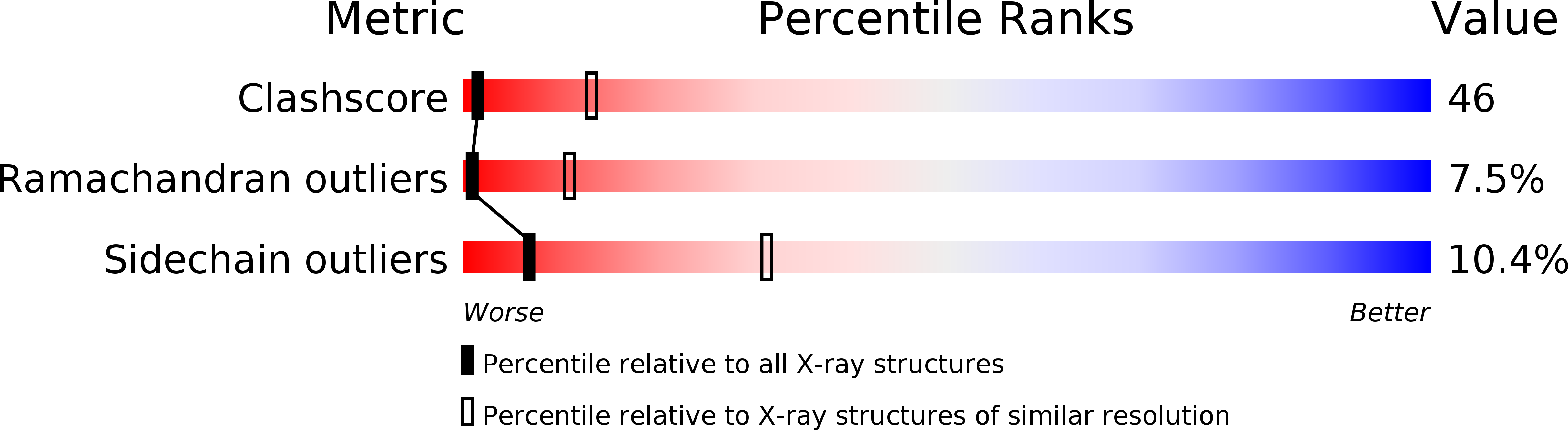
Macromolecular Entities
Structures with similar UniProt ID
Protein Blast
Polymer Type:polypeptide(L)
Molecule:Coat protein VP2
Chain IDs:C (auth: A)
Chain Length:587
Number of Molecules:1
Biological Source:Murine minute virus (STRAIN MVMI)
Primary Citation
Structural determinants of tissue tropism and in vivo pathogenicity for the parvovirus minute virus of mice.
J.Virol. 79 10931 10943 (2005)
PMID: 16103145 DOI: 10.1128/JVI.79.17.10931-10943.2005

Abstact

Two strains of the parvovirus minute virus of mice (MVM), the immunosuppressive (MVMi) and the prototype (MVMp) strains, display disparate in vitro tropism and in vivo pathogenicity. We report the crystal structures of MVMp virus-like particles (MVMp(b)) and native wild-type (wt) empty capsids (MVMp(e)), determined and refined to 3.25 and 3.75 A resolution, respectively, and their comparison to the structure of MVMi, also refined to 3.5 A resolution in this study. A comparison of the MVMp(b) and MVMp(e) capsids showed their structures to be the same, providing structural verification that some heterologously expressed parvovirus capsids are indistinguishable from wt capsids produced in host cells. The structures of MVMi and MVMp capsids were almost identical, but local surface conformational differences clustered from symmetry-related capsid proteins at three specific domains: (i) the icosahedral fivefold axis, (ii) the "shoulder" of the protrusion at the icosahedral threefold axis, and (iii) the area surrounding the depression at the icosahedral twofold axis. The latter two domains contain important determinants of MVM in vitro tropism (residues 317 and 321) and forward mutation residues (residues 399, 460, 553, and 558) conferring fibrotropism on MVMi. Furthermore, these structural differences between the MVM strains colocalize with tropism and pathogenicity determinants mapped for other autonomous parvovirus capsids, highlighting the importance of common parvovirus capsid regions in the control of virus-host interactions.

Legend

Protein

Chemical

Disease

Primary Citation of related structures
Feedback Form
Name
Email
Institute
Feedback