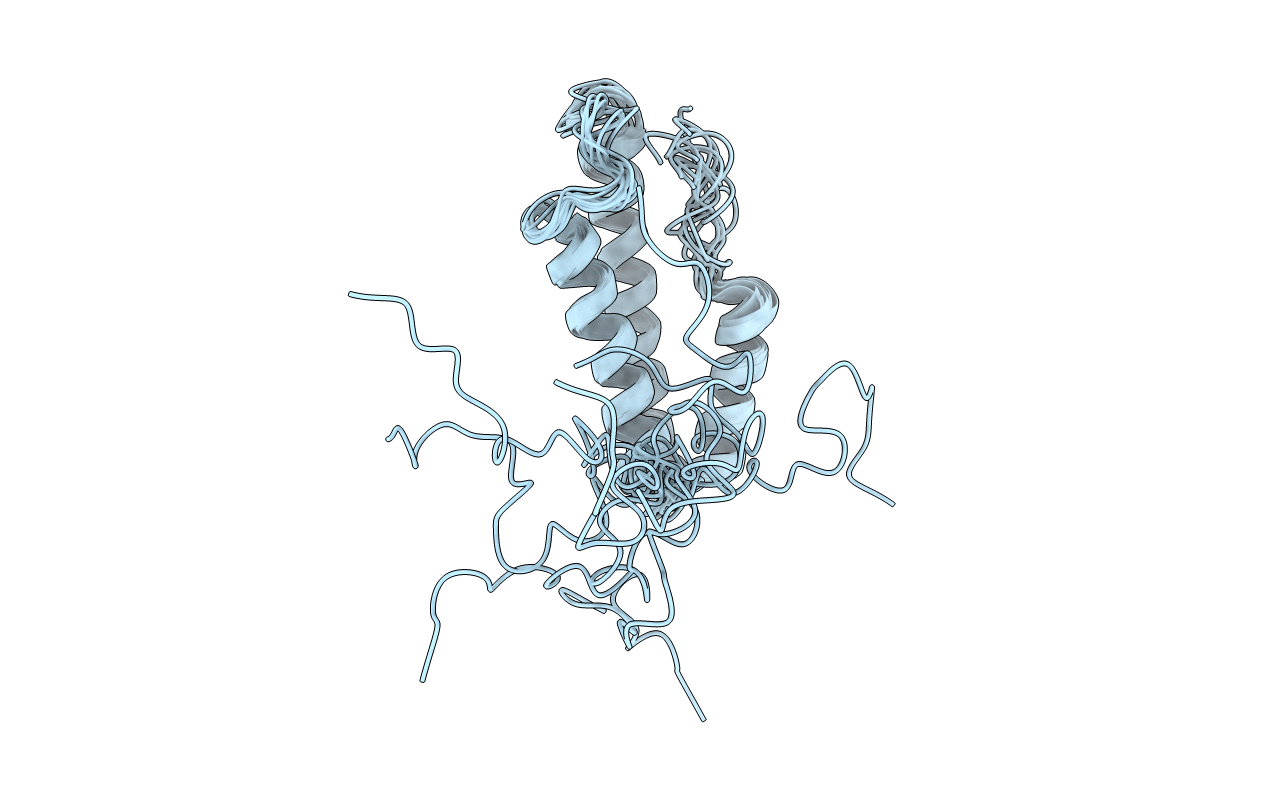
1YZC image
Deposition Date 2005-02-28
Release Date 2006-03-28
Last Version Date 2024-05-29
Entry Detail
PDB ID:
1YZC
Title:
The solution structure of a redesigned apocytochrome B562 (Rd-apocyt b562) with the N- and a part of the C-terminal helices unfolded
Biological Source:
Source Organism:
Homo sapiens (Taxon ID: 9606)
Host Organism:
Method Details:
Experimental Method:
Conformers Calculated:
100
Conformers Submitted:
10
Macromolecular Entities
Structures with similar UniProt ID
Protein Blast
Polymer Type:polypeptide(L)
Molecule:edesigned apo-cytochrome b562
Mutagens:W7D, L10G, L14G, V16G, I17G, I98G, Y101G, Y105G
Chain IDs:A
Chain Length:106
Number of Molecules:1
Biological Source:Homo sapiens
Ligand Molecules
Primary Citation
A protein folding pathway with multiple folding intermediates at atomic resolution
Proc.Natl.Acad.Sci.Usa 102 5026 5031 (2005)
PMID: 15793003 DOI: 10.1073/pnas.0501372102

Abstact

Using native-state hydrogen-exchange-directed protein engineering and multidimensional NMR, we determined the high-resolution structure (rms deviation, 1.1 angstroms) for an intermediate of the four-helix bundle protein: Rd-apocytochrome b562. The intermediate has the N-terminal helix and a part of the C-terminal helix unfolded. In earlier studies, we also solved the structures of two other folding intermediates for the same protein: one with the N-terminal helix alone unfolded and the other with a reorganized hydrophobic core. Together, these structures provide a description of a protein folding pathway with multiple intermediates at atomic resolution. The two general features for the intermediates are (i) native-like backbone topology and (ii) nonnative side-chain interactions. These results have implications for important issues in protein folding studies, including large-scale conformation search, -value analysis, and computer simulations.

Legend

Protein

Chemical

Disease

Primary Citation of related structures
Feedback Form
Name
Email
Institute
Feedback