1YZA image
Deposition Date 2005-02-28
Release Date 2005-08-28
Last Version Date 2024-05-29
Entry Detail
PDB ID:
1YZA
Title:
The solution structure of a redesigned apocytochrome B562 (Rd-apocyt b562) with the N-terminal helix unfolded
Biological Source:
Source Organism:
Homo sapiens (Taxon ID: 9606)
Host Organism:
Method Details:
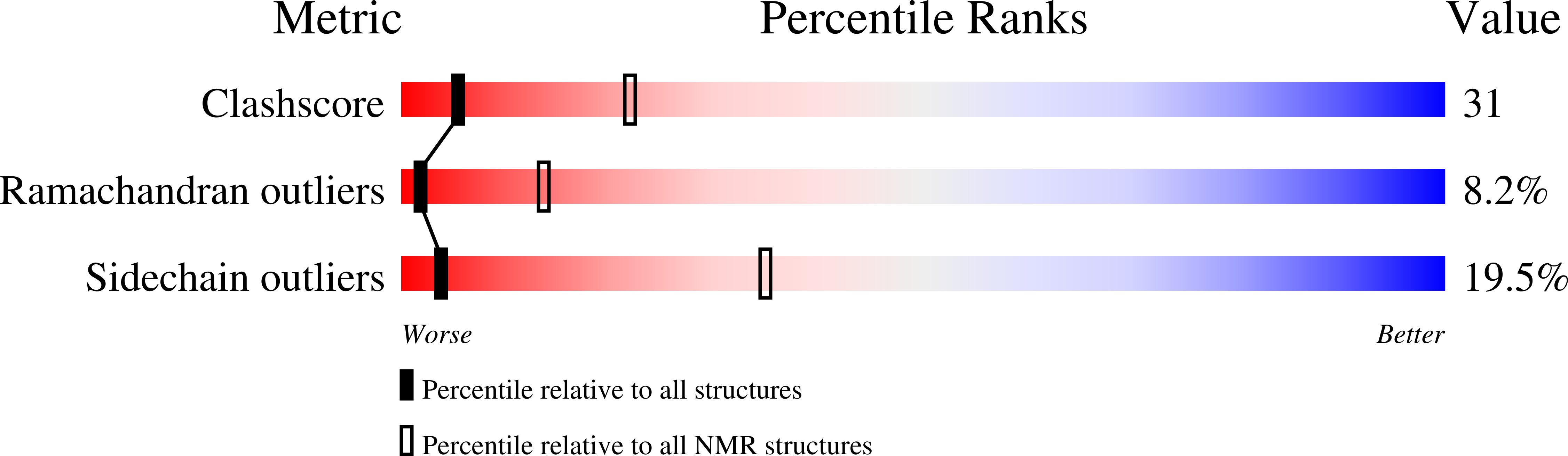
Experimental Method:
Conformers Calculated:
100
Conformers Submitted:
10
Macromolecular Entities
Structures with similar UniProt ID
Protein Blast
Polymer Type:polypeptide(L)
Molecule:Redesigned apo-cytochrome b562
Mutagens:W7D, L10G, L14G, V16G, I17G
Chain IDs:A
Chain Length:106
Number of Molecules:1
Biological Source:Homo sapiens
Ligand Molecules
Primary Citation
Specific non-native hydrophobic interactions in a hidden folding intermediate: implication for protein folding
Biochemistry 42 12461 12465 (2003)
PMID: 14580191 DOI: 10.1021/bi035561s

Abstact

Structures of intermediates and transition states in protein folding are usually characterized by amide hydrogen exchange and protein engineering methods and interpreted on the basis of the assumption that they have native-like conformations. We were able to stabilize and determine the high-resolution structure of a partially unfolded intermediate that exists after the rate-limiting step of a four-helix bundle protein, Rd-apocyt b(562), by multidimensional NMR methods. The intermediate has partial native-like secondary structure and backbone topology, consistent with our earlier native state hydrogen exchange results. However, non-native hydrophobic interactions exist throughout the structure. These and other results in the literature suggest that non-native hydrophobic interactions may occur generally in partially folded states. This can alter the interpretation of mutational protein engineering results in terms of native-like side chain interactions. In addition, since the intermediate exists after the rate-limiting step and Rd-apocyt b(562) folds very rapidly (k(f) approximately 10(4) s(-1)), these results suggest that non-native hydrophobic interactions, in the absence of topological misfolding, are repaired too rapidly to slow folding and cause the accumulation of folding intermediates. More generally, these results illustrate an approach for determining the high-resolution structure of folding intermediates.

Legend

Protein

Chemical

Disease

Primary Citation of related structures
Feedback Form
Name
Email
Institute
Feedback