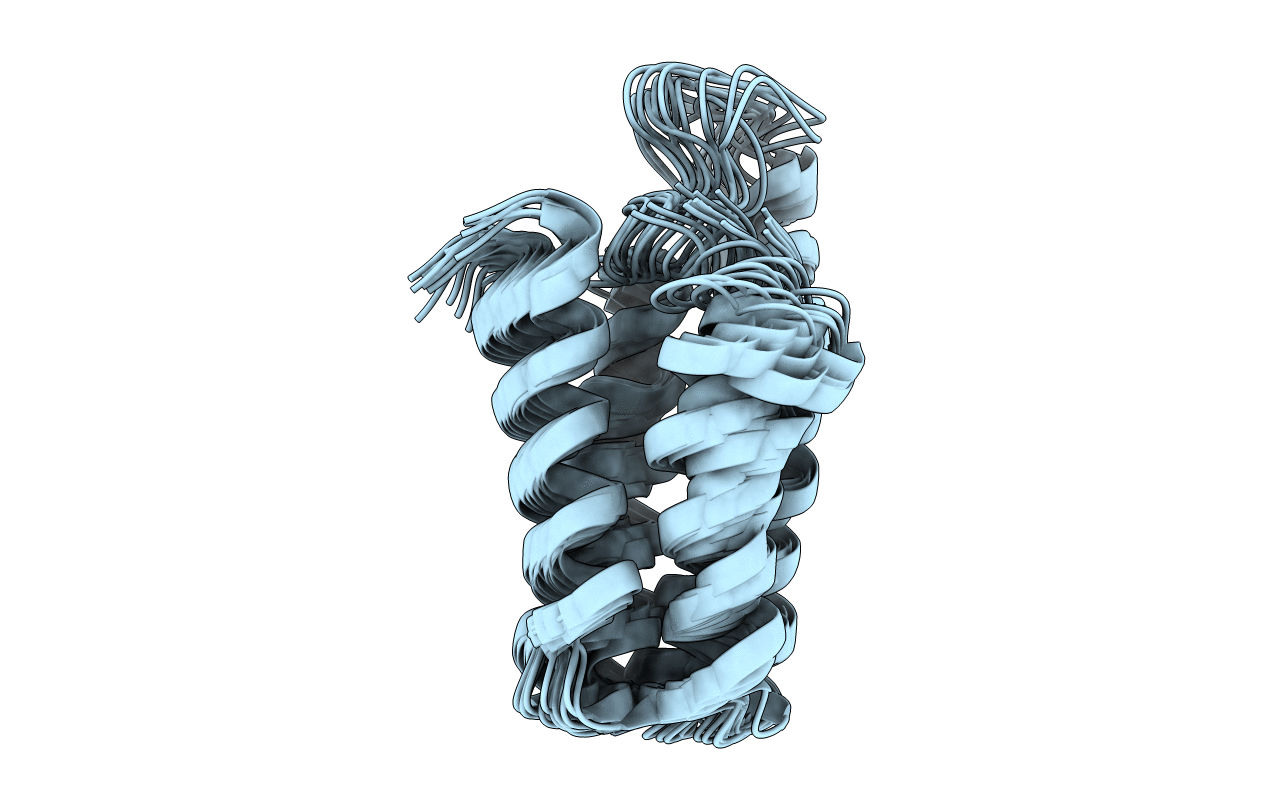
1YYX image
Deposition Date 2005-02-25
Release Date 2005-08-25
Last Version Date 2024-05-29
Entry Detail
PDB ID:
1YYX
Keywords:
Title:
The solution structure of a redesigned apocytochrome B562 (Rd-apocyt b562) at 2.8M urea
Biological Source:
Source Organism:
Method Details:
Experimental Method:
Conformers Calculated:
100
Conformers Submitted:
15
Macromolecular Entities
Polymer Type:polypeptide(L)
Molecule:Redesigned apo-cytochrome b562
Chain IDs:A
Chain Length:106
Number of Molecules:1
Biological Source:
Ligand Molecules
Primary Citation
Detection and structure determination of an equilibrium unfolding intermediates of Rd-apocytochrome b562: native fold with non-native hydrophobic interactions
J.Mol.Biol. 343 1477 1485 (2004)
PMID: 15491625 DOI: 10.1016/j.jmb.2004.08.099

Abstact

The absence of detectable kinetic and equilibrium folding intermediates by optical probes is commonly taken to indicate that protein folding is a two-state process. However, for some small proteins with apparent two-state behavior, unfolding intermediates have been identified in native-state hydrogen exchange or kinetic unfolding experiments monitored by nuclear magnetic resonance. Rd-apocytochrome b(562), a four-helix bundle, is one such protein. Here, we found another unfolding intermediate for Rd-apocytochrome b(562). It is based on a cooperative transition of (15)N chemical shifts of amide protons as a function of urea concentrations before the global unfolding. We have solved the high-resolution structure of the protein at 2.8 M urea, which is after this cooperative transition but before the global unfolding. All four helices remained intact, but a number of hydrophobic core residues repacked. This intermediate provides a possible structural interpretation for the kinetic unfolding intermediates observed using nuclear magnetic resonance methods for several proteins and has important implications for theoretical studies of protein folding.

Legend

Protein

Chemical

Disease

Primary Citation of related structures
Feedback Form
Name
Email
Institute
Feedback