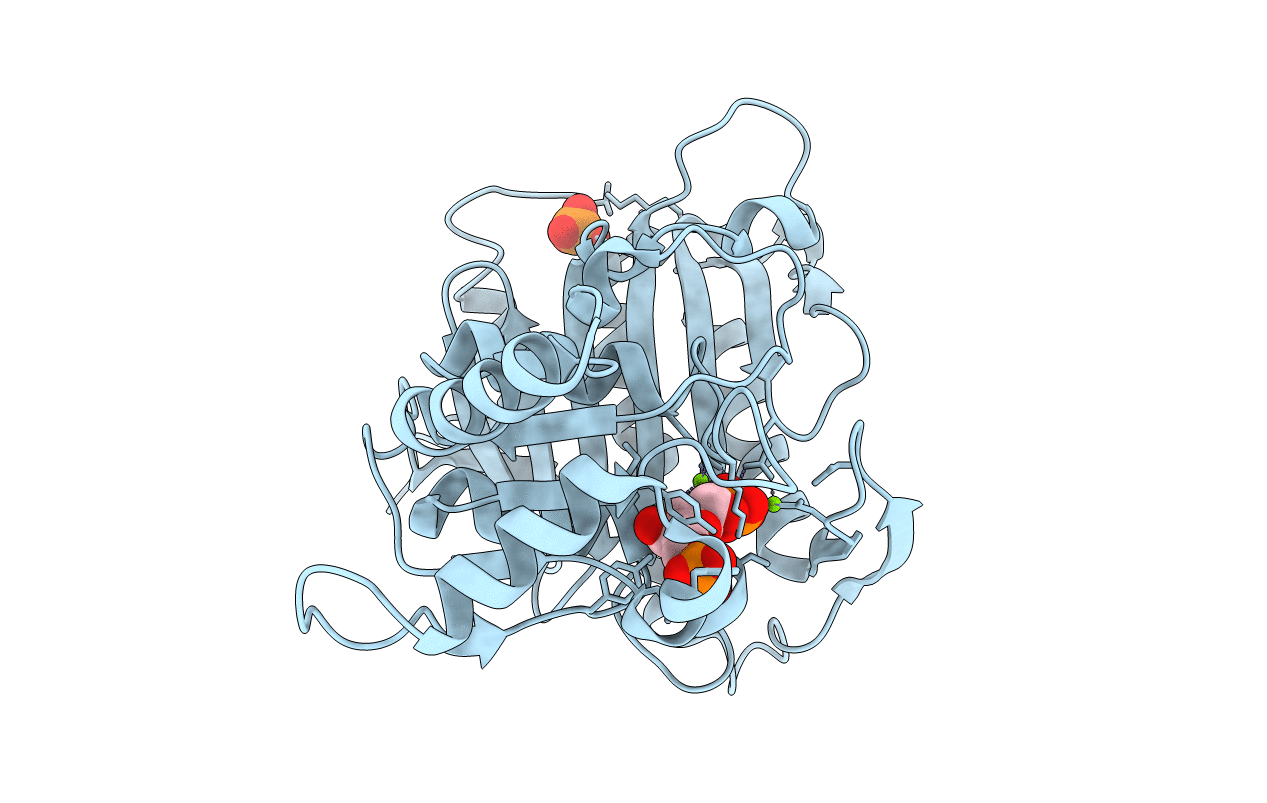
1YXI image
Deposition Date 2005-02-21
Release Date 2005-03-15
Last Version Date 2023-08-23
Entry Detail
PDB ID:
1YXI
Keywords:
Title:
R-State AMP Complex Reveals Initial Steps of the Quaternary Transition of Fructose-1,6-bisphosphatase
Biological Source:
Source Organism:
Sus scrofa (Taxon ID: 9823)
Host Organism:
Method Details:
Experimental Method:
Resolution:
2.00 Å
R-Value Free:
0.24
R-Value Work:
0.19
R-Value Observed:
0.19
Space Group:
I 2 2 2
Macromolecular Entities
Structures with similar UniProt ID
Protein Blast
Polymer Type:polypeptide(L)
Molecule:Fructose-1,6-bisphosphatase
Gene (Uniprot):FBP1
Mutagens:A54L
Chain IDs:A
Chain Length:337
Number of Molecules:1
Biological Source:Sus scrofa
Primary Citation
R-state AMP complex reveals initial steps of the quaternary transition of fructose-1,6-bisphosphatase.
J.Biol.Chem. 280 19737 19745 (2005)
PMID: 15767255 DOI: 10.1074/jbc.M501011200

Abstact

AMP transforms fructose-1,6-bisphosphatase from its active R-state to its inactive T-state; however, the mechanism of that transformation is poorly understood. The mutation of Ala(54) to leucine destabilizes the T-state of fructose-1,6-bisphosphatase. The mutant enzyme retains wild-type levels of activity, but the concentration of AMP that causes 50% inhibition increases 50-fold. In the absence of AMP, the Leu(54) enzyme adopts an R-state conformation nearly identical to that of the wild-type enzyme. The mutant enzyme, however, grows in two crystal forms in the presence of saturating AMP. In one form, the AMP-bound tetramer is in a T-like conformation, whereas in the other form, the AMP-bound tetramer is in a R-like conformation. The latter reveals conformational changes in two helices due to the binding of AMP. Helix H1 moves toward the center of the tetramer and displaces Ile(10) from a hydrophobic pocket. The displacement of Ile(10) exposes a hydrophobic surface critical to interactions that stabilize the T-state. Helix H2 moves away from the center of the tetramer, breaking hydrogen bonds with a buried loop (residues 187-195) in an adjacent subunit. The same hydrogen bonds reform but only after the quaternary transition to the T-state. Proposed here is a model that accounts for the quaternary transition and cooperativity in the inhibition of catalysis by AMP.

Legend

Protein

Chemical

Disease

Primary Citation of related structures
Feedback Form
Name
Email
Institute
Feedback