1YSC image
Deposition Date 1994-03-08
Release Date 1994-06-22
Last Version Date 2024-11-20
Entry Detail
PDB ID:
1YSC
Title:
2.8 ANGSTROMS STRUCTURE OF YEAST SERINE CARBOXYPEPTIDASE
Biological Source:
Source Organism:
Method Details:
Experimental Method:
Resolution:
2.80 Å
R-Value Observed:
0.16
Space Group:
P 21 3
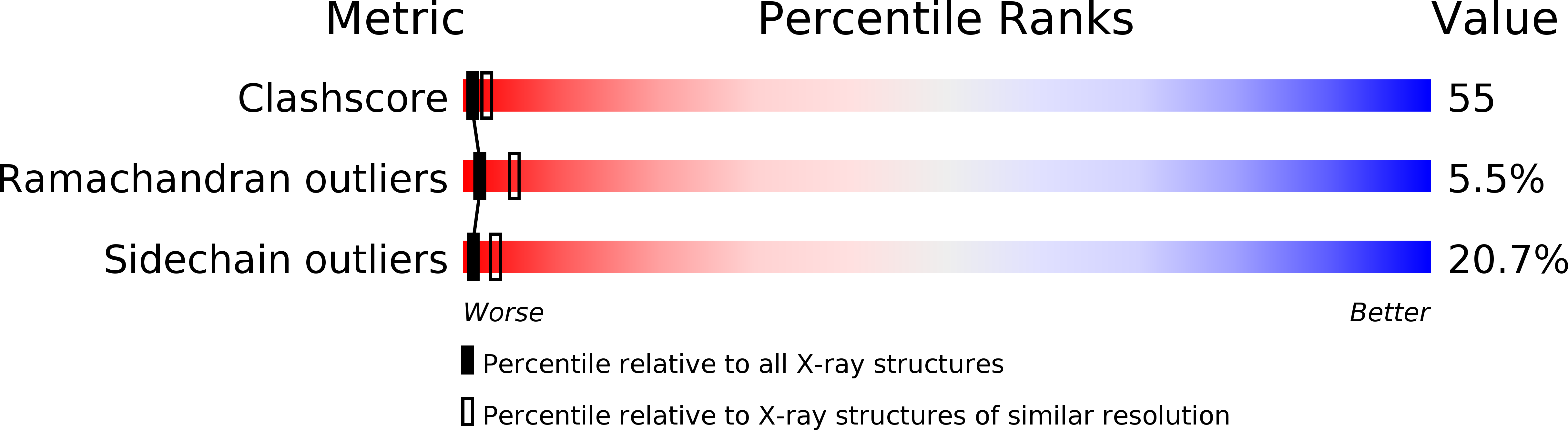
Macromolecular Entities
Structures with similar UniProt ID
Protein Blast
Polymer Type:polypeptide(L)
Molecule:SERINE CARBOXYPEPTIDASE
Gene (Uniprot):PRC1
Chain IDs:A
Chain Length:421
Number of Molecules:1
Biological Source:Saccharomyces cerevisiae
Modified Residue
Compound ID Chain ID Parent Comp ID Details 2D Image
ASN A ASN GLYCOSYLATION SITE
Ligand Molecules
Primary Citation
2.8-A structure of yeast serine carboxypeptidase
Biochemistry 33 11106 11120 (1994)
PMID: 7727362 DOI: 10.1021/bi00203a007

Abstact

The structure of monomeric serine carboxypeptidase from Saccharomyces cerevisiae (CPD-Y), deglycosylated by an efficient new procedure, has been determined by multiple isomorphous replacement and crystallographic refinement. The model contains 3333 non-hydrogen atoms, all 421 amino acids, 3 of 4 carbohydrate residues, 5 disulfide bridges, and 38 water molecules. The standard crystallographic R-factor is 0.162 for 10,909 reflections observed between 20.0- and 2.8-A resolution. The model has rms deviations from ideality of 0.016 A for bond lengths and 2.7 degrees for bond angles and from restrained thermal parameters of 7.9 A2. CPD-Y, which exhibits a preference for hydrophobic peptides, is distantly related to dimeric wheat serine carboxypeptidase II (CPD-WII), which has a preference for basic peptides. Comparison of the two structures suggests that substitution of hydrophobic residues in CPD-Y for negatively charged residues in CPD-WII in the binding site is largely responsible for this difference. Catalytic residues are in essentially identical configurations in the two molecules, including strained main-chain conformational angles for three active site residues (Ser 146, Gly 52, and Gly 53) and an unusual hydrogen bond between the carboxyl groups of Glu 145 and Glu 65. The binding of an inhibitor, benzylsuccinic acid, suggests that the C-terminal carboxylate binding site for peptide substrates is Asn 51, Gly 52, Glu 145, and His 397 and that the "oxyanion hole" consists of the amides of Gly 53 and Tyr 147. A surprising result of the study is that the domains consisting of residues 180-317, which form a largely alpha-helical insertion into the highly conserved cores surrounding the active site, are quite different structurally in the two molecules. It is suggested that these domains have evolved much more rapidly than other parts of the molecule and are involved in substrate recognition.

Legend

Protein

Chemical

Disease

Primary Citation of related structures
Feedback Form
Name
Email
Institute
Feedback