1YNT image
Deposition Date 2005-01-25
Release Date 2005-12-27
Last Version Date 2024-11-13
Entry Detail
PDB ID:
1YNT
Keywords:
Title:
Structure of the monomeric form of T. gondii SAG1 surface antigen bound to a human Fab
Biological Source:
Source Organism:
Host Organism:
Method Details:
Experimental Method:
Resolution:
3.10 Å
R-Value Free:
0.28
R-Value Work:
0.24
Space Group:
C 1 2 1
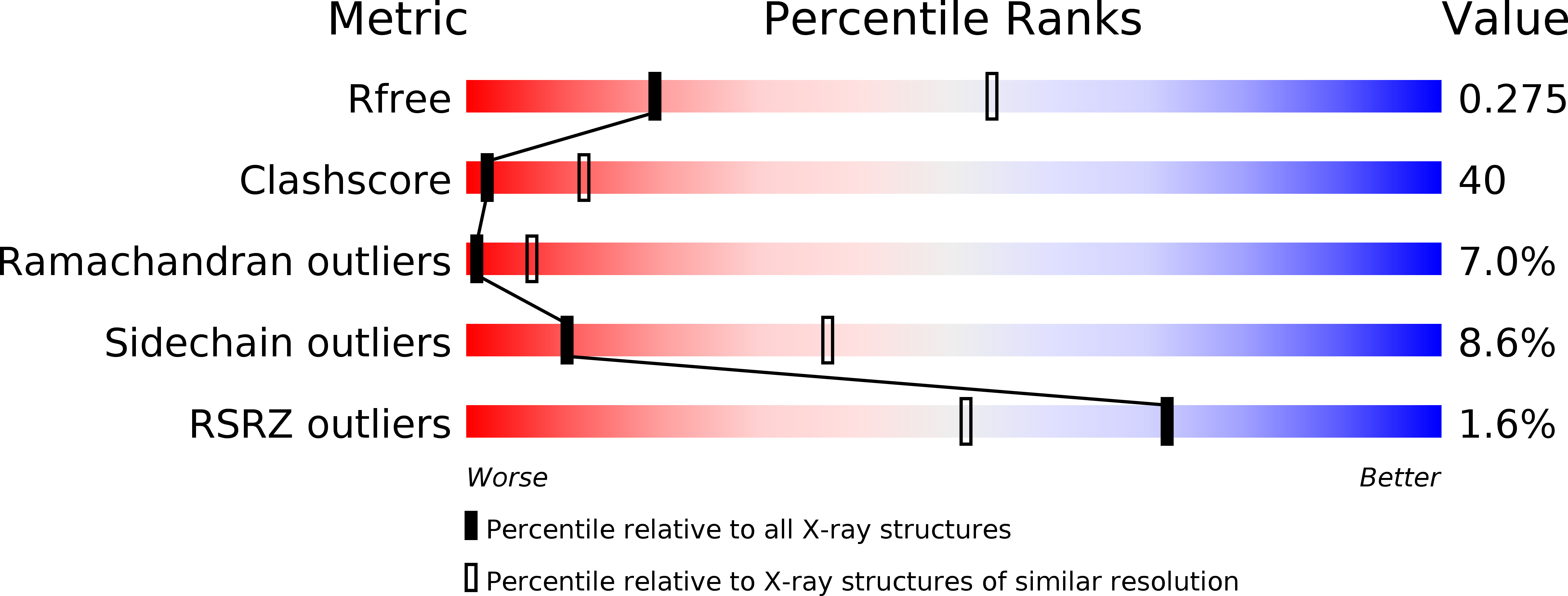
Macromolecular Entities
Polymer Type:polypeptide(L)
Molecule:4F11E12 Fab variable light chain region
Chain IDs:A, C
Chain Length:213
Number of Molecules:2
Biological Source:Mus musculus
Polymer Type:polypeptide(L)
Molecule:4F11E12 Fab variable heavy chain region
Chain IDs:B, D
Chain Length:218
Number of Molecules:2
Biological Source:Mus musculus
Structures with similar UniProt ID
Protein Blast
Polymer Type:polypeptide(L)
Molecule:protein L
Chain IDs:E
Chain Length:61
Number of Molecules:1
Biological Source:Finegoldia magna
Structures with similar UniProt ID
Protein Blast
Polymer Type:polypeptide(L)
Molecule:Major surface antigen p30
Chain IDs:F, G
Chain Length:254
Number of Molecules:2
Biological Source:Toxoplasma gondii
Ligand Molecules
Primary Citation
Crystal structure of the complex between the monomeric form of Toxoplasma gondii surface antigen 1 (SAG1) and a monoclonal antibody that mimics the human immune response
J.Mol.Biol. 354 447 458 (2005)
PMID: 16242717 DOI: 10.1016/j.jmb.2005.09.028

Abstact

Toxoplasma gondii, the intracellular parasite responsible for toxoplasmosis infects more than one-third of the world population and can be life-threatening for fetuses and immunocompromised patients. The surface protein SAG1 is an important immune target, which provides a strong immune response against the invasive tachyzoite while the other forms of the parasite, devoid of SAG1 at their surface, are multiplying. In addition to this role as a "hot spot" decoy, SAG1 is predicted to act as an adhesin during host-cell attachment through its binding to proteoglycans. To begin to understand the relationships between SAG1 epitopes and the ligand-binding site, we have solved the crystal structure of the monomeric form of T.gondii SAG1 complexed to a Fab derived from a monoclonal antibody raised against tachyzoite particles. This antibody competes strongly with human Toxoplasma-specific sera, suggesting that its epitope is part of an immunodominant region present on the surface of SAG1. The structure reveals that this conformational epitope, located within the SAG1 N-terminal domain, does not overlap with the proposed ligand-binding pocket. This study provides the first structural description of the monomeric form of SAG1, and significant insights into its dual role of adhesin and immune target during parasite infection.

Legend

Protein

Chemical

Disease

Primary Citation of related structures
Feedback Form
Name
Email
Institute
Feedback