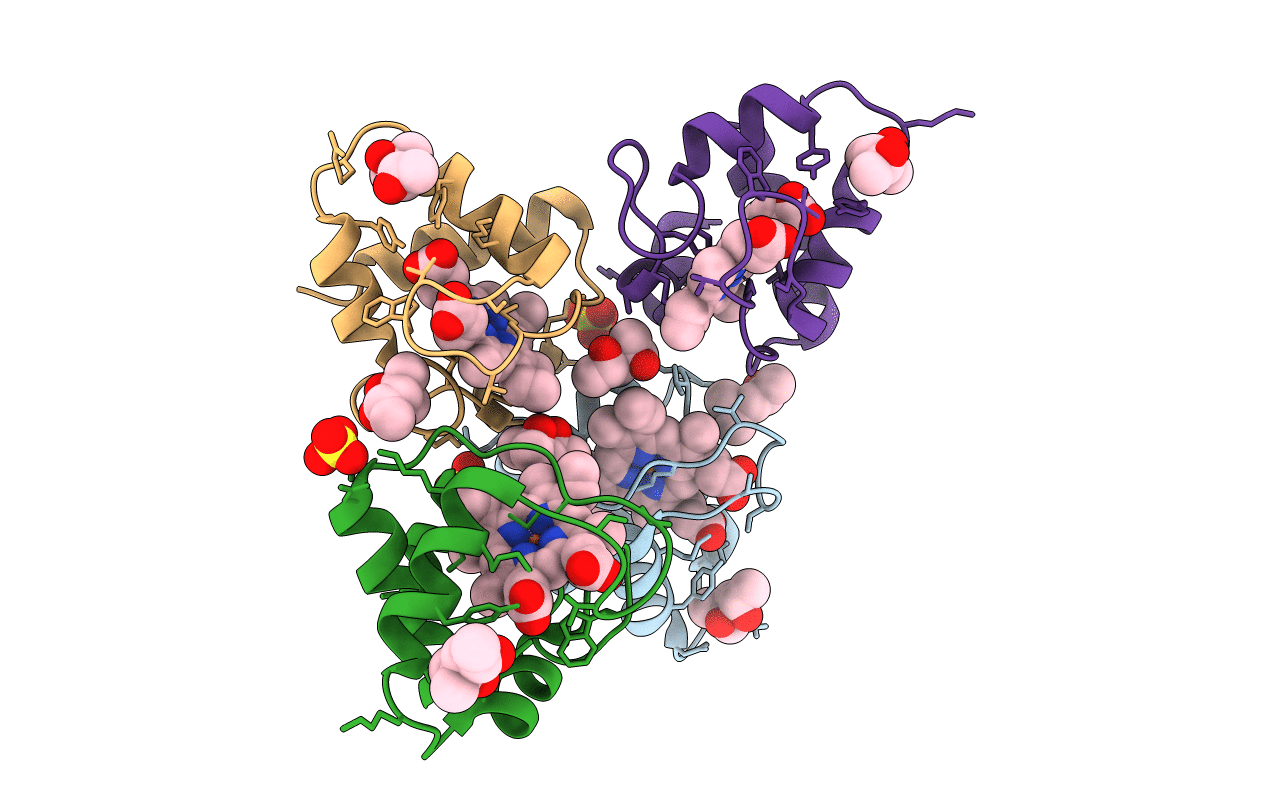
1YNR image
Deposition Date 2005-01-25
Release Date 2005-05-17
Last Version Date 2024-10-16
Entry Detail
PDB ID:
1YNR
Title:
Crystal structure of the cytochrome c-552 from Hydrogenobacter thermophilus at 2.0 resolution
Biological Source:
Source Organism:
Host Organism:
Method Details:
Experimental Method:
Resolution:
2.00 Å
R-Value Free:
0.21
R-Value Work:
0.17
R-Value Observed:
0.17
Space Group:
P 43 2 2

Macromolecular Entities
Structures with similar UniProt ID
Protein Blast
Polymer Type:polypeptide(L)
Molecule:Cytochrome c-552
Gene (Uniprot):HTH_0988, Hydth_0984
Chain IDs:A, B, C, D
Chain Length:80
Number of Molecules:4
Biological Source:Hydrogenobacter thermophilus
Primary Citation
An Obligatory Intermediate in the Folding Pathway of Cytochrome c552 from Hydrogenobacter thermophilus
J.Biol.Chem. 280 25729 25734 (2005)
PMID: 15883159 DOI: 10.1074/jbc.M502628200

Abstact

The folding mechanism of many proteins involves the population of partially organized structures en route to the native state. Identification and characterization of these intermediates is particularly difficult, as they are often only transiently populated and may play different mechanistic roles, being either on-pathway productive species or off-pathway kinetic traps. Following different spectroscopic probes, and employing state-of-the-art kinetic analysis, we present evidence that the folding mechanism of the thermostable cytochrome c552 from Hydrogenobacter thermophilus does involve the presence of an elusive, yet compact, on-pathway intermediate. Characterization of the folding mechanism of this cytochrome c is particularly interesting for the purpose of comparative folding studies, because H. thermophilus cytochrome c552 shares high sequence identity and structural homology with its homologue from the mesophilic bacterium Pseudomonas aeruginosa cytochrome c551, which refolds through a broad energy barrier without the accumulation of intermediates. Analysis of the folding kinetics and correlation with the three-dimensional structure add new evidence for the validity of a consensus folding mechanism in the cytochrome c family.

Legend

Protein

Chemical

Disease

Primary Citation of related structures
Feedback Form
Name
Email
Institute
Feedback