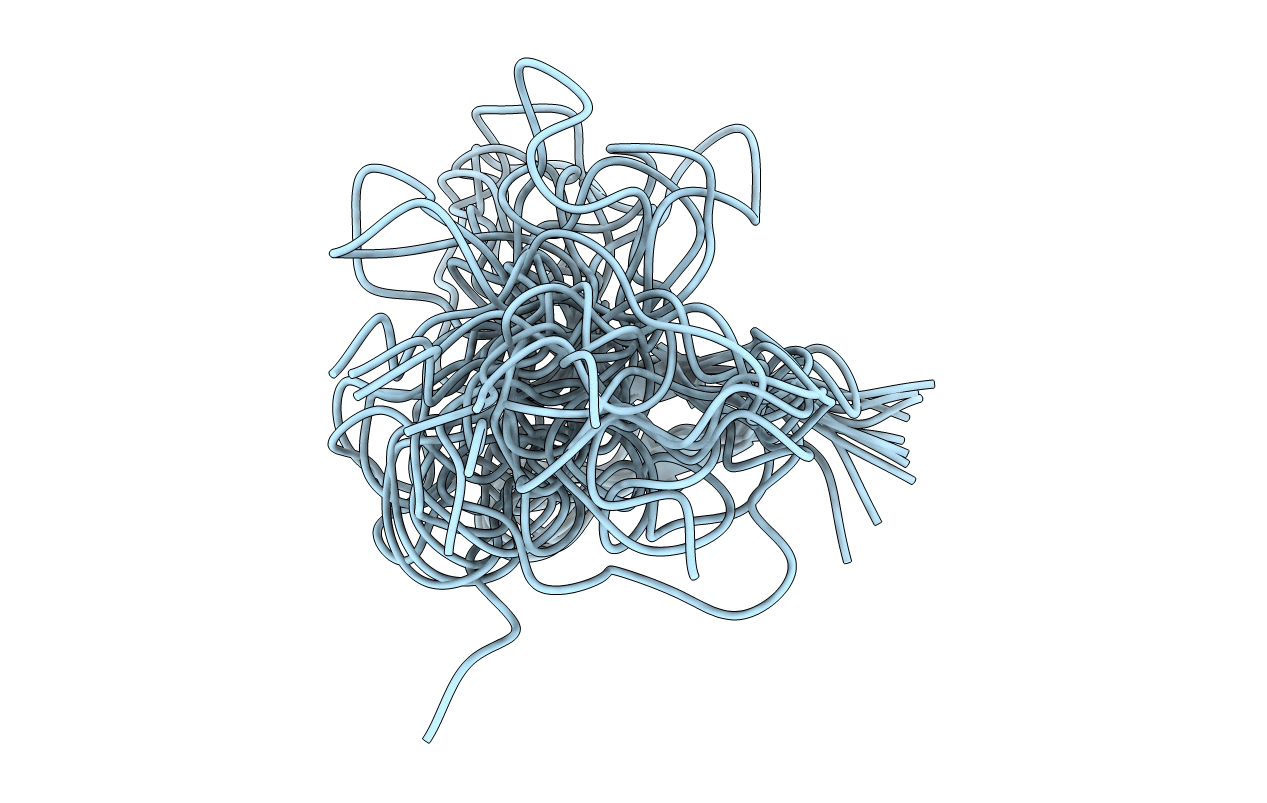
1Y2Y image
Deposition Date 2004-11-23
Release Date 2005-12-06
Last Version Date 2024-05-22
Entry Detail
PDB ID:
1Y2Y
Title:
Structural Characterization of Nop10p using Nuclear Magnetic Resonance Spectroscopy
Biological Source:
Source Organism:
Host Organism:
Method Details:
Experimental Method:
Conformers Calculated:
30
Conformers Submitted:
10
Selection Criteria:
structures with the lowest energy
Macromolecular Entities
Structures with similar UniProt ID
Protein Blast
Polymer Type:polypeptide(L)
Molecule:Ribosome biogenesis protein Nop10
Gene (Uniprot):NOP10
Chain IDs:A
Chain Length:58
Number of Molecules:1
Biological Source:Saccharomyces cerevisiae
Ligand Molecules
Primary Citation
Structural study of the H/ACA snoRNP components Nop10p and the 3' hairpin of U65 snoRNA
RNA 12 40 52 (2006)
PMID: 16373493 DOI: 10.1261/rna.2221606

Abstact

The H/ACA small nucleolar ribonucleoprotein (snoRNP) complexes guide the modification of uridine to pseudouridine at conserved sites in rRNA. The H/ACA snoRNPs each comprise a target-site-specific snoRNA and four core proteins, Nop10p, Nhp2p, Gar1p, and the pseudouridine synthase, Cbf5p, in yeast. The secondary structure of the H/ACA snoRNAs includes two hairpins that each contain a large internal loop (the pseudouridylation pocket), one or both of which are partially complementary to the target RNA(s). We have determined the solution structure of an RNA hairpin derived from the human U65 box H/ACA snoRNA including the pseudouridylation pocket and adjacent stems, providing the first three-dimensional structural information on these H/ACA snoRNAs. We have also determined the structure of Nop10p and investigated its interaction with RNA using NMR spectroscopy. Nop10p contains a structurally well-defined N-terminal region composed of a beta-hairpin, and the rest of the protein lacks a globular structure. Chemical shift mapping of the interaction of RNA constructs of U65 box H/ACA 3' hairpin with Nop10p shows that the beta-hairpin binds weakly but specifically to RNA. The unstructured region of Nop10p likely interacts with Cbf5p.

Legend

Protein

Chemical

Disease

Primary Citation of related structures
Feedback Form
Name
Email
Institute
Feedback