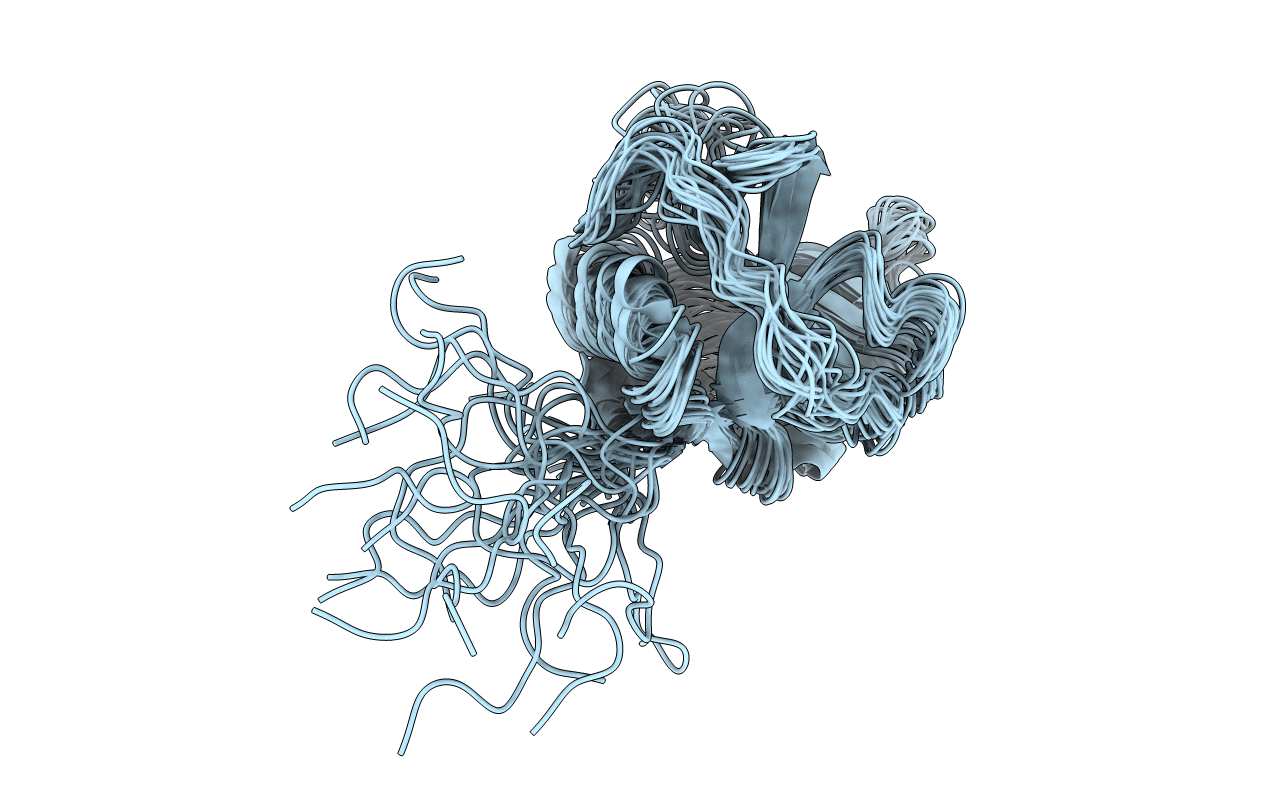
1XWN image
Deposition Date 2004-11-01
Release Date 2005-10-18
Last Version Date 2024-05-29
Entry Detail
PDB ID:
1XWN
Keywords:
Title:
solution structure of cyclophilin like 1(PPIL1) and insights into its interaction with SKIP
Biological Source:
Source Organism:
Homo sapiens (Taxon ID: 9606)
Method Details:
Experimental Method:
Conformers Calculated:
100
Conformers Submitted:
20
Selection Criteria:
structures with the lowest energy

Macromolecular Entities
Structures with similar UniProt ID
Protein Blast
Polymer Type:polypeptide(L)
Molecule:Peptidyl-prolyl cis-trans isomerase like 1
Gene (Uniprot):PPIL1
Chain IDs:A
Chain Length:174
Number of Molecules:1
Biological Source:Homo sapiens
Ligand Molecules
Primary Citation
Solution structure of human peptidyl prolyl isomerase like protein 1 and insights into its interaction with SKIP
J.Biol.Chem. 281 15900 15908 (2006)
PMID: 16595688 DOI: 10.1074/jbc.M511155200

Abstact

The human PPIL1 (peptidyl prolyl isomerase-like protein 1) is a specific component of human 35 S U5 small nuclear ribonucleoprotein particle and 45 S activated spliceosome. It is recruited by SKIP, another essential component of 45 S activated spliceosome, into spliceosome just before the catalytic step 1. It stably associates with SKIP, which also exists in 35 S and activated spliceosome as a nuclear matrix protein. We report here the solution structure of PPIL1 determined by NMR spectroscopy. The structure of PPIL1 resembles other members of the cyclophilin family and exhibits PPIase activity. To investigate its interaction with SKIP in vitro, we identified the SKIP contact region by GST pulldown experiments and surface plasmon resonance. We provide direct evidence of PPIL1 stably associated with SKIP. The dissociation constant is 1.25 x 10(-7) M for the N-terminal peptide of SKIP-(59-129) with PPIL1. We also used chemical shift perturbation experiments to show the possible SKIP binding interface on PPIL1. These results illustrated that a novel cyclophilin-protein contact mode exists in the PPIL1-SKIP complex during activation of the spliceosome. The biological implication of this binding with spliceosome rearrangement during activation is discussed.

Legend

Protein

Chemical

Disease

Primary Citation of related structures
Feedback Form
Name
Email
Institute
Feedback