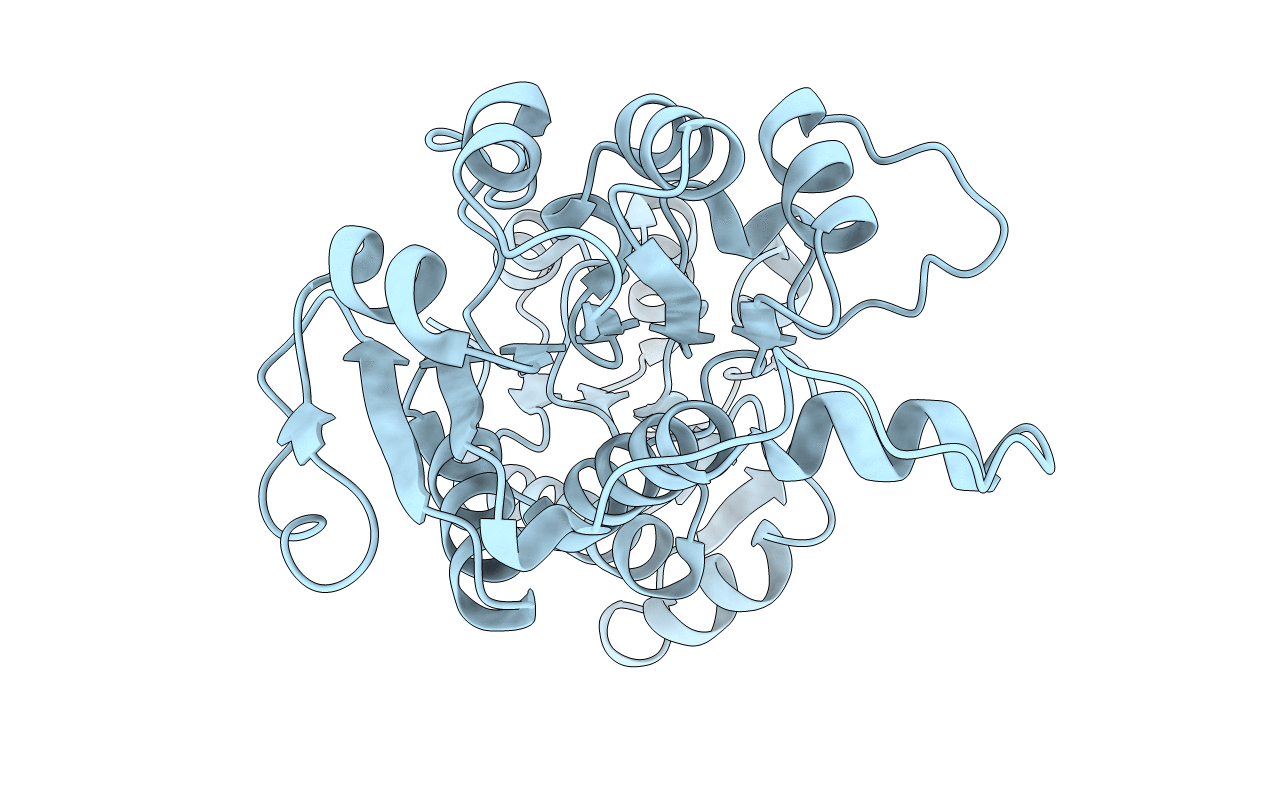
1XDW image
Deposition Date 2004-09-08
Release Date 2005-03-08
Last Version Date 2024-02-14
Entry Detail
PDB ID:
1XDW
Keywords:
Title:
NAD+-dependent (R)-2-Hydroxyglutarate Dehydrogenase from Acidaminococcus fermentans
Biological Source:
Source Organism(s):
Expression System(s):
Method Details:
Experimental Method:
Resolution:
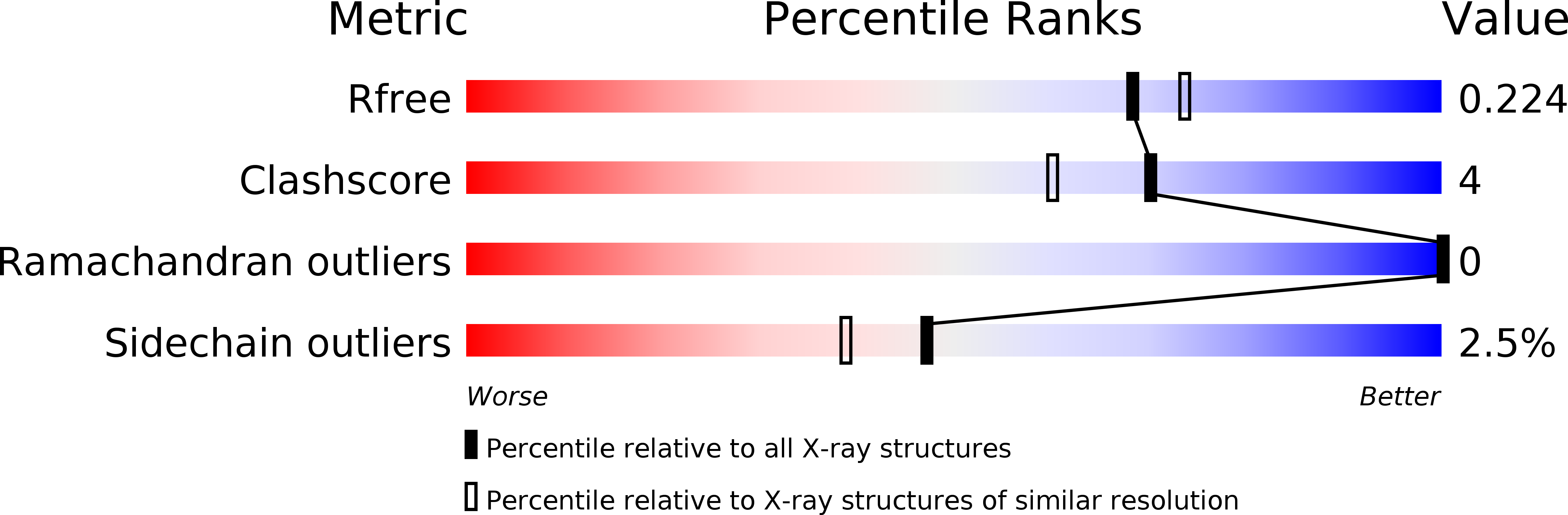
1.98 Å
R-Value Free:
0.22
R-Value Work:
0.17
R-Value Observed:
0.17
Space Group:
P 61 2 2
Macromolecular Entities
Polymer Type:polypeptide(L)
Molecule:NAD+-dependent (R)-2-Hydroxyglutarate Dehydrogenase
Chain IDs:A
Chain Length:331
Number of Molecules:1
Biological Source:Acidaminococcus fermentans
Primary Citation
Structural basis for stereo-specific catalysis in NAD(+)-dependent (R)-2-hydroxyglutarate dehydrogenase from Acidaminococcus fermentans.
Febs J. 272 269 281 (2005)
PMID: 15634349 DOI: 10.1111/j.1432-1033.2004.04417.x

Abstact

NAD(+)-dependent (R)-2-hydroxyglutarate dehydrogenase (HGDH) catalyses the reduction of 2-oxoglutarate to (R)-2-hydroxyglutarate and belongs to the d-2-hydroxyacid NAD(+)-dependent dehydrogenase (d-2-hydroxyacid dehydrogenase) protein family. Its crystal structure was determined by phase combination to 1.98 A resolution. Structure-function relationships obtained by the comparison of HGDH with other members of the d-2-hydroxyacid dehydrogenase family give a chemically satisfying view of the substrate stereoselectivity and catalytic requirements for the hydride transfer reaction. A model for substrate recognition and turnover is discussed. The HGDH active site architecture is structurally optimized to recognize and bind the negatively charged substrate 2-oxoglutarate. The structural position of the side chain of Arg52, and its counterparts in other family members, strongly correlates with substrate specificity towards substitutions at the C3 atom (linear or branched substrates). Arg235 interacts with the substrate's alpha-carboxylate and carbonyl groups, having a dual role in both substrate binding and activation, and the gamma-carboxylate group can dock at an arginine cluster. The proton-relay system built up by Glu264 and His297 permits His297 to act as acid-base catalyst and the 4Re-hydrogen from NADH is transferred as hydride to the carbonyl group Si-face leading to the formation of the correct enantiomer (R)-2-hydroxyglutarate.

Legend

Protein

Chemical

Disease

Primary Citation of related structures
Feedback Form
Name
Email
Institute
Feedback