1WZD image
Deposition Date 2005-03-04
Release Date 2006-02-21
Last Version Date 2024-03-13
Entry Detail
PDB ID:
1WZD
Keywords:
Title:
Crystal Structure Of An Artificial Metalloprotein: Fe(10-CH2CH2COOH-Salophen)/Wild Type Heme oxygenase
Biological Source:
Source Organism:
Method Details:
Experimental Method:
Resolution:
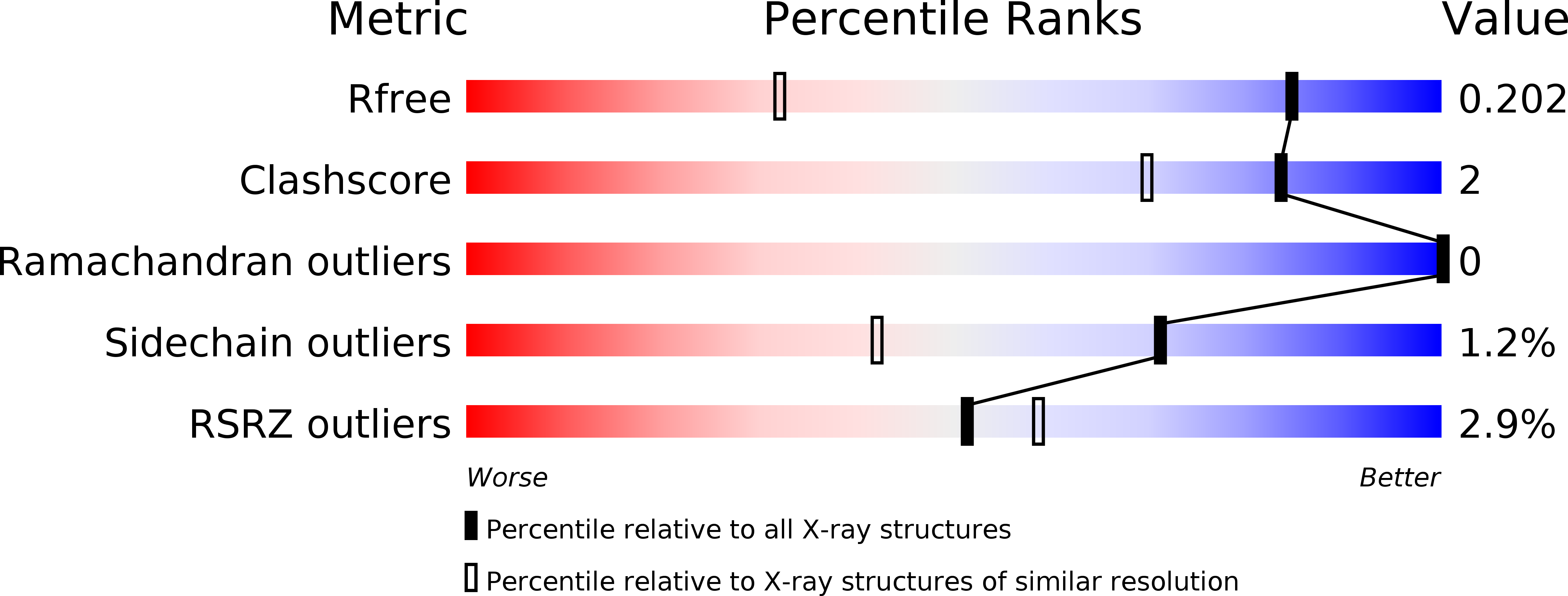
1.35 Å
R-Value Free:
0.20
R-Value Work:
0.17
R-Value Observed:
0.17
Space Group:
P 1 21 1
Macromolecular Entities
Structures with similar UniProt ID
Protein Blast
Polymer Type:polypeptide(L)
Molecule:Heme oxygenase
Chain IDs:A, B
Chain Length:215
Number of Molecules:2
Biological Source:Corynebacterium diphtheriae
Primary Citation
Design of metal cofactors activated by a protein-protein electron transfer system.
Proc.Natl.Acad.Sci.Usa 103 9416 9421 (2006)
PMID: 16769893 DOI: 10.1073/pnas.0510968103

Abstact

Protein-to-protein electron transfer (ET) is a critical process in biological chemistry for which fundamental understanding is expected to provide a wealth of applications in biotechnology. Investigations of protein-protein ET systems in reductive activation of artificial cofactors introduced into proteins remains particularly challenging because of the complexity of interactions between the cofactor and the system contributing to ET. In this work, we construct an artificial protein-protein ET system, using heme oxygenase (HO), which is known to catalyze the conversion of heme to biliverdin. HO uses electrons provided from NADPH/cytochrome P450 reductase (CPR) through protein-protein complex formation during the enzymatic reaction. We report that a Fe(III)(Schiff-base), in the place of the active-site heme prosthetic group of HO, can be reduced by NADPH/CPR. The crystal structure of the Fe(10-CH(2)CH(2)COOH-Schiff-base).HO composite indicates the presence of a hydrogen bond between the propionic acid carboxyl group and Arg-177 of HO. Furthermore, the ET rate from NADPH/CPR to the composite is 3.5-fold faster than that of Fe(Schiff-base).HO, although the redox potential of Fe(10-CH(2)CH(2)COOH-Schiff-base).HO (-79 mV vs. NHE) is lower than that of Fe(Schiff-base).HO (+15 mV vs. NHE), where NHE is normal hydrogen electrode. This work describes a synthetic metal complex activated by means of a protein-protein ET system, which has not previously been reported. Moreover, the result suggests the importance of the hydrogen bond for the ET reaction of HO. Our Fe(Schiff-base).HO composite model system may provide insights with regard to design of ET biosystems for sensors, catalysts, and electronics devices.

Legend

Protein

Chemical

Disease

Primary Citation of related structures
Feedback Form
Name
Email
Institute
Feedback