1WLK image
Deposition Date 2004-06-28
Release Date 2005-07-19
Last Version Date 2024-05-29
Entry Detail
PDB ID:
1WLK
Title:
L122E mutant of FMN-binding protein from Desulfovibrio vulgaris (Miyazaki F)
Biological Source:
Source Organism:
Host Organism:
Method Details:
Experimental Method:
Resolution:
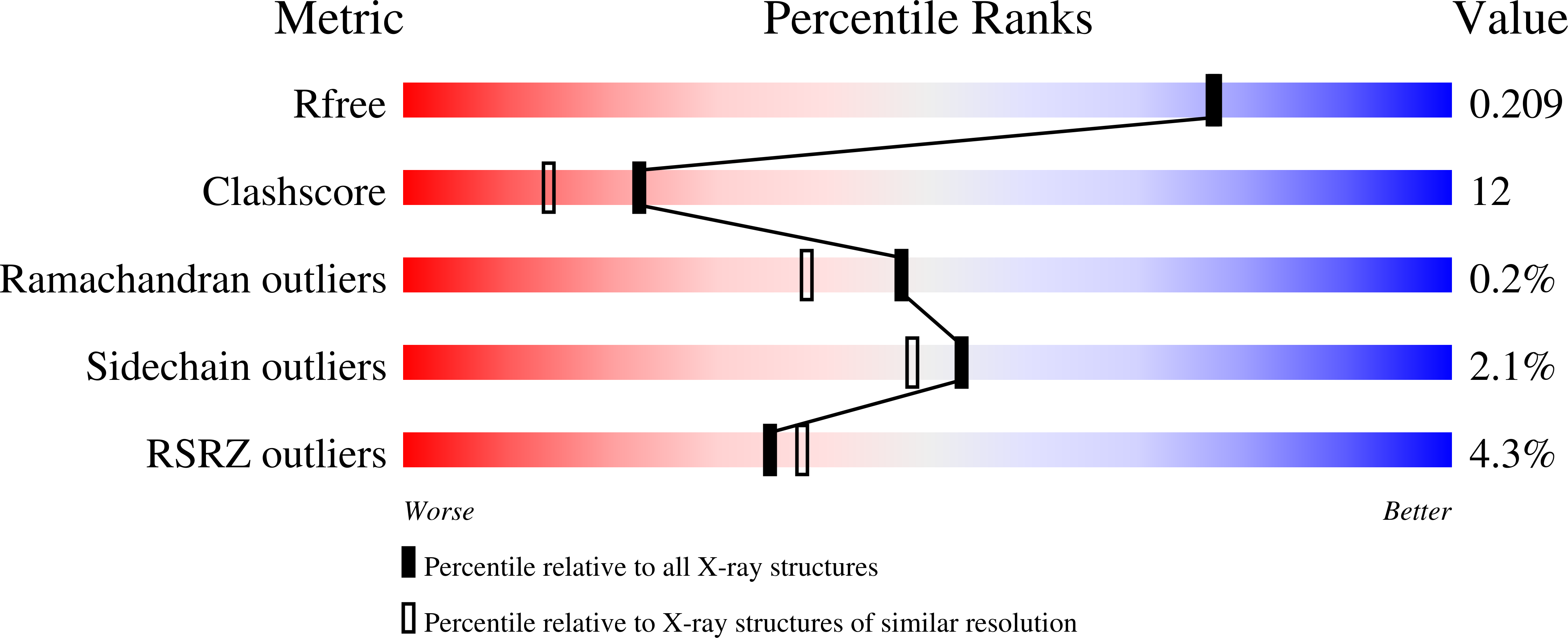
1.90 Å
R-Value Free:
0.21
R-Value Work:
0.18
R-Value Observed:
0.18
Space Group:
P 1 21 1
Macromolecular Entities
Structures with similar UniProt ID
Protein Blast
Polymer Type:polypeptide(L)
Molecule:FMN-binding protein
Gene (Uniprot):DvMF_2023
Mutagens:L122E
Chain IDs:A, B, C, D
Chain Length:122
Number of Molecules:4
Biological Source:Desulfovibrio vulgaris str. 'Miyazaki F'
Ligand Molecules
Primary Citation
Determination of the role of the Carboxyl-terminal leucine-122 in FMN-binding protein by mutational and structural analysis.
J.Biochem. 141 459 468 (2007)
PMID: 17261542 DOI: 10.1093/jb/mvm051

Abstact

Mutants of flavin mononucleotide-binding protein (FMN-bp) were made by site-directed mutagenesis to investigate the role of carboxyl-terminal Leu122 of the pairing subunit in controlling redox potentials, binding the prosthetic group, and forming the tertiary and quaternary structure. We compared the oxidation-reduction potentials, FMN-binding properties, and higher structures of wild-type FMN-bp and four mutant proteins (L122Y, L122E, L122K and L122-deleted). We found that the redox potentials were affected by mutations. Also, the affinities of L122E, L122K and L122 deletion mutant apoproteins for FMN were lower than for the wild-type apoprotein, whereas the affinity of L122Y for FMN was increased. Analytical ultracentrifugation showed that the dissociation constants for dimerization of L122E and L122K were larger than for wild-type FMN-bp, whereas the dissociation constants for L122Y and the deletion mutant were lower than for the wild type. Finally, we determined the higher structures of L122Y, L122E and L122K mutants by X-ray crystallography. Our results show that the mutation of Leu122 in FMN-bp changes midpoint potentials, dissociation constants for FMN, and dimer formation, indicating that this residue is important in the pairing subunit.

Legend

Protein

Chemical

Disease

Primary Citation of related structures
Feedback Form
Name
Email
Institute
Feedback