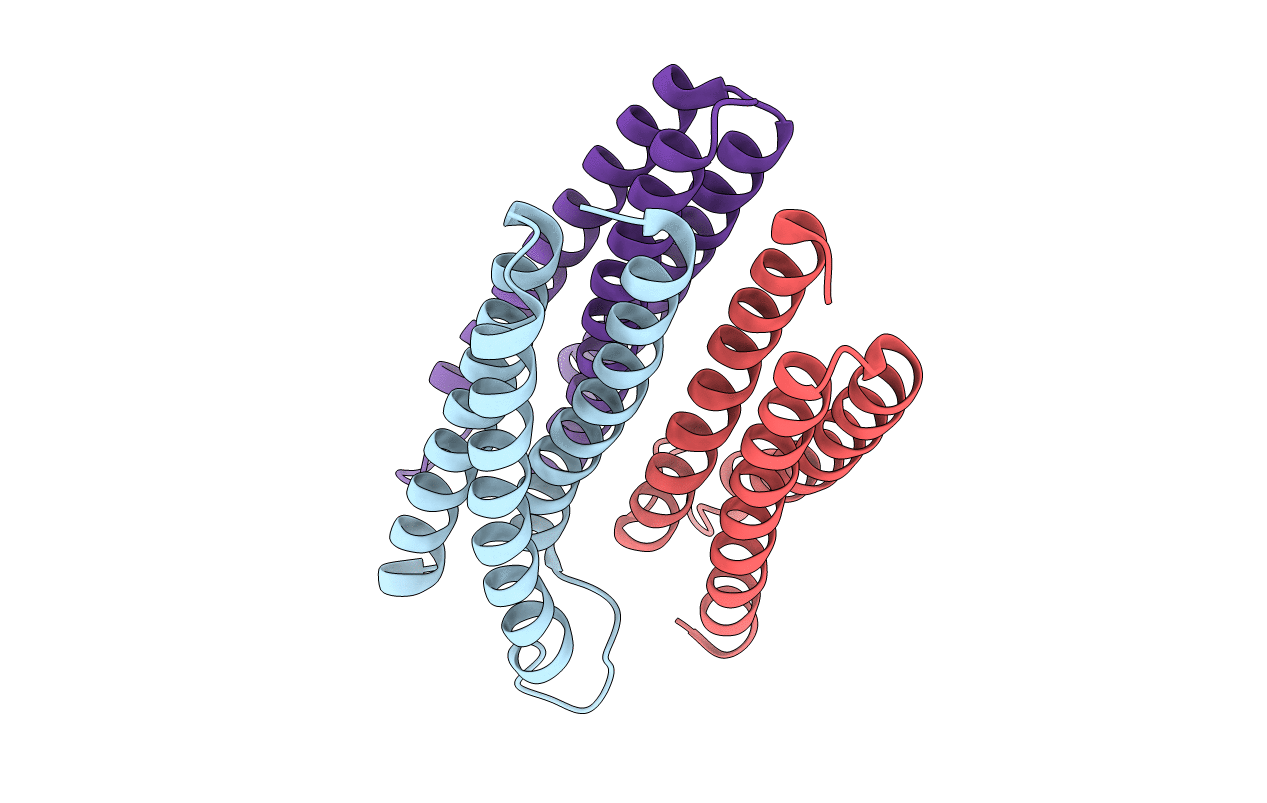
1WCR image
Deposition Date 2004-11-19
Release Date 2005-01-19
Last Version Date 2024-05-15
Entry Detail
PDB ID:
1WCR
Keywords:
Title:
Trimeric Structure of the Enzyme IIA from Escherichia coli Phosphotransferase System Specific for N,N'-Diacetylchitobiose
Biological Source:
Source Organism(s):
ESCHERICHIA COLI (Taxon ID: 562)
Expression System(s):
Method Details:
Experimental Method:
Conformers Calculated:
100
Conformers Submitted:
1
Selection Criteria:
RESTRAINED REGULARIZED MEAN STRUCTURE

Macromolecular Entities
Structures with similar UniProt ID
Protein Blast
Polymer Type:polypeptide(L)
Molecule:PTS SYSTEM, N, N'-DIACETYLCHITOBIOSE-SPECIFIC IIA COMPONENT
Mutagens:YES
Chain IDs:A, B, C
Chain Length:103
Number of Molecules:3
Biological Source:ESCHERICHIA COLI
Ligand Molecules
Primary Citation
Solution Structure of Enzyme Iiachitobiose from the N,N'-Diacetylchitobiose Branch of the Escherichia Coli Phosphotransferase System
J.Biol.Chem. 280 11770 ? (2005)
PMID: 15654077 DOI: 10.1074/JBC.M414300200

Abstact

The solution structure of trimeric Escherichia coli enzyme IIA(Chb) (34 kDa), a component of the N,N'-diacetylchitobiose/lactose branch of the phosphotransferase signal transduction system, has been determined by NMR spectroscopy. Backbone residual dipolar couplings were used to provide long range orientational restraints, and long range (|i - j| > or = 5 residues) nuclear Overhauser enhancement restraints were derived exclusively from samples in which at least one subunit was 15N/13C/2H/(Val-Leu-Ile)-methyl-protonated. Each subunit consists of a three-helix bundle. Hydrophobic residues lining helix 3 of each subunit are largely responsible for the formation of a parallel coiled-coil trimer. The active site histidines (His-89 from each subunit) are located in three symmetrically placed deep crevices located at the interface of two adjacent subunits (A and C, C and B, and B and A). Partially shielded from bulk solvent, structural modeling suggests that phosphorylated His-89 is stabilized by electrostatic interactions with the side chains of His-93 from the same subunit and Gln-91 from the adjacent subunit. Comparison with the x-ray structure of Lactobacillus lactis IIA(Lac) reveals some substantial structural differences, particularly in regard to helix 3, which exhibits a 40 degrees kink in IIA(Lac) versus a 7 degrees bend in IIA(Chb). This is associated with the presence of an unusually large (230-angstroms3) buried hydrophobic cavity at the trimer interface in IIA(Lac) that is reduced to only 45 angstroms3) in IIA(Chb).

Legend

Protein

Chemical

Disease

Primary Citation of related structures
Feedback Form
Name
Email
Institute
Feedback