1W5R image
Deposition Date 2004-08-09
Release Date 2005-05-11
Last Version Date 2024-05-08
Entry Detail
PDB ID:
1W5R
Keywords:
Title:
X-ray crystallographic structure of a C70Q Mycobacterium smegmatis N- arylamine Acetyltransferase
Biological Source:
Source Organism:
Host Organism:
Method Details:
Experimental Method:
Resolution:
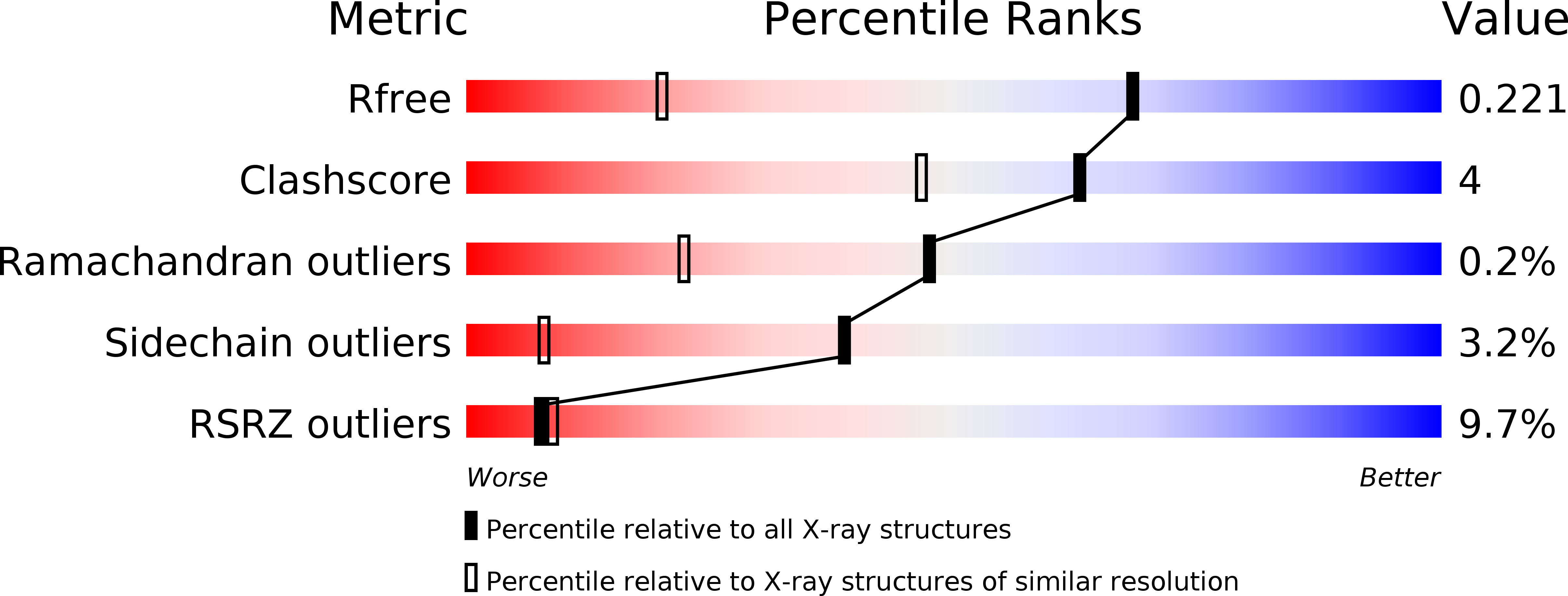
1.45 Å
R-Value Free:
0.22
R-Value Work:
0.19
R-Value Observed:
0.19
Space Group:
P 41 21 2
Macromolecular Entities
Structures with similar UniProt ID
Protein Blast
Polymer Type:polypeptide(L)
Molecule:ARYLAMINE N-ACETYLTRANSFERASE
Gene (Uniprot):nat
Mutagens:YES
Chain IDs:A, B
Chain Length:278
Number of Molecules:2
Biological Source:MYCOBACTERIUM SMEGMATIS
Primary Citation
Investigation of the Catalytic Triad of Arylamine N-Acetyltransferases: Essential Residues Required for Acetyl Transfer to Arylamines.
Biochem.J. 390 115 ? (2005)
PMID: 15869465 DOI: 10.1042/BJ20050277

Abstact

The NATs (arylamine N-acetyltransferases) are a well documented family of enzymes found in both prokaryotes and eukaryotes. NATs are responsible for the acetylation of a range of arylamine, arylhydrazine and hydrazine compounds. We present here an investigation into the catalytic triad of residues (Cys-His-Asp) and other structural features of NATs using a variety of methods, including site-directed mutagenesis, X-ray crystallography and bioinformatics analysis, in order to investigate whether each of the residues of the catalytic triad is essential for catalytic activity. The catalytic triad of residues, Cys-His-Asp, is a well defined motif present in several families of enzymes. We mutated each of the catalytic residues in turn to investigate the role they play in catalysis. We also mutated a key residue, Gly126, implicated in acetyl-CoA binding, to examine the effects on acetylation activity. In addition, we have solved the structure of a C70Q mutant of Mycobacterium smegmatis NAT to a resolution of 1.45 A (where 1 A=0.1 nm). This structure confirms that the mutated protein is correctly folded, and provides a structural model for an acetylated NAT intermediate. Our bioinformatics investigation analysed the extent of sequence conservation between all eukaryotic and prokaryotic NAT enzymes for which sequence data are available. This revealed several new sequences, not yet reported, of NAT paralogues. Together, these studies have provided insight into the fundamental core of NAT enzymes, and the regions where sequence differences account for the functional diversity of this family. We have confirmed that each of the three residues of the triad is essential for acetylation activity.

Legend

Protein

Chemical

Disease

Primary Citation of related structures
Feedback Form
Name
Email
Institute
Feedback