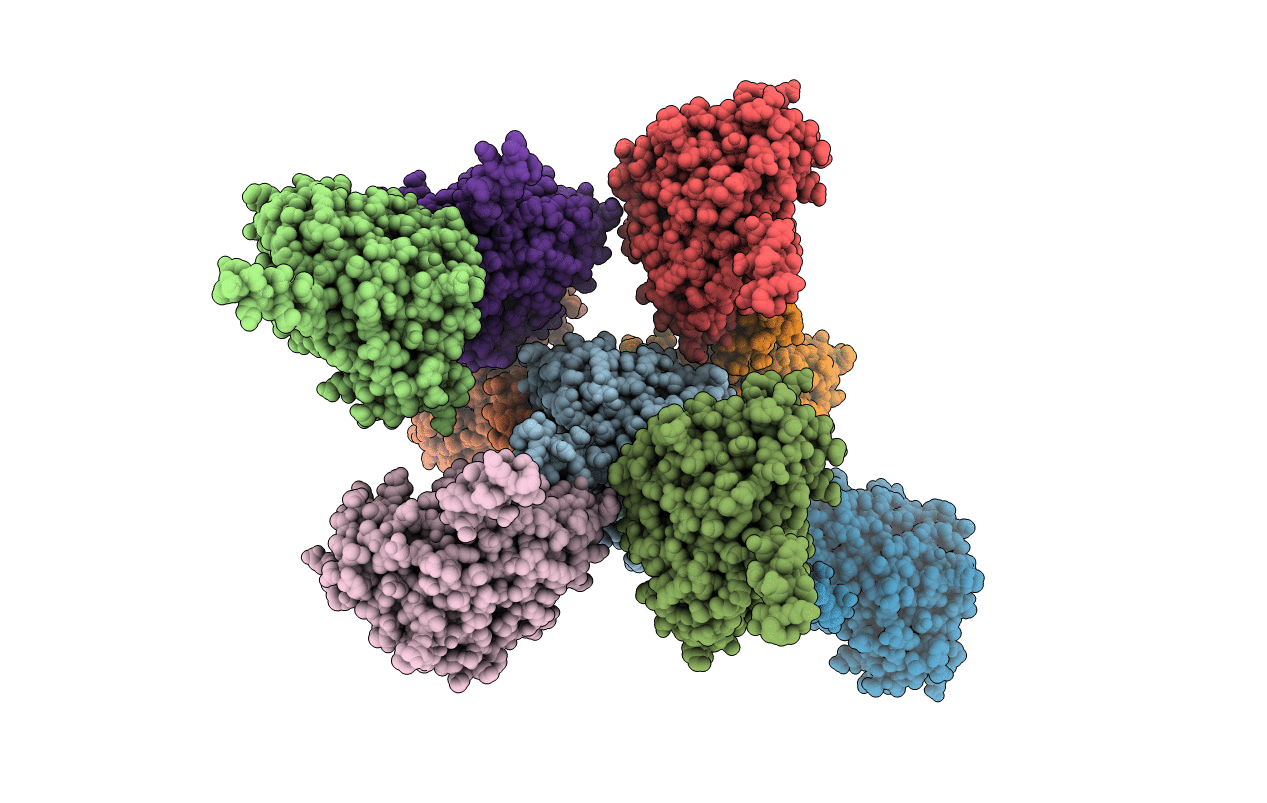
1W5E image
Deposition Date 2004-08-06
Release Date 2004-12-01
Last Version Date 2023-12-13
Entry Detail
PDB ID:
1W5E
Keywords:
Title:
FtsZ W319Y mutant, P1 (M. jannaschii)
Biological Source:
Source Organism:
Method Details:
Experimental Method:
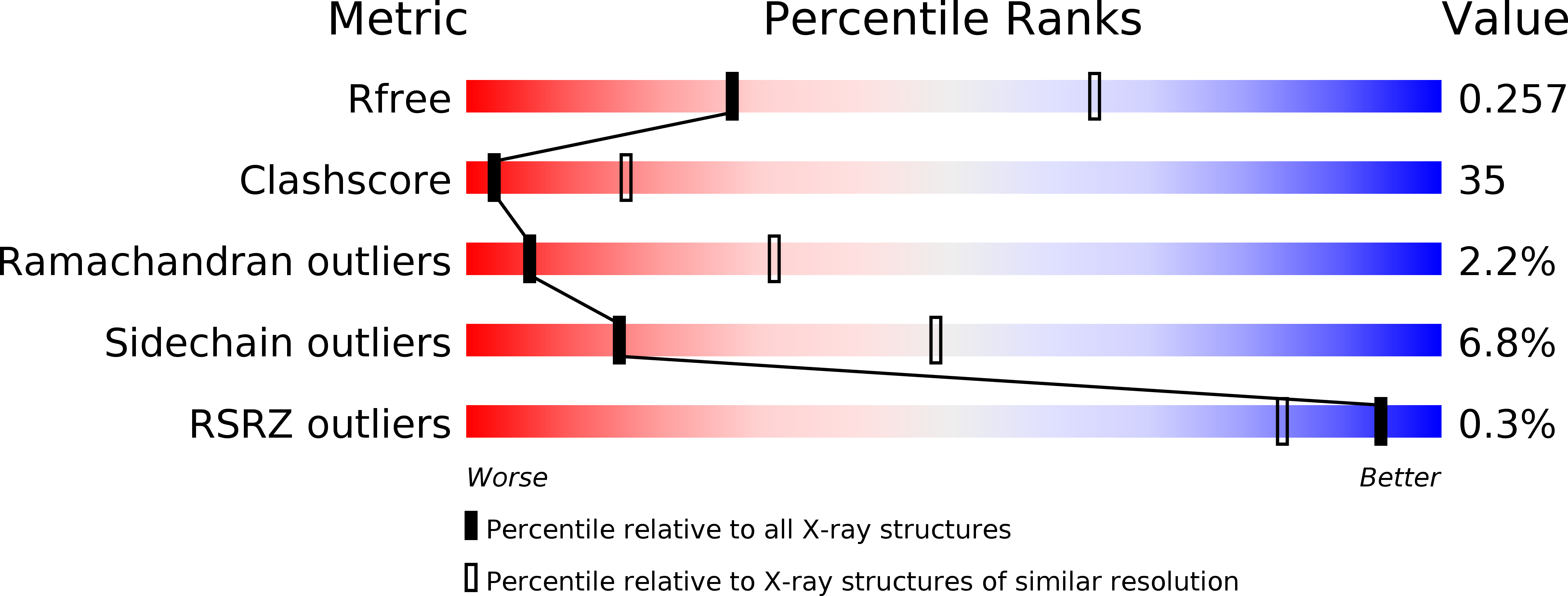
Resolution:
3.00 Å
R-Value Free:
0.29
R-Value Work:
0.26
R-Value Observed:
0.26
Space Group:
P 1
Macromolecular Entities
Structures with similar UniProt ID
Protein Blast
Polymer Type:polypeptide(L)
Molecule:FTSZ
Gene (Uniprot):ftsZ1
Mutagens:YES
Chain IDs:A, B, C, D, E, F, G, H, I
Chain Length:364
Number of Molecules:9
Biological Source:METHANOCALDOCOCCUS JANNASCHII
Ligand Molecules
Primary Citation
Structural Insights Into Ftsz Protofilament Formation
Nat.Struct.Mol.Biol. 11 1243 ? (2004)
PMID: 15558053 DOI: 10.1038/NSMB855

Abstact

The prokaryotic tubulin homolog FtsZ polymerizes into a ring structure essential for bacterial cell division. We have used refolded FtsZ to crystallize a tubulin-like protofilament. The N- and C-terminal domains of two consecutive subunits in the filament assemble to form the GTPase site, with the C-terminal domain providing water-polarizing residues. A domain-swapped structure of FtsZ and biochemical data on purified N- and C-terminal domains show that they are independent. This leads to a model of how FtsZ and tubulin polymerization evolved by fusing two domains. In polymerized tubulin, the nucleotide-binding pocket is occluded, which leads to nucleotide exchange being the rate-limiting step and to dynamic instability. In our FtsZ filament structure the nucleotide is exchangeable, explaining why, in this filament, nucleotide hydrolysis is the rate-limiting step during FtsZ polymerization. Furthermore, crystal structures of FtsZ in different nucleotide states reveal notably few differences.

Legend

Protein

Chemical

Disease

Primary Citation of related structures
Feedback Form
Name
Email
Institute
Feedback