1W36 image
Deposition Date 2004-07-13
Release Date 2004-11-04
Last Version Date 2024-05-08
Entry Detail
PDB ID:
1W36
Keywords:
Title:
RecBCD:DNA complex
Biological Source:
Source Organism:
ESCHERICHIA COLI (Taxon ID: 562)
Host Organism:
Method Details:
Experimental Method:
Resolution:
3.10 Å
R-Value Free:
0.29
R-Value Work:
0.24
R-Value Observed:
0.24
Space Group:
P 21 21 21
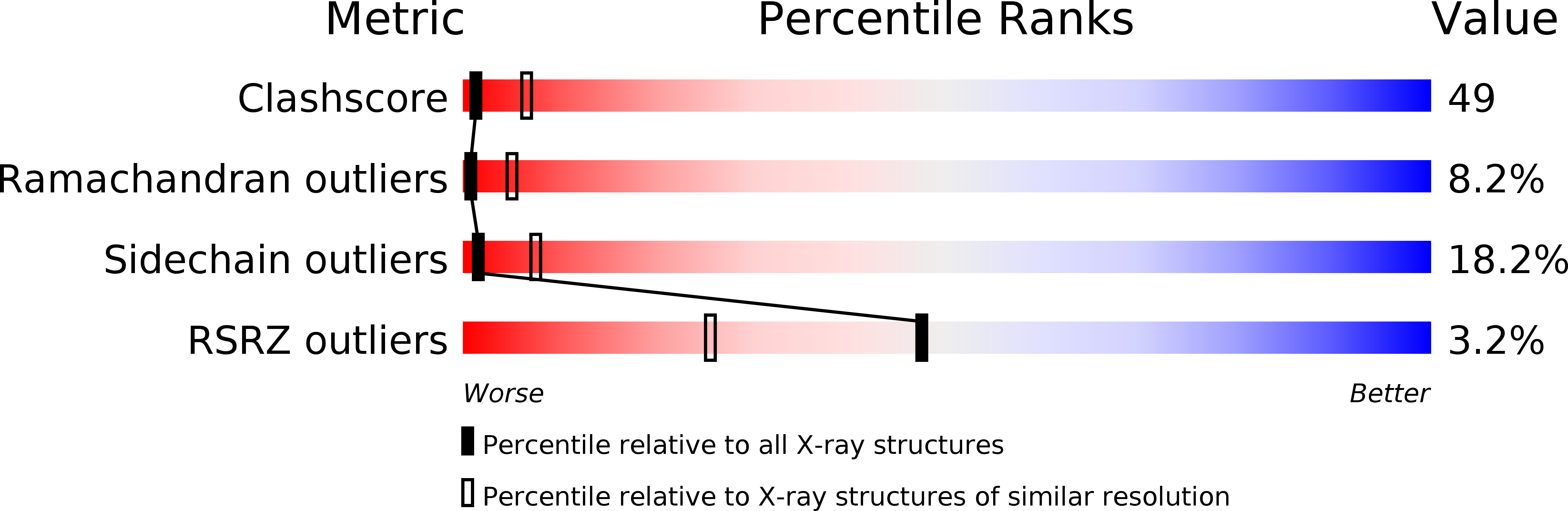
Macromolecular Entities
Structures with similar UniProt ID
Protein Blast
Polymer Type:polypeptide(L)
Molecule:EXODEOXYRIBONUCLEASE V BETA CHAIN
Gene (Uniprot):recB
Chain IDs:A (auth: B), D (auth: E)
Chain Length:1180
Number of Molecules:2
Biological Source:ESCHERICHIA COLI
Structures with similar UniProt ID
Protein Blast
Polymer Type:polypeptide(L)
Molecule:EXODEOXYRIBONUCLEASE V GAMMA CHAIN
Gene (Uniprot):recC
Chain IDs:B (auth: C), E (auth: F)
Chain Length:1122
Number of Molecules:2
Biological Source:ESCHERICHIA COLI
Structures with similar UniProt ID
Protein Blast
Polymer Type:polypeptide(L)
Molecule:EXODEOXYRIBONUCLEASE V ALPHA CHAIN
Gene (Uniprot):recD
Chain IDs:C (auth: D), F (auth: G)
Chain Length:608
Number of Molecules:2
Biological Source:ESCHERICHIA COLI
Ligand Molecules
Primary Citation
Crystal Structure of Recbcd Enzyme Reveals a Machine for Processing DNA Breaks
Nature 432 187 ? (2004)
PMID: 15538360 DOI: 10.1038/NATURE02988

Abstact

RecBCD is a multi-functional enzyme complex that processes DNA ends resulting from a double-strand break. RecBCD is a bipolar helicase that splits the duplex into its component strands and digests them until encountering a recombinational hotspot (Chi site). The nuclease activity is then attenuated and RecBCD loads RecA onto the 3' tail of the DNA. Here we present the crystal structure of RecBCD bound to a DNA substrate. In this initiation complex, the DNA duplex has been split across the RecC subunit to create a fork with the separated strands each heading towards different helicase motor subunits. The strands pass along tunnels within the complex, both emerging adjacent to the nuclease domain of RecB. Passage of the 3' tail through one of these tunnels provides a mechanism for the recognition of a Chi sequence by RecC within the context of double-stranded DNA. Gating of this tunnel suggests how nuclease activity might be regulated.

Legend

Protein

Chemical

Disease

Primary Citation of related structures
Feedback Form
Name
Email
Institute
Feedback