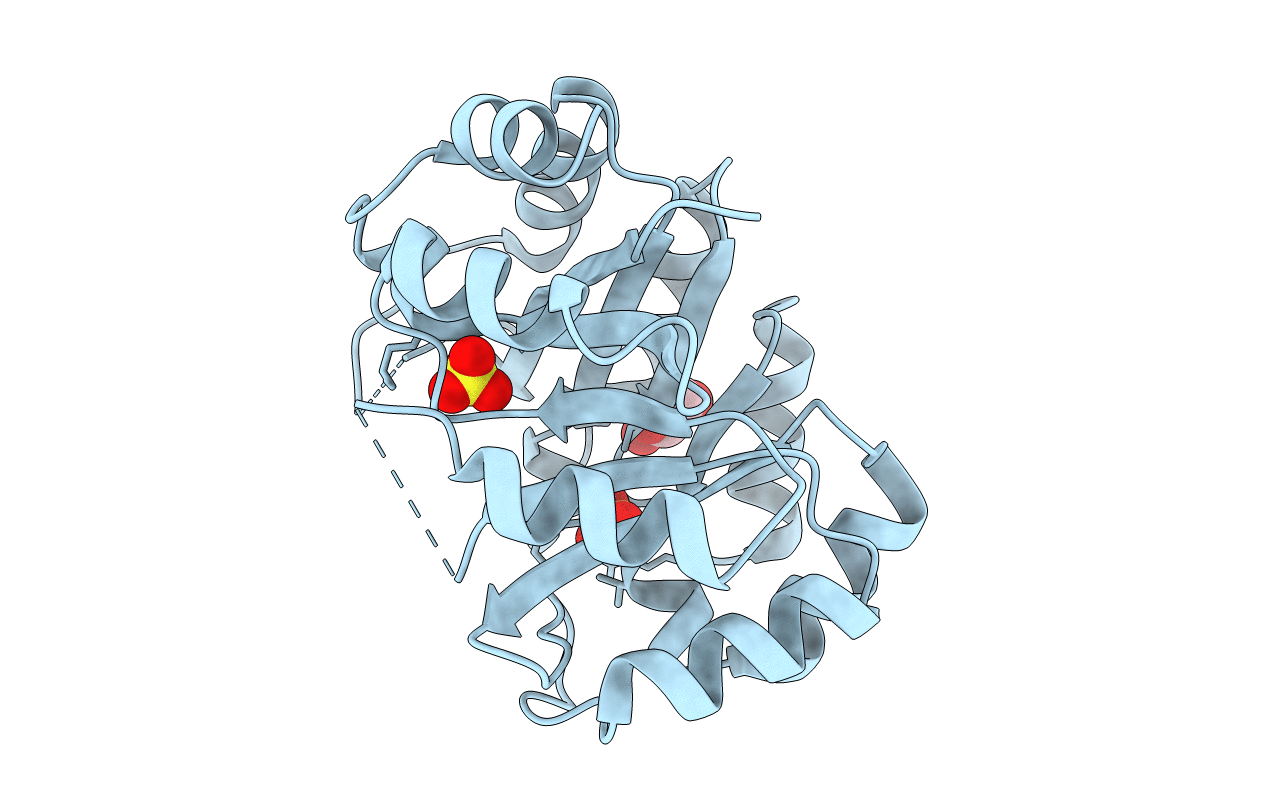
1VZW image
Deposition Date 2004-05-27
Release Date 2005-01-19
Last Version Date 2023-12-13
Entry Detail
PDB ID:
1VZW
Keywords:
Title:
Crystal structure of the bifunctional protein Pria
Biological Source:
Source Organism:
Host Organism:
Method Details:
Experimental Method:
Resolution:
1.80 Å
R-Value Free:
0.20
R-Value Work:
0.16
Space Group:
P 31 2 1

Macromolecular Entities
Structures with similar UniProt ID
Protein Blast
Polymer Type:polypeptide(L)
Molecule:PHOSPHORIBOSYL ISOMERASE A
Gene (Uniprot):priA
Chain IDs:A
Chain Length:244
Number of Molecules:1
Biological Source:STREPTOMYCES COELICOLOR
Primary Citation
Two-Fold Repeated (Beta-Alpha)(4) Half-Barrels May Provide a Molecular Tool for Dual Substrate Specificity
Embo Rep. 6 134 ? (2005)
PMID: 15654319 DOI: 10.1038/SJ.EMBOR.7400330

Abstact

Some bacterial genomes contain an incomplete set of genes encoding phosphoribosyl isomerases, raising the question of whether there exists broadened substrate specificity for the missing gene products. To investigate the underlying molecular principles of this hypothesis, we have determined the crystal structure of the bifunctional enzyme PriA from Streptomyces coelicolor at 1.8 A resolution. It consists of a (betaalpha)(8)-barrel fold that is assembled by two symmetric (betaalpha)(4) half-barrels. The structure shows how its active site may catalyse the isomerization reactions of two different substrates, and we provide a plausible model of how the smaller of the two substrates could be bound in two different orientations. Our findings expand the half-barrel ancestor concept by demonstrating that symmetry-related half-barrels could provide a smart solution to cope with dual substrate specificity. The data may help to unravel molecular rationales regarding how organisms with miniature genomes can keep central biological pathways functional.

Legend

Protein

Chemical

Disease

Primary Citation of related structures
Feedback Form
Name
Email
Institute
Feedback