1VZ0 image
Deposition Date 2004-05-12
Release Date 2004-07-19
Last Version Date 2024-05-08
Entry Detail
PDB ID:
1VZ0
Keywords:
Title:
Chromosome segregation protein Spo0J from Thermus thermophilus
Biological Source:
Source Organism:
Method Details:
Experimental Method:
Resolution:
2.30 Å
R-Value Free:
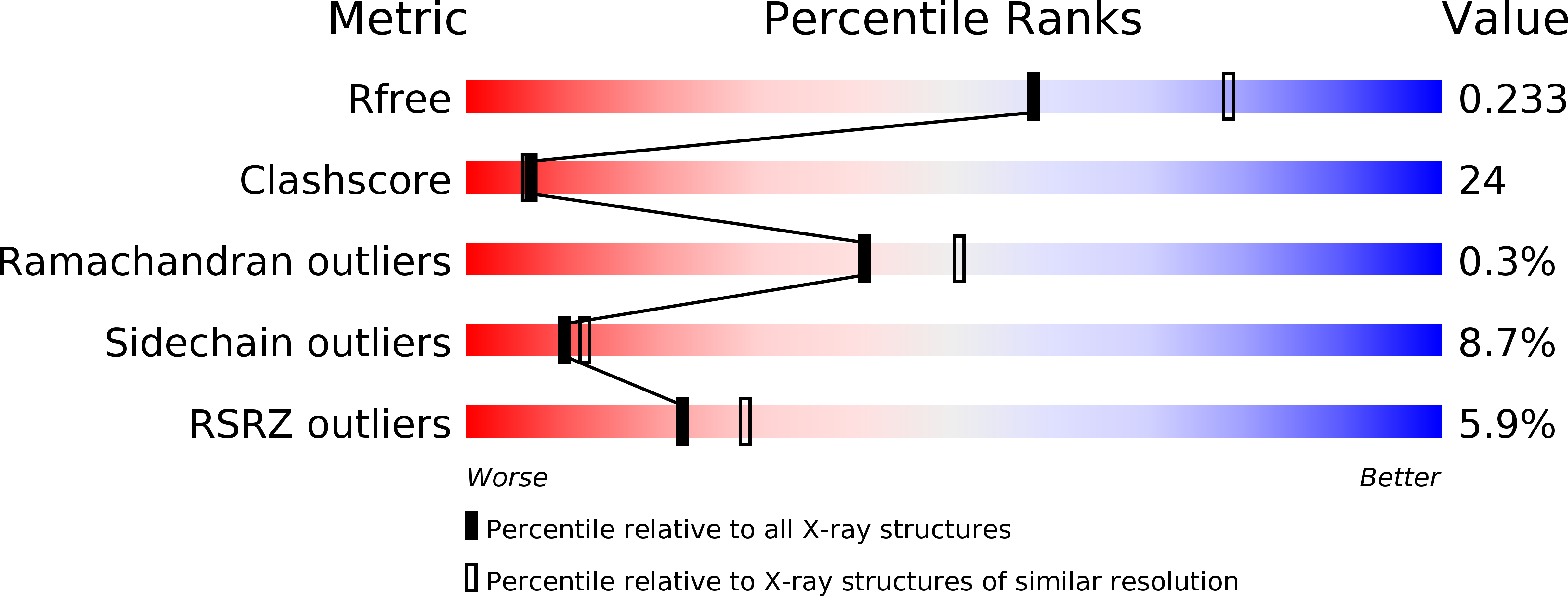
0.27
R-Value Work:
0.23
R-Value Observed:
0.23
Space Group:
C 2 2 2
Macromolecular Entities
Structures with similar UniProt ID
Protein Blast
Polymer Type:polypeptide(L)
Molecule:Chromosome-partitioning protein Spo0J
Gene (Uniprot):spo0C
Chain IDs:A, B, C, D, E, F, G, H
Chain Length:230
Number of Molecules:8
Biological Source:Thermus thermophilus HB27
Primary Citation
Structural analysis of the chromosome segregation protein Spo0J from Thermus thermophilus.
Mol. Microbiol. 53 419 432 (2004)
PMID: 15228524 DOI: 10.1111/j.1365-2958.2004.04133.x

Abstact

Prokaryotic chromosomes and plasmids encode partitioning systems that are required for DNA segregation at cell division. The plasmid partitioning loci encode two proteins, ParA and ParB, and a cis-acting centromere-like site denoted parS. The chromosomally encoded homologues of ParA and ParB, Soj and Spo0J, play an active role in chromosome segregation during bacterial cell division and sporulation. Spo0J is a DNA-binding protein that binds to parS sites in vivo. We have solved the X-ray crystal structure of a C-terminally truncated Spo0J (amino acids 1-222) from Thermus thermophilus to 2.3 A resolution by multiwavelength anomalous dispersion. It is a DNA-binding protein with structural similarity to the helix-turn-helix (HTH) motif of the lambda repressor DNA-binding domain. The crystal structure is an antiparallel dimer with the recognition alpha-helices of the HTH motifs of each monomer separated by a distance of 34 A corresponding to the length of the helical repeat of B-DNA. Sedimentation velocity and equilibrium ultracentrifugation studies show that full-length Spo0J exists in a monomer-dimer equilibrium in solution and that Spo0J1-222 is exclusively monomeric. Sedimentation of the C-terminal domain of Spo0J shows it to be exclusively dimeric, confirming that the C-terminus is the primary dimerization domain. We hypothesize that the C-terminus mediates dimerization of Spo0J, thereby effectively increasing the local concentration of the N-termini, which most probably dimerize, as shown by our structure, upon binding to a cognate parS site.

Legend

Protein

Chemical

Disease

Primary Citation of related structures
Feedback Form
Name
Email
Institute
Feedback