1V66 image
Deposition Date 2003-11-27
Release Date 2004-12-07
Last Version Date 2023-12-27
Entry Detail
PDB ID:
1V66
Keywords:
Title:
Solution structure of human p53 binding domain of PIAS-1
Biological Source:
Source Organism:
Homo sapiens (Taxon ID: 9606)
Method Details:
Experimental Method:
Conformers Submitted:
20
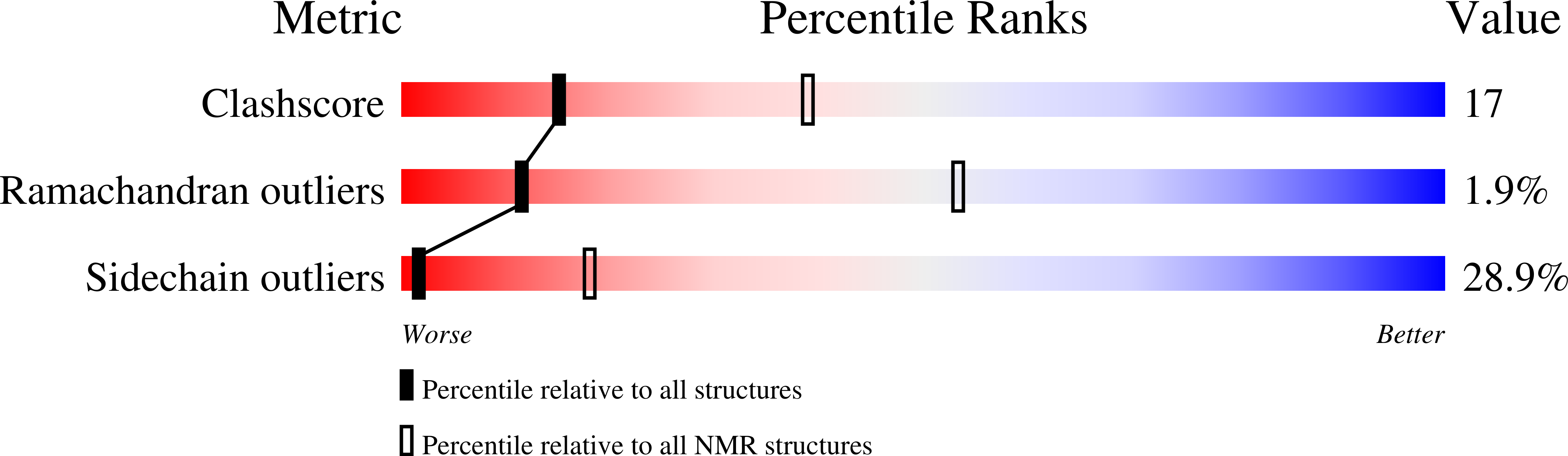
Macromolecular Entities
Structures with similar UniProt ID
Protein Blast
Polymer Type:polypeptide(L)
Molecule:Protein inhibitor of activated STAT protein 1
Gene (Uniprot):PIAS1
Chain IDs:A
Chain Length:65
Number of Molecules:1
Biological Source:Homo sapiens
Ligand Molecules
Primary Citation
NMR structure of the N-terminal domain of SUMO ligase PIAS1 and its interaction with tumor suppressor p53 and A/T-rich DNA oligomers
J.Biol.Chem. 279 31455 31461 (2004)
PMID: 15133049 DOI: 10.1074/jbc.M403561200

Abstact

A member of the PIAS (protein inhibitor of activated STAT) family of proteins, PIAS1, have been reported to serve as an E3-type SUMO ligase for tumor suppressor p53 and its own. It also was proposed that the N-terminal domain of PIAS1 interacts with DNA as well as p53. Extensive biochemical studies have been devoted recently to understand sumoylations and its biological implications, whereas the structural aspects of the PIAS family and the mechanism of its interactions with various factors are less well known to date. In this study, the three-dimensional structure of the N-terminal domain (residues 1-65) of SUMO ligase PIAS1 was determined by NMR spectroscopy. The structure revealed a unique four-helix bundle with a topology of an up-down-extended loop-down-up, a part of which the helix-extended loop-helix represented the SAP (SAF-A/B, Acinus, and PIAS) motif. Thus, this N-terminal domain may be referred to as a four-helix SAP domain. The glutathione S-transferase pull-down assay demonstrated that this domain possesses a binding ability to tumor suppressor p53, a target protein for sumoylation by PIAS1, whereas gel mobility assays showed that it has a strong affinity toward A/T-rich DNA. An NMR analysis of the four-helix SAP domain complexed with the 16-bp-long DNA demonstrated that one end of the four-helix bundle is the binding site and may fit into the minor groove of DNA. The three-dimensional structure and its binding duality are discussed in conjunction with the biological functions of PIAS1 as a SUMO ligase.

Legend

Protein

Chemical

Disease

Primary Citation of related structures
Feedback Form
Name
Email
Institute
Feedback