1ULI image
Deposition Date 2003-09-12
Release Date 2004-09-28
Last Version Date 2023-12-27
Entry Detail
PDB ID:
1ULI
Keywords:
Title:
Biphenyl dioxygenase (BphA1A2) derived from Rhodococcus sp. strain RHA1
Biological Source:
Source Organism:
Method Details:
Experimental Method:
Resolution:
2.20 Å
R-Value Free:
0.20
R-Value Work:
0.16
R-Value Observed:
0.16
Space Group:
P 43 21 2
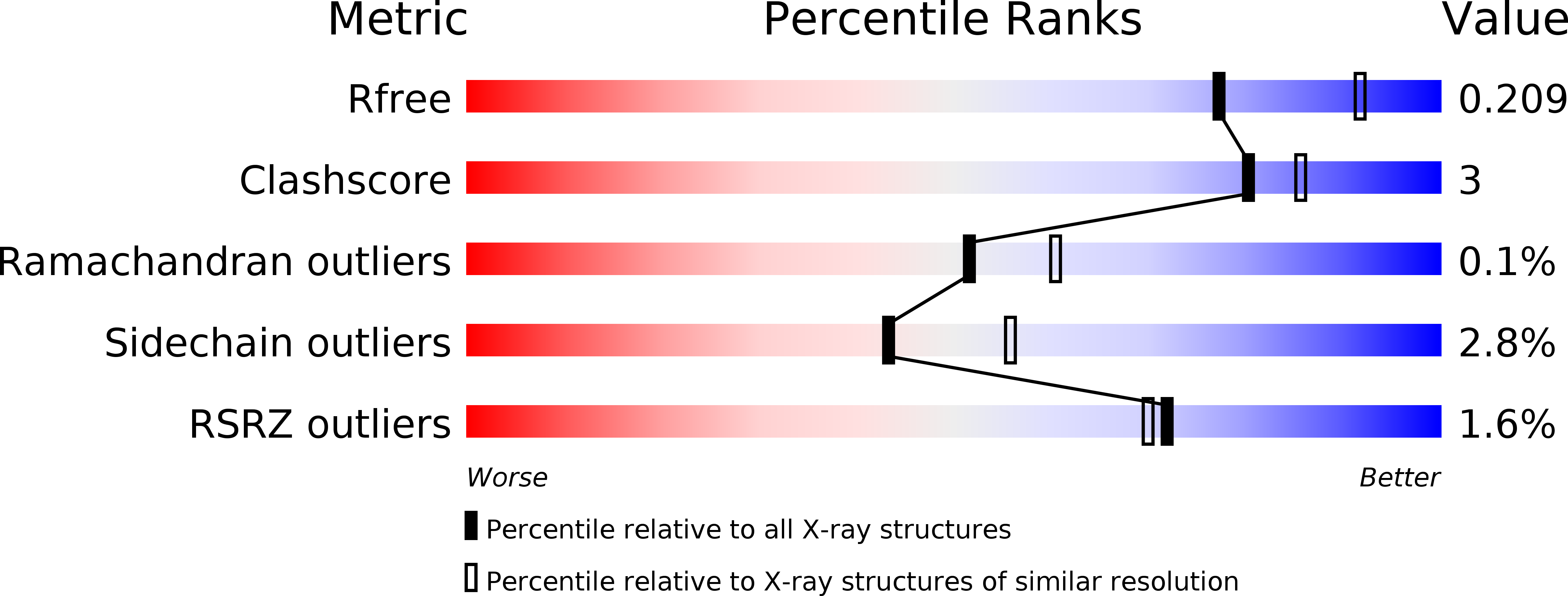
Macromolecular Entities
Structures with similar UniProt ID
Protein Blast
Polymer Type:polypeptide(L)
Molecule:biphenyl dioxygenase large subunit
Gene (Uniprot):bphA1
Chain IDs:A, C, E
Chain Length:460
Number of Molecules:3
Biological Source:Rhodococcus sp.
Structures with similar UniProt ID
Protein Blast
Polymer Type:polypeptide(L)
Molecule:biphenyl dioxygenase small subunit
Gene (Uniprot):bphA2
Chain IDs:B, D, F
Chain Length:187
Number of Molecules:3
Biological Source:Rhodococcus sp.
Primary Citation
Crystal Structure of the Terminal Oxygenase Component of Biphenyl Dioxygenase Derived from Rhodococcus sp. Strain RHA1
J.Mol.Biol. 342 1041 1052 (2004)
PMID: 15342255 DOI: 10.1016/j.jmb.2004.07.062

Abstact

Biphenyl dioxygenase is the enzyme that catalyzes the stereospecific dioxygenation of the aromatic ring. This enzyme has attracted the attention of researchers due to its ability to oxidize polychlorinated biphenyls, which is one of the serious environmental contaminants. We determined the crystal structure of the terminal oxygenase component of the biphenyl dioxygenase (BphA1A2) derived from Rhodococcus strain sp. RHA1 in substrate-free and complex forms. These crystal structures revealed that the substrate-binding pocket makes significant conformational changes upon substrate binding to accommodate the substrate into the pocket. Our analysis of the crystal structures suggested that the residues in the substrate-binding pocket can be classified into three groups, which, respectively, seem to be responsible for the catalytic reaction, the orientation/conformation of the substrate, and the conformational changes of the substrate-binding pocket. The cooperative actions of residues in the three groups seem to determine the substrate specificity of the enzyme.

Legend

Protein

Chemical

Disease

Primary Citation of related structures
Feedback Form
Name
Email
Institute
Feedback