1UIY image
Deposition Date 2003-07-24
Release Date 2003-08-05
Last Version Date 2024-11-20
Entry Detail
PDB ID:
1UIY
Keywords:
Title:
Crystal Structure of Enoyl-CoA Hydratase from Thermus Thermophilus HB8
Biological Source:
Source Organism:
Method Details:
Experimental Method:
Resolution:
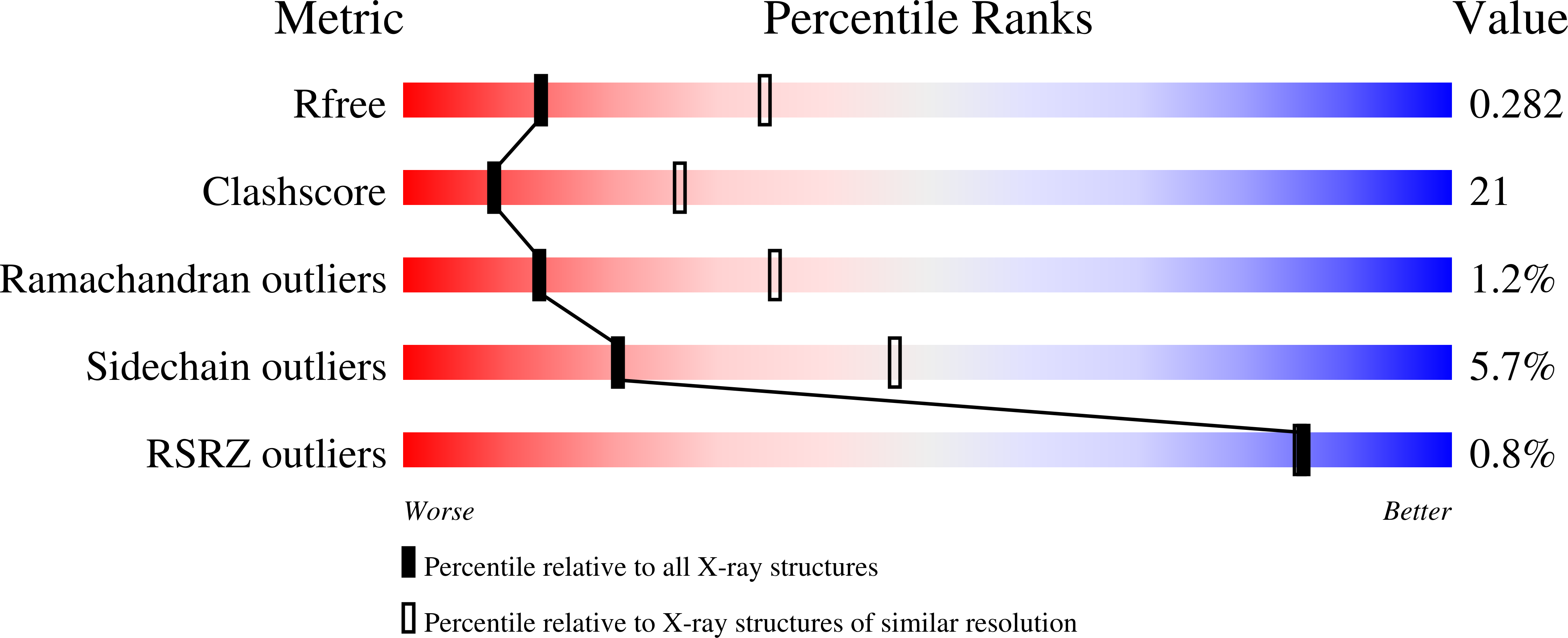
2.85 Å
R-Value Free:
0.26
R-Value Work:
0.20
Space Group:
H 3 2
Macromolecular Entities
Structures with similar UniProt ID
Protein Blast
Polymer Type:polypeptide(L)
Molecule:Enoyl-CoA Hydratase
Chain IDs:A
Chain Length:253
Number of Molecules:1
Biological Source:Thermus thermophilus
Modified Residue
Compound ID Chain ID Parent Comp ID Details 2D Image
MSE A MET SELENOMETHIONINE
Primary Citation
Crystal structure of enoyl-CoA hydratase from Thermus thermophilus HB8.
Acta Crystallogr.,Sect.F 77 148 155 (2021)
PMID: 33949975 DOI: 10.1107/S2053230X21004593

Abstact

Fatty-acid degradation is an oxidative process that involves four enzymatic steps and is referred to as the β-oxidation pathway. During this process, long-chain acyl-CoAs are broken down into acetyl-CoA, which enters the mitochondrial tricarboxylic acid (TCA) cycle, resulting in the production of energy in the form of ATP. Enoyl-CoA hydratase (ECH) catalyzes the second step of the β-oxidation pathway by the syn addition of water to the double bond between C2 and C3 of a 2-trans-enoyl-CoA, resulting in the formation of a 3-hydroxyacyl CoA. Here, the crystal structure of ECH from Thermus thermophilus HB8 (TtECH) is reported at 2.85 Å resolution. TtECH forms a hexamer as a dimer of trimers, and wide clefts are uniquely formed between the two trimers. Although the overall structure of TtECH is similar to that of a hexameric ECH from Rattus norvegicus (RnECH), there is a significant shift in the positions of the helices and loops around the active-site region, which includes the replacement of a longer α3 helix with a shorter α-helix and 310-helix in RnECH. Additionally, one of the catalytic residues of RnECH, Glu144 (numbering based on the RnECH enzyme), is replaced by a glycine in TtECH, while the other catalytic residue Glu164, as well as Ala98 and Gly141 that stabilize the enolate intermediate, is conserved. Their putative ligand-binding sites and active-site residue compositions are dissimilar.

Legend

Protein

Chemical

Disease

Primary Citation of related structures
Feedback Form
Name
Email
Institute
Feedback