1UHL image
Deposition Date 2003-07-03
Release Date 2004-06-01
Last Version Date 2023-10-25
Entry Detail
PDB ID:
1UHL
Title:
Crystal structure of the LXRalfa-RXRbeta LBD heterodimer
Biological Source:
Source Organism:
Homo sapiens (Taxon ID: 9606)
Method Details:
Experimental Method:
Resolution:
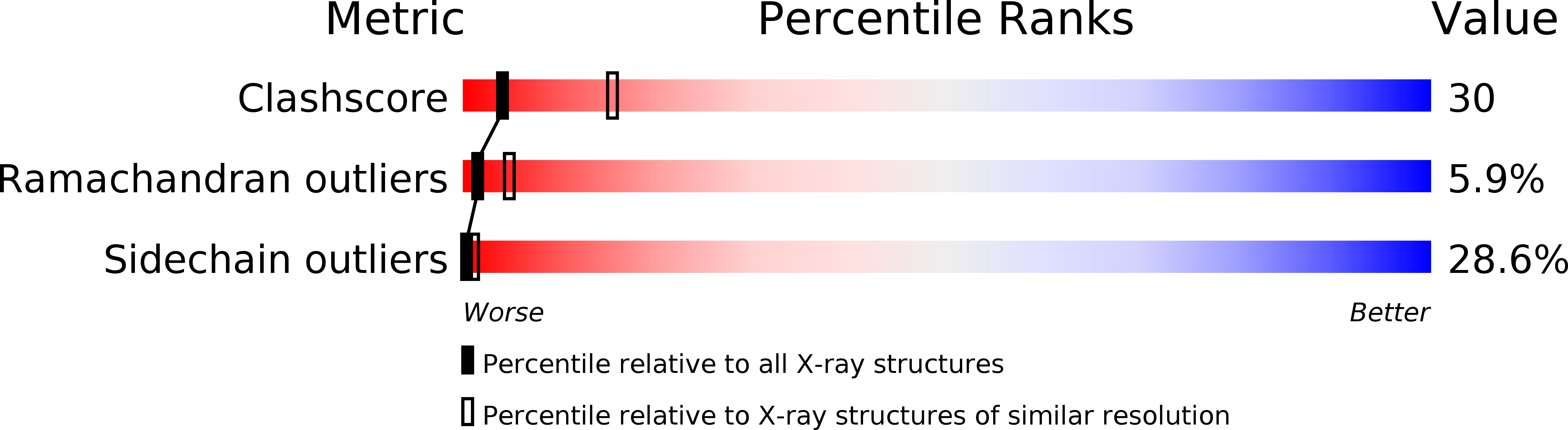
2.90 Å
R-Value Free:
0.32
R-Value Work:
0.21
R-Value Observed:
0.22
Space Group:
P 21 21 21
Macromolecular Entities
Structures with similar UniProt ID
Protein Blast
Polymer Type:polypeptide(L)
Molecule:Retinoic acid receptor RXR-beta
Gene (Uniprot):RXRB
Chain IDs:A
Chain Length:236
Number of Molecules:1
Biological Source:Homo sapiens
Structures with similar UniProt ID
Protein Blast
Polymer Type:polypeptide(L)
Molecule:Oxysterols receptor LXR-alpha
Gene (Uniprot):NR1H3
Chain IDs:B
Chain Length:242
Number of Molecules:1
Biological Source:Homo sapiens
Structures with similar UniProt ID
Protein Blast
Polymer Type:polypeptide(L)
Molecule:10-mer peptide from Nuclear receptor coactivator 2
Gene (Uniprot):NCOA2
Chain IDs:C, D
Chain Length:10
Number of Molecules:2
Biological Source:
Primary Citation
Crystal structure of the heterodimeric complex of LXRalpha and RXRbeta ligand-binding domains in a fully agonistic conformation
Embo J. 22 4625 4633 (2003)
PMID: 12970175 DOI: 10.1093/emboj/cdg456

Abstact

The nuclear receptor heterodimers of liver X receptor (LXR) and retinoid X receptor (RXR) are key transcriptional regulators of genes involved in lipid homeostasis and inflammation. We report the crystal structure of the ligand-binding domains (LBDs) of LXRalpha and RXRbeta complexed to the synthetic LXR agonist T-0901317 and the RXR agonist methoprene acid (Protein Data Base entry 1UHL). Both LBDs are in agonist conformation with GRIP-1 peptides bound at the coactivator binding sites. T-0901317 occupies the center of the LXR ligand-binding pocket and its hydroxyl head group interacts with H421 and W443, residues identified by mutational analysis as critical for ligand-induced transcriptional activation by T-0901317 and various endogenous oxysterols. The topography of the pocket suggests a common anchoring of these oxysterols via their 22-, 24- or 27-hydroxyl group to H421 and W443. Polyunsaturated fatty acids act as LXR antagonists and an E267A mutation was found to enhance their transcriptional inhibition. The present structure provides a powerful tool for the design of novel modulators that can be used to characterize further the physiological functions of the LXR-RXR heterodimer.

Legend

Protein

Chemical

Disease

Primary Citation of related structures
Feedback Form
Name
Email
Institute
Feedback