1U0P image
Deposition Date 2004-07-14
Release Date 2005-02-22
Last Version Date 2024-05-22
Entry Detail
PDB ID:
1U0P
Title:
Stable A-state hairpin of T4 fibritin foldon
Biological Source:
Source Organism(s):
Expression System(s):
Method Details:
Experimental Method:
Conformers Calculated:
100
Conformers Submitted:
10
Selection Criteria:
structures with the least restraint violations
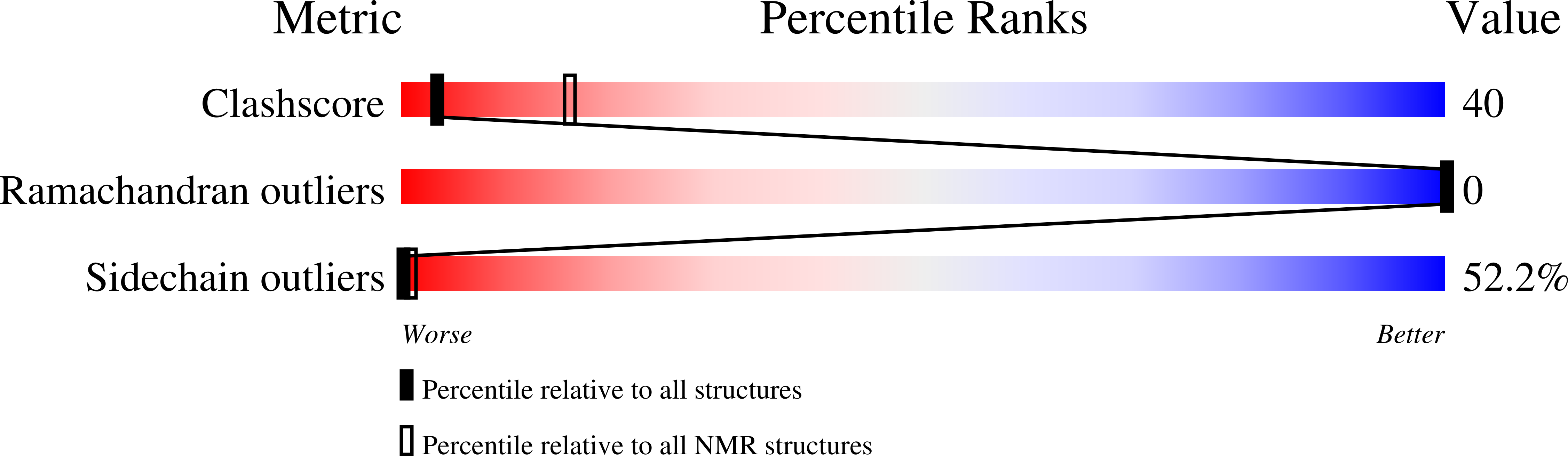
Macromolecular Entities
Structures with similar UniProt ID
Protein Blast
Polymer Type:polypeptide(L)
Molecule:fibritin
Gene (Uniprot):wac
Chain IDs:A
Chain Length:27
Number of Molecules:1
Biological Source:Enterobacteria phage Ox2
Ligand Molecules
Primary Citation
Foldon, the natural trimerization domain of T4 fibritin, dissociates into a monomeric A-state form containing a stable beta-hairpin: atomic details of trimer dissociation and local beta-hairpin stability from residual dipolar couplings
J.Mol.Biol. 344 1051 1069 (2004)
PMID: 15544812 DOI: 10.1016/j.jmb.2004.09.079

Abstact

The C-terminal domain of T4 fibritin (foldon) is obligatory for the formation of the fibritin trimer structure and can be used as an artificial trimerization domain. Its native structure consists of a trimeric beta-hairpin propeller. At low pH, the foldon trimer disintegrates into a monomeric (A-state) form that has similar properties as that of an early intermediate of the trimer folding pathway. The formation of this A-state monomer from the trimer, its structure, thermodynamic stability, equilibrium association and folding dynamics have been characterized to atomic detail by modern high-resolution NMR techniques. The foldon A-state monomer forms a beta-hairpin with intact and stable H-bonds that is similar to the monomer in the foldon trimer, but lacks a defined structure in its N and C-terminal parts. Its thermodynamic stability in pure water is comparable to designed hairpins stabilized in alcohol/water mixtures. Details of the thermal unfolding of the foldon A-state have been characterized by chemical shifts and residual dipolar couplings (RDCs) detected in inert, mechanically stretched polyacrylamide gels. At the onset of the thermal transition, uniform relative changes in RDC values indicate a uniform decrease of local N-HN and Calpha-Halpha order parameters for the hairpin strand residues. In contrast, near-turn residues show particular thermal stability in RDC values and hence in local order parameters. This coincides with increased transition temperatures of the beta-turn residues observed by chemical shifts. At high temperatures, the RDCs converge to non-zero average values consistent with predictions from random chain polymer models. Residue-specific deviations above the unfolding transition reveal the persistence of residual order around proline residues, large hydrophobic residues and at the beta-turn.

Legend

Protein

Chemical

Disease

Primary Citation of related structures
Feedback Form
Name
Email
Institute
Feedback